N11 — Chronic Tubulo-Interstitial Nephritis: ICD-10 Code Explained
Reviewed by the LabReadAI medical team
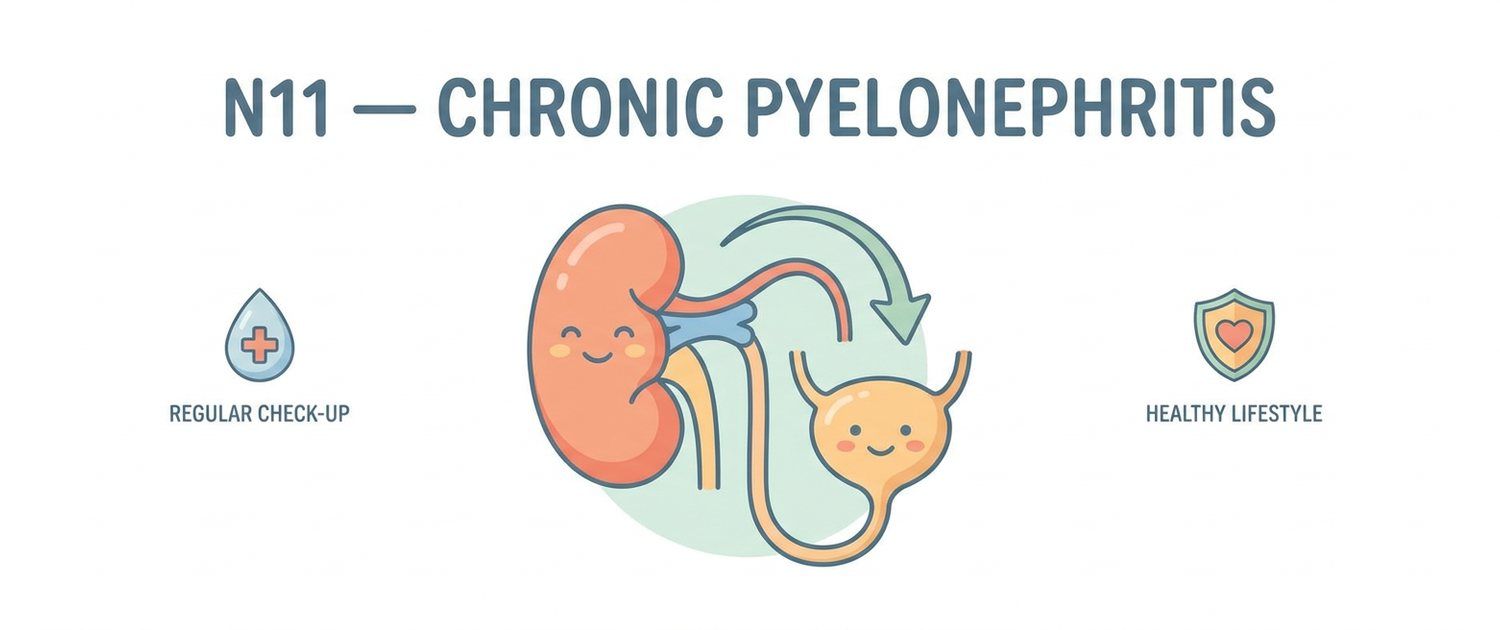
If the «Diagnosis» field of a discharge note, referral or visit record contains only N11, two things are worth establishing at once. First, this is the code of an established condition, not a reason for contact: something was found and recorded. Second, behind the dry wording «chronic tubulo-interstitial nephritis» stands a far more familiar name — chronic pyelonephritis. Below we take the code apart, show how N11 differs from acute N10 and from cystitis, and point to what actually reflects the state of your kidneys — because the code itself does not.
What ICD-10 code N11 means, element by element
The official wording of the category is «Chronic tubulo-interstitial nephritis», and the Russian adaptation of ICD-10 adds a clarification in square brackets: [chronic pyelonephritis]. Element by element:
- N — the letter of ICD-10 Class XIV: «Diseases of the genitourinary system» (categories N00–N99), covering the kidneys, ureters, bladder, urethra and genital organs.
- 11 — the category number inside the class. The block N10–N16 is reserved for tubulo-interstitial kidney diseases, that is, inflammation of the tubules and surrounding tissue rather than of the glomeruli.
- Tubulo-interstitial — an anatomical qualifier: tubules are the kidney's microscopic ducts that process the fluid already filtered by the glomeruli, and the interstitium is the tissue between them. This is the part affected in pyelonephritis, whereas glomerulonephritis inflames the glomeruli (categories N00–N08).
- Chronic — a description of course, not of severity. It means the process has been present for a long time and tends to flare, not that things are severe right now.
The category has subcategories; the digit after the point specifies the cause:
- N11.0 — non-obstructive chronic pyelonephritis associated with reflux (backflow of urine from the bladder into the ureter);
- N11.1 — chronic obstructive pyelonephritis (urine outflow is blocked, for example by a stone or a stricture);
- N11.8 — other chronic tubulo-interstitial nephritis;
- N11.9 — chronic tubulo-interstitial nephritis, unspecified.
If your document shows plain N11 with no digit after the point, it usually means the qualifying subcategory was simply left unfilled, not that the condition is undefined.
Where you may have seen this code
N11 codes a chronic condition, so it appears both during flares and between them:
| Document | Why N11 is there |
|---|---|
| Referral for tests or a kidney ultrasound | The doctor is monitoring a known condition and orders a follow-up check |
| Outpatient visit record | The administrative record of the visit and the condition it concerned |
| Hospital discharge summary | The final diagnosis after the work-up, often with the phase noted — flare or remission |
| Nephrologist's or urologist's report | An established diagnosis with the cause and kidney function spelled out |
| Insurance claim | The basis for paying for the appointment and the investigations |
| Chronic-care follow-up record | Long-term conditions are managed with scheduled reviews |
A practical nuance: a code on a referral may be a working hypothesis — the doctor enters the most plausible category simply to issue the document. A code in a report issued after the work-up is a conclusion. The surrounding text tells them apart: urinalysis results, a culture, an ultrasound description and a note on the phase mean you are reading a conclusion rather than an assumption.
Is it dangerous, and what the code actually says
Plainly, without alarm and without softening.
What N11 does mean. There is long-standing inflammation in kidney tissue, most often driven by infection ascending from the lower urinary tract or by impaired urine drainage. Such inflammation runs in waves: quiet periods alternate with flares involving flank pain, fever, chills and changes in the urine.
What N11 does not mean. It is not kidney failure and not a verdict on function. Many people carry this code on their record for decades with normal kidney function, because the condition is monitored and flares are treated promptly.
What genuinely deserves attention. Uncontrolled chronic inflammation damages kidney tissue over years. Possible consequences are a gradual fall in filtration, persistently raised blood pressure and, with significant damage, chronic kidney disease (category N18). N11.1 deserves particular attention: while the obstruction remains, inflammation keeps coming back, and it will not settle until the cause is dealt with.
What the code cannot tell you. Neither the phase (flare or remission), nor how far function is affected, nor whether one kidney or both are involved. The category is identical for an incidental finding and for a severe course. Only results show the difference: white blood cells in urine and other sediment findings, urine culture, serum creatinine with calculated filtration, and the ultrasound picture.
Neighbouring codes: acute N10, chronic N11 and the rest
The commonest point of confusion is the N10 / N11 pair. The wordings are nearly identical and differ by a single word:
| Code | Meaning | How it differs from N11 |
|---|---|---|
| N10 | Acute tubulo-interstitial nephritis [acute pyelonephritis] | Acute course: sudden onset, high fever, flank pain, a first or isolated episode |
| N11 | Chronic tubulo-interstitial nephritis [chronic pyelonephritis] | Long-standing course with flares, present for months or years |
| N12 | Tubulo-interstitial nephritis, not specified as acute or chronic | The course is undetermined in the document — common at first contact |
| N13 | Obstructive and reflux uropathy | Codes the obstruction or reflux itself, not the inflammation |
| N39.0 | Urinary tract infection, site not specified | Infection confirmed, but bladder versus kidney is not established |
| N18 | Chronic kidney disease | Codes reduced function, whatever caused it |
Why one person's documents may show N10 in one place and N11 in another. A first episode with fever and flank pain is coded N10. If episodes recur, or a persistent background exists (reflux, a stone, an anatomical anomaly), or urinary changes persist over time, the diagnosis is reformulated as chronic and the code becomes N11. So N10 → N11 is not «deterioration» — it is a refinement of the course as more is known about you.
Another frequent pair is kidney versus bladder. Inflammation of the bladder has its own category: N30 — cystitis. The presentations differ — cystitis means burning and frequent urges low in the abdomen, pyelonephritis means flank pain with fever and general malaise. One can lead to the other, but the codes are separate categories.
Which investigations are usually ordered for code N11
The work-up in chronic pyelonephritis serves three goals: confirm the inflammation, find its cause and assess kidney function. The usual set:
- Urinalysis — the basic test, showing leukocytes, bacteria, protein, red cells and urine density. What each line of the report means is covered in the guide to the general urine test.
- Urine culture with susceptibility testing — identifies the organism sustaining the inflammation; the treating doctor relies on it directly.
- Quantitative urine sediment count — clarifies leukocyte and red-cell numbers when the basic test is borderline.
- Serum creatinine with eGFR — the key measure of kidney function, and more informative than the code itself: the estimated glomerular filtration rate shows whether function has suffered, and it can be estimated in the eGFR calculator using the CKD-EPI formula.
- Full blood count — helps establish whether inflammation is active right now.
- Kidney ultrasound — shows size, structure, scarring and dilatation of the collecting system when drainage is impaired.
- Blood pressure monitoring — kidneys and blood pressure influence each other, so pressure is tracked alongside the lab results.
Once the reports are in hand, the useful step is understanding what each value means and which deviations matter for this particular diagnosis. That is exactly where it is easy to get lost between a laboratory's reference range and your own number.
What to do next
A sensible sequence after seeing N11 in a document:
- Work out where the code came from. A referral is usually a working version; a discharge summary or nephrologist's report with results is an established diagnosis.
- Check the subcategory. The digit after the point names the cause: N11.1 means urine drainage is obstructed, and that obstruction needs a decision of its own.
- Complete the ordered tests even if nothing hurts. Between flares chronic pyelonephritis is often silent, and urinalysis plus creatinine are the only way to see its activity.
- Put kidney function into numbers. Creatinine alone says little without conversion: the figure to discuss with a doctor is the eGFR.
- Address the cause if one is named. Reflux, stones, an anatomical anomaly, or in men impaired drainage from the condition coded N40 — prostate hyperplasia: while the cause persists, flares will return.
- Bring the results and your questions to the doctor. Choice of therapy, its duration and what to do during flares are the doctor's decisions, based on culture, kidney function and imaging — not on a line with a code.
- Keep up follow-up. Chronic conditions are managed with scheduled testing; regularity matters more than intensity here.
The short version
N11 in a medical document means chronic tubulo-interstitial nephritis — chronic pyelonephritis: long-standing inflammation of kidney tissue with quiet spells and flares. Only the course, not the nature of the process, separates it from acute N10. The code conveys neither phase nor kidney function; urinalysis, culture, eGFR and ultrasound do. With monitoring and with the cause addressed, most people keep their kidney function for years; without monitoring, chronic inflammation slowly damages the kidney. The meaning lies in regular results, not in the coded line.
For informational purposes only
This article is for informational purposes only and does not constitute medical advice, diagnosis, or treatment. Please consult a healthcare professional for medical guidance.