High Creatinine: Causes, What to Do and How to Lower It
Reviewed by the LabReadAI medical team
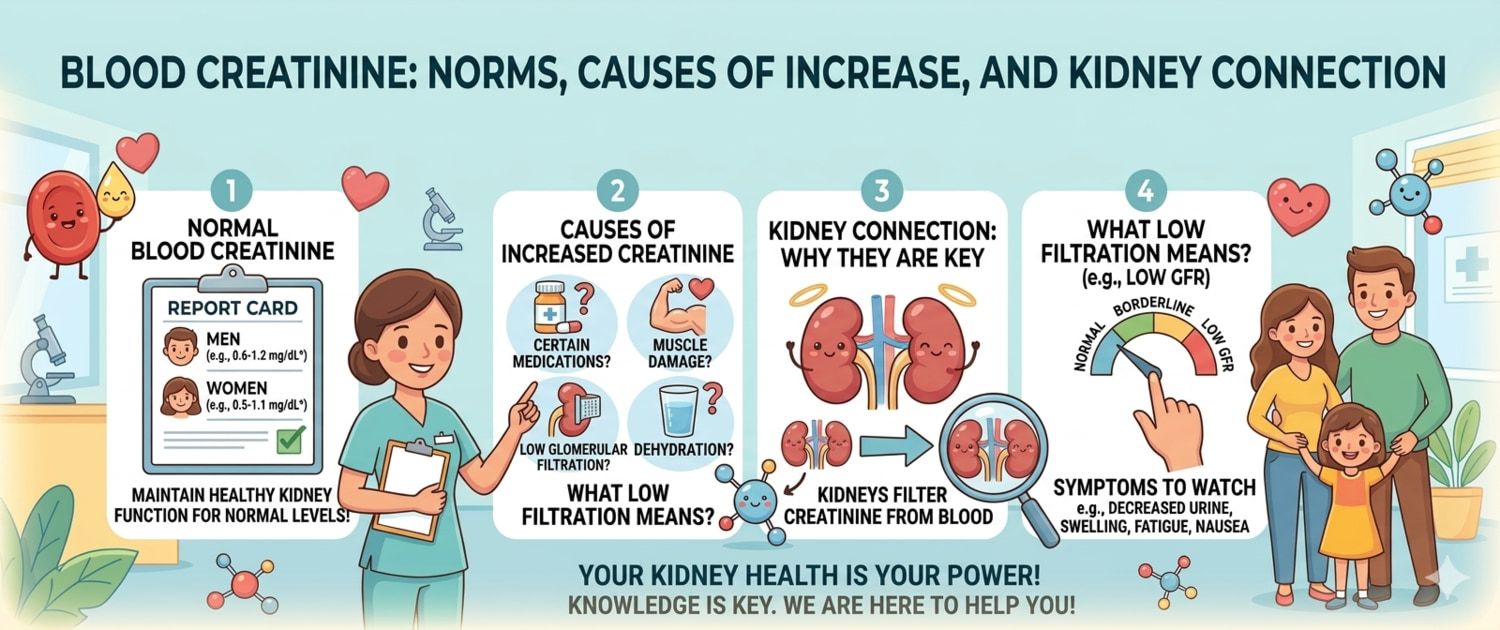
You received a biochemical blood panel and noticed creatinine is above normal. The first question is: how serious is this? The answer depends on many factors — how far above normal, whether symptoms are present, how it relates to muscle mass, and what the calculated eGFR shows. Creatinine is the end product of energy metabolism in muscles, and it is cleared exclusively by the kidneys. This makes its blood concentration one of the simplest and most reliable markers of renal filtration. This article covers normal ranges by sex and age, causes of deviation, and when an abnormal result demands urgent action.
What Is Creatinine and Why Is It Tested?
Creatine is a substance muscles use as a rapid energy source. The final product of this metabolism is creatinine. The body neither reuses nor reabsorbs it: the kidneys filter it through the glomeruli and excrete it in urine in an almost constant daily amount. This makes it a convenient marker: when the kidneys function well, creatinine is cleared at a stable rate. The moment filtration declines — it accumulates in the blood.
An important limitation: blood creatinine depends on muscle mass. A muscular man will have a legitimately higher level than a frail elderly woman — even with equally healthy kidneys. This is why creatinine alone is insufficient for assessing kidney function: the doctor uses it to calculate eGFR (estimated glomerular filtration rate), adjusted for age, sex, and race. For a comprehensive renal assessment, creatinine is always evaluated within the kidney function test.
Indications for ordering the test:
- Routine screening in hypertension, diabetes mellitus, or obesity
- Symptoms of renal pathology: oedema, changes in urine colour, flank pain
- Monitoring nephrotoxic drugs: NSAIDs, aminoglycosides, contrast agents, lithium
- Pre-operative evaluation
- Monitoring established chronic kidney disease
- Assessing dialysis adequacy in patients with end-stage renal failure
How to Prepare for the Test
Creatinine is sensitive to several physiological factors that must be controlled before the draw to avoid a falsely elevated result.
Preparation guidelines:
- Blood drawn fasting in the morning — at least 8–12 hours after the last meal.
- Limit red meat and organ meats for 24 hours beforehand: high-protein digestion raises creatinine by 10–20%.
- Do not take creatine sports supplements the day before — they sharply elevate the level.
- Avoid intense physical exercise for 24 hours: muscle protein breakdown temporarily raises creatinine.
- Do not become dehydrated: fluid deficit concentrates the blood and inflates the result.
- Inform your doctor about NSAIDs, ACE inhibitors, and angiotensin receptor blockers — they reduce renal perfusion and affect the level.
- For serial monitoring — always use the same laboratory: eGFR calculation methods differ between labs.
Normal Creatinine Range: Table by Sex and Age
Normal values depend on muscle mass and change with age. Reference ranges may vary slightly between laboratories — always check the values printed on your own report.
| Category | Normal (µmol/L) | Normal (mg/dL) |
|---|---|---|
| Men 18–60 years | 62–115 | 0.7–1.3 |
| Men > 60 years | 65–120 | 0.73–1.36 |
| Women 18–60 years | 53–97 | 0.6–1.1 |
| Women > 60 years | 50–100 | 0.57–1.13 |
| Children 1–12 years | 27–62 | 0.3–0.7 |
| Adolescents 13–17 years | 44–88 | 0.5–1.0 |
| Pregnant women (any trimester) | 40–80 | 0.45–0.9 |
Why men's normal is higher: men have greater muscle mass and therefore higher daily creatinine production. Athletes with significant muscle hypertrophy will have a legitimately elevated "normal" for themselves.
Why pregnant women's normal is lower: during pregnancy, renal blood flow and GFR increase by 40–65%, accelerating creatinine excretion. A value that is "normal" in a non-pregnant woman may already indicate impaired function during pregnancy.
Important caveat: elderly patients with sarcopaenia (age-related muscle loss) produce less creatinine. Their "normal" level may be lower than in young adults — while their GFR is already reduced. This is why creatinine alone should never be used in older patients without calculating eGFR.
High Creatinine: Causes and What It Means
A creatinine above the upper reference limit requires interpretation in the context of the clinical picture and eGFR. By mechanism, causes fall into three categories.
Pre-renal causes — reduced renal blood flow with intact kidney tissue:
- Dehydration — the most common cause of transient elevation. Blood is concentrated, renal blood flow falls, filtration drops. Normalises with rehydration.
- Heart failure, shock — reduced cardiac output decreases renal perfusion
- Major haemorrhage, burns — loss of circulating volume
- NSAIDs in patients with chronic kidney disease — prostaglandin blockade reduces glomerular filtration
Renal causes — damage to kidney tissue itself:
- Acute kidney injury (AKI) — rapid creatinine rise over hours to days. Causes: acute tubular necrosis (ischaemia, nephrotoxins), glomerulonephritis, interstitial nephritis, myoglobinuria from rhabdomyolysis
- Chronic kidney disease (CKD) — gradual rise over months to years. Full details on progression mechanisms and staging: chronic kidney disease
- Diabetic nephropathy, hypertensive nephropathy — leading causes of CKD worldwide
- Glomerulonephritis of various origins
Post-renal causes — obstructed urine outflow:
- Urinary stone disease with ureteral obstruction
- Benign prostatic hyperplasia — chronic outflow obstruction in older men
- Urinary tract tumours
Extra-renal causes of elevation (not related to reduced filtration):
- Rhabdomyolysis — massive muscle breakdown (trauma, extreme exertion, high-dose statins) sharply increases daily creatinine production
- Acromegaly — excess growth hormone increases muscle mass
- Hyperthyroidism — accelerated metabolism increases protein turnover
Low Creatinine: When It Matters
Low creatinine is a less common and less alarming finding, but several situations warrant attention.
Causes of low creatinine:
- Sarcopaenia and cachexia — muscle mass reduction in ageing, malignancy, or severe chronic illness. Low creatinine in an emaciated patient is a marker of poor prognosis.
- Pregnancy — physiological reduction (see table above)
- Vegetarian and vegan diet — absence of animal protein reduces precursor (creatine) intake
- Hypothyroidism — slowed metabolic rate reduces creatinine production
- Myopathies — genetic or acquired muscle diseases with atrophy
Isolated low creatinine with normal eGFR and good general health is most often a normal variant requiring no treatment. Low creatinine combined with weakness, weight loss, and other symptoms warrants investigation.
eGFR and Creatinine: How Kidney Function Is Calculated
Estimated GFR is the most important derived value calculated from creatinine. It — not the raw creatinine — is the basis for staging chronic kidney disease and guiding clinical decisions.
Modern formulas (CKD-EPI, MDRD) combine creatinine with age, sex, and race. The result is expressed in mL/min/1.73 m² and shows how many millilitres of blood the kidneys filter per minute.
Normal eGFR in adults: above 90 mL/min/1.73 m². Decline staging:
| eGFR (mL/min) | CKD stage | Description |
|---|---|---|
| ≥ 90 | G1 | Normal / damage markers present |
| 60–89 | G2 | Mildly reduced |
| 45–59 | G3a | Mildly-moderately reduced |
| 30–44 | G3b | Moderately-severely reduced |
| 15–29 | G4 | Severely reduced |
| < 15 | G5 | Kidney failure |
The same creatinine level produces very different eGFR values in different individuals. For example, creatinine of 120 µmol/L in a muscular young man corresponds to an eGFR of around 70–75 mL/min — mildly reduced. The same level in a 75-year-old woman gives an eGFR of approximately 40–45 mL/min — moderately-severely reduced.
Alongside creatinine, urinalysis is checked for renal function assessment: albuminuria is an early marker of filtration barrier damage, appearing before eGFR falls.
When High Creatinine Requires Urgent Medical Attention
A moderate single elevation without symptoms — repeat the test in 1–2 weeks under proper conditions. But several situations call for immediate consultation:
- Creatinine above 200 µmol/L without a known pre-existing kidney condition
- Creatinine doubling within a few days from a previously normal baseline
- Newly discovered eGFR below 30 mL/min
- Reduced urine output or complete anuria
- Dark or cloudy urine combined with rising creatinine
- Worsening oedema, hypertension, or breathlessness alongside high creatinine
- Hyperkalaemia (potassium > 6.0 mmol/L) with high creatinine — arrhythmia risk
- Rhabdomyolysis: acute muscle pain + dark urine + rising creatinine
- Any creatinine rise in a pregnant woman — immediate obstetric review
With a stable elevated creatinine from established chronic kidney disease — regular nephrology monitoring and control of all contributing risk factors: blood pressure, blood glucose, nephrotoxic drug avoidance.
Conclusion
Creatinine is a simple, accessible marker — but correct interpretation requires context: sex, age, muscle mass, medical history, and eGFR calculation. A single moderate elevation above the reference range is not a diagnosis; it is a signal to repeat the test under controlled conditions. Persistent elevation, a worsening trend, or a sudden rise warrants a full nephrology workup. Protect the kidneys while they are still silent: by the time symptoms appear, significant function may already have been lost.
On a report the second nitrogen waste product almost always sits next to creatinine, and what interests the clinician is not either value alone but their ratio: that is what separates dehydration, protein breakdown and genuine kidney failure. High urea (BUN) with a calm creatinine is usually not a conversation about the kidneys at all.
This content is for informational purposes only and does not replace professional medical advice.
For informational purposes only
This article is for informational purposes only and does not constitute medical advice, diagnosis, or treatment. Please consult a healthcare professional for medical guidance.