Creatine by the Label: Monohydrate vs HCl, Grams and Purity
Reviewed by the LabReadAI medical team
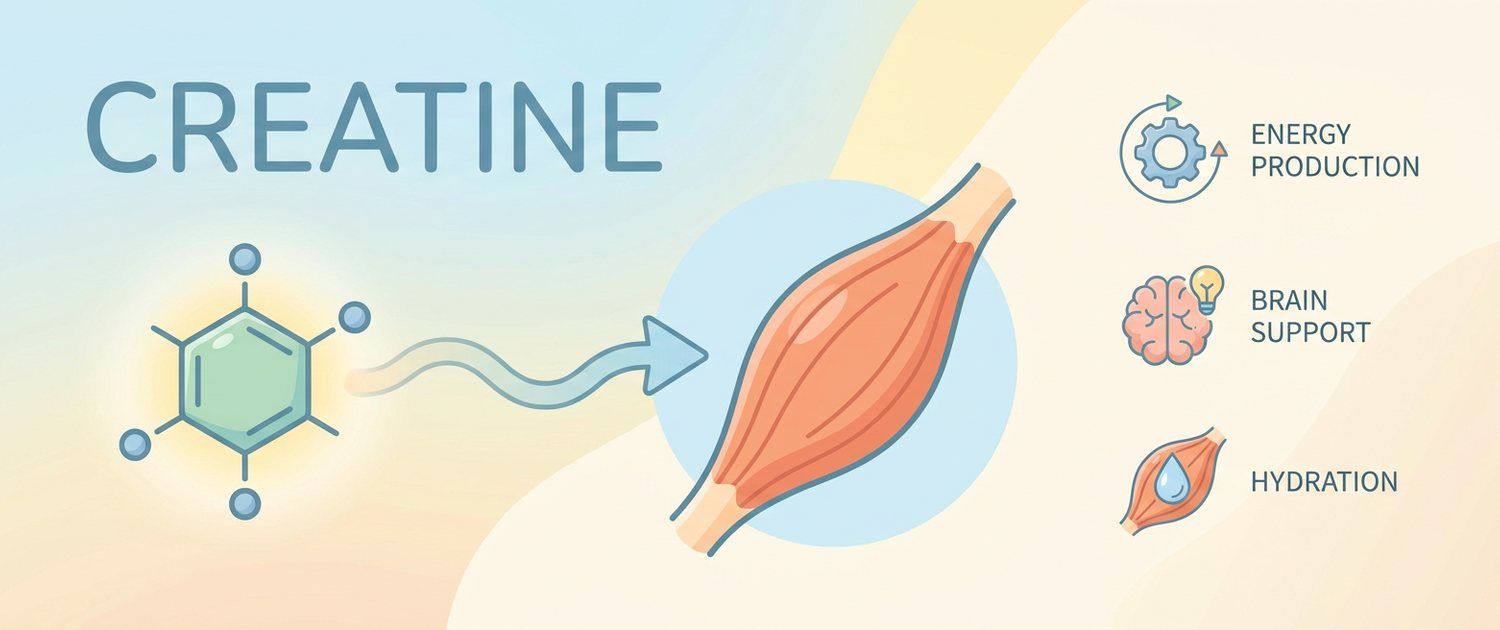
Creatine is the best-studied sports supplement and at the same time one of the most cluttered by marketing: the shelf holds a dozen «new forms», «transport systems» and «stacks», while what works is still one powder. Below is how to read a creatine label: how monohydrate, hydrochloride, ethyl ester, nitrate and «buffered» differ, how many grams of creatine each gives per serving, what «micronised» and Creapure mean, why purity matters and how to compare two products by price per 5 g.
How to take creatine, whether loading is needed, how it affects lab tests and how to choose a protein are in the article on creatine and protein: which form to choose. Here — the label only.
Creatine monohydrate, hydrochloride, ester, buffered: forms on the label
| Form on the label | Creatine by mass | Evidence base | Notes |
|---|---|---|---|
| Monohydrate | ~88 % | hundreds of studies | the reference; «micronised» is the same monohydrate finely milled |
| Hydrochloride (HCl) | ~78 % | a few studies | dissolves better; no outcome advantage shown |
| Buffered (Kre-Alkalyn) | ~88 % with alkaline buffer | one comparison | no better than monohydrate in that study |
| Nitrate | ~67 % | little data | part of the mass is nitrate, not creatine |
| Ethyl ester | ~82 % | lost the comparison | breaks down rapidly to creatinine in the body; worse than monohydrate |
| Malate, citrate, magnesium chelate | 50–75 % | little data | less creatine per gram at a higher price |
The International Society of Sports Nutrition position stand (2017) explicitly names monohydrate the most effective and safest form and «novel forms» as not superior to it. The review by Jäger and colleagues (2011) examined the regulatory status and data on the alternatives: most have neither evidence of advantage nor a complete safety dossier, and ethyl ester in a head-to-head comparison gave a smaller rise in muscle creatine than monohydrate. The practical label conclusion: anything other than «creatine monohydrate» means either less creatine per gram or a surcharge with no proven benefit.
How many grams of creatine per serving
Creatine is neither a vitamin nor a mineral; the Russian MR 2.3.1.0253-21 has no norm for it and EFSA has set no upper level. The benchmarks come from research: ISSN describes a maintenance dose of 3–5 g/day, and EFSA approved the physical-performance claim specifically for 3 g of creatine per day. On the label look for «creatine monohydrate 5 g» per serving — that is ~4.4 g of creatine itself, within the benchmark. Capsule makers often write «creatine 3000 mg» per serving of 4–6 capsules of 500–750 mg: count capsules per serving and servings per bottle. A 300 g tub of powder is 60 servings of 5 g; a bottle of 120 capsules of 750 mg is 18 servings of 5 g.
Purity, Creapure and impurities
Monohydrate is synthesised from sarcosine and cyanamide; with poor control, dicyandiamide and dihydrotriazines — by-products of synthesis — end up in the powder, and a quality product should not contain them. Creapure is a brand of monohydrate from the German maker AlzChem with a claimed purity of ≥99.9 % and control of these impurities; it appears on the label as a separate logo. A product without Creapure is not necessarily bad: many makers claim the same 99.9 % purity — then it is worth finding the batch certificate of analysis on their site. If purity is not stated at all and the price is well below average, that is a reason for doubt. Independent laboratory tests (ConsumerLab, Labdoor) regularly find under-dosed creatine and excess creatinine — its breakdown product — in cheap powders.
What else to check in the formula
- A one-line formula. Honest monohydrate has one ingredient. Flavouring, sweetener and anti-caking agent in a flavoured powder are acceptable; sugar, maltodextrin, caffeine, beta-alanine, a «transport matrix» make it a different product with a different price per gram of creatine.
- Powder or capsules. Same substance; capsules cost 2–4 times more per gram and need 6–7 pieces for 5 g.
- «Micronised». A 200-mesh grind dissolves better and settles less; it does not affect absorption.
- Position in the list. In «pre-workout stacks» creatine is often near the end of the list at 1–2 g — too little for the working range.
- Registration. The registration number on the pack lets you cross-check the formula against the official register.
How to compare two products: price per 5 g
Divide the pack price by the mass of creatine monohydrate in grams and multiply by 5. Plain monohydrate powder is the cheapest option; Creapure costs 30–80 % more for guaranteed purity; hydrochloride costs 2–5 times more for a smaller dose «because it dissolves better»; capsules are a surcharge for convenience. Compare stacks only if you need the whole formula.
Checklist before buying
- Ingredients: «creatine monohydrate» and nothing else (or only flavour and sweetener).
- Serving of 3–5 g; for capsules, recalculate by number of capsules and mg.
- Purity ≥99.9 % on the label or in the batch certificate; Creapure is a guarantee, not a requirement.
- «Hydrochloride», «ester», «buffered» — a surcharge with no proven benefit; ethyl ester is worse than monohydrate.
- Calculate the price per 5 g and compare with plain powder.
- With kidney disease or on drugs affecting the kidneys, discuss intake with a doctor; creatine raises creatinine in tests — mention it.
Is this creatine right for you
The label tells you whether a product is honest and what a dose costs. Whether it will help you depends on the goal and on your baseline tests: creatine predictably raises blood creatinine, and a doctor needs to know about it so as not to hunt for a kidney disease that is not there; the basic panel for someone who trains is on the page on tests for athletes. Upload your report — the service will match what you actually need. How products are scored in this section is explained on the method page. Products with creatine and their label score are in the catalogue.
Products with this nutrient in the catalogue
Full catalogue →
For informational purposes only
This article is for informational purposes only and does not constitute medical advice, diagnosis, or treatment. Please consult a healthcare professional for medical guidance.