Vitamin D3 by the Label: IU vs mcg, Drops or Capsules, K2 or Not
Reviewed by the LabReadAI medical team
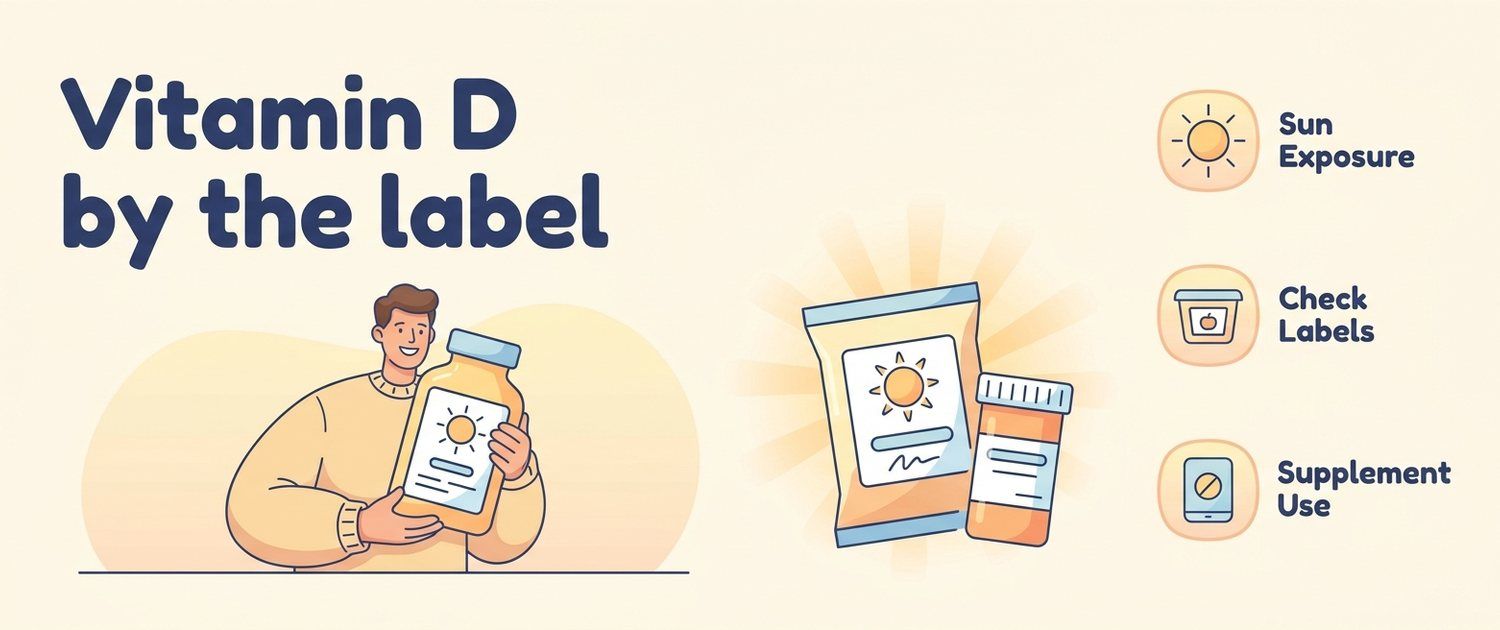
Vitamin D is the rare case where the label is complicated not by forms but by units: the same dose appears as «25 mcg», «1000 IU» and «25 µg», and «5000» on the front may refer to a serving or to the whole pack. Below is how to read a vitamin D supplement label: D3 or D2, converting IU to mcg, how oil drops, water-based solution and capsules differ, what K2 actually does in the formula and how to compare two products per 1000 IU.
Which dose to take, for how long and when to retest is decided by the 25(OH)D level and covered in the article which vitamin D to choose. This page is about the label only.
D3 or D2: what to look for in the ingredients
The ingredients should say cholecalciferol (D3). Ergocalciferol (D2) is the plant form, which at an equal dose raises blood 25(OH)D substantially less: the meta-analysis by Tripkovic and colleagues (2012) found D3 superior in most comparisons. D2 appears in vegan products and some prescription drugs; for a supplement there is no reason to pick it without a specific cause. Vegan D3 from lichen exists — look for the word «cholecalciferol» and a source note.
IU and mcg: one dose, two spellings
| On the label | In IU | In mcg | Comment |
|---|---|---|---|
| 10 mcg | 400 IU | 10 | children's and «basic» dose |
| 15 mcg | 600 IU | 15 | adult reference intake (MR 2.3.1.0253-21) |
| 25 mcg | 1000 IU | 25 | the most common supplement dose |
| 50 mcg | 2000 IU | 50 | maintenance after a confirmed deficiency |
| 100 mcg | 4000 IU | 100 | upper safe level for adults (EFSA) |
| 125 mcg | 5000 IU | 125 | above the upper level — prescription only |
One factor: 1 mcg = 40 IU. The second thing to check is what the dose refers to: 1 drop, 5 drops, a capsule or a «serving» of two. Drops add a third question — how many drops per millilitre in this bottle (usually 25–30), which decides how many days it lasts.
Drops, capsules or water-based solution
Vitamin D is fat-soluble, so the classic is an oil solution in drops or capsules with a vegetable oil (MCT, olive, sunflower). A water-based solution is a micellar form where the vitamin is pre-packed into droplets absorbable without bile: it suits children and people with fat malabsorption. In comparative studies in healthy adults, oil and water-based forms raised 25(OH)D comparably; dry tablet forms also work when they contain a carrier. The practical difference is in dosing convenience and price per IU, not efficacy.
K2 in the formula: what it adds
Vitamin K2 (menaquinone, usually MK-7) activates the proteins that steer calcium into bone and keep it out of vessel walls. The «D3 + K2» pair makes sense during long high-dose D courses, when calcium absorption rises; at 1000–2000 IU adding K2 is not required, and on warfarin K2 is contraindicated. On the label check the form (MK-7 stays in the blood longer than MK-4) and the dose — usually 50–100 mcg. «D3 + K2» costs more; choosing it for the suffix alone is unnecessary.
What else to look at
- Carrier. For oil forms — which oil; for drops — whether there is a preservative and flavouring (children's products often have them).
- Serving and bottle. IU per drop and drops per bottle decide the course price.
- Neighbours. Calcium in the same tablet is a standard, sensible pair for bone; magnesium too (it is needed to activate vitamin D). High-dose vitamin A next to D is a reason to check the total A dose.
- Registration. A supplement carries an SGR number; a vitamin D medicine carries a marketing authorisation and a leaflet whose doses are verified by law.
How to compare two products: price per 1000 IU
Divide the price by the total IU in the pack (IU per serving × servings) and multiply by 1000. Drops are almost always cheaper per IU than capsules, and «premium» D3 + K2 costs 2–4 times more: if you do not need K2, that markup buys nothing.
Checklist before buying
- Cholecalciferol (D3) in the ingredients, not D2.
- Convert the dose to IU (1 mcg = 40 IU) and confirm what it refers to — a drop, a capsule or a serving.
- Do not take more than 4000 IU/day without a 25(OH)D test and a prescription.
- K2 only if you plan a long high-dose course and take no anticoagulants.
- Calculate the price per 1000 IU and compare.
- For children — a water-based solution or oil drops with a clear per-drop dose.
Is this vitamin D right for you
The label tells whether a product is honest and what each thousand IU costs. Whether you need a supplement at all and at what dose is told by your blood 25(OH)D: with a deficiency 1000 IU changes nothing, with a normal level 5000 IU is excess. Upload your report — the service will match the dose and form to your number and say when to retest. How products are scored in this section is explained on the method page. Products with vitamin D and their label score are in the catalogue.
Products with this nutrient in the catalogue
Full catalogue →
For informational purposes only
This article is for informational purposes only and does not constitute medical advice, diagnosis, or treatment. Please consult a healthcare professional for medical guidance.