E03.9 — Hypothyroidism, Unspecified: What This Code Means
Reviewed by the LabReadAI medical team
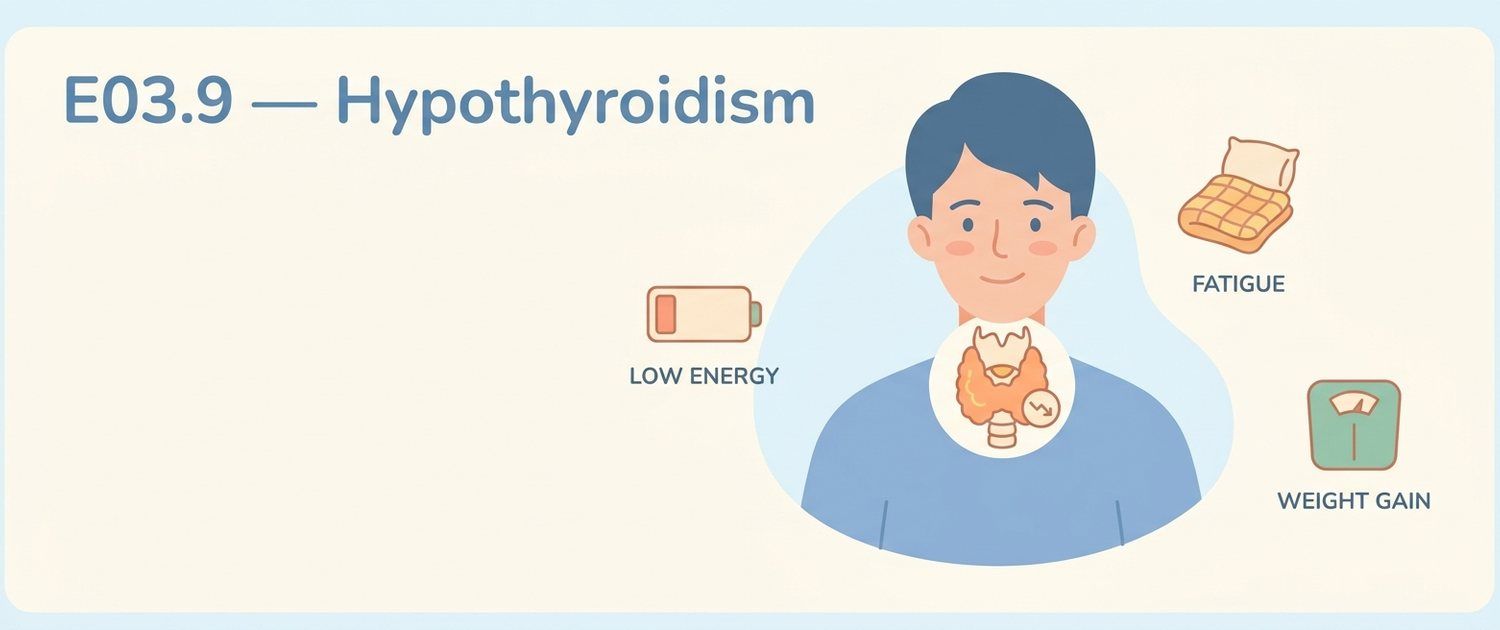
If the «Diagnosis» field of a referral, certificate or discharge note contains only E03.9, the natural reaction is to look up what disease that is and how serious it might be. The short answer: the code records reduced thyroid function whose cause has not been specified in the document. Below we take the code apart element by element, explain why it says «unspecified», how it differs from neighbouring codes and which numbers actually describe your condition.
What E03.9 means in ICD-10 — hypothyroidism, unspecified
The official wording of E03.9 is «Hypothyroidism, unspecified». Element by element:
- E — the letter of ICD-10 Class IV: «Endocrine, nutritional and metabolic diseases». This is a class of diseases rather than reasons for contact, so this is a genuine diagnosis, not an administrative entry.
- E00–E07 — the block «Disorders of thyroid gland», covering everything from iodine deficiency states to thyrotoxicosis and thyroiditis.
- E03 — the category «Other hypothyroidism»: reduced thyroid function not caused by iodine deficiency and not induced by treatment.
- .9 — the «unspecified» subcategory: the condition is named, the cause is not.
What hypothyroidism means in practice: the thyroid gland produces less hormone than the body needs. These hormones set the pace of metabolism, so when they run low the body slows down — hence the typical complaints of fatigue, cold intolerance, dry skin, weight gain and low mood.
A crucial nuance about the word «unspecified»: it refers to the cause, not to severity. The code does not say the case is obscure or advanced. It says only that reduced function was recorded and its origin was not entered into this particular document.
Where you may have seen this code
E03.9 usually appears in documents issued after a first appointment or an initial blood test:
| Document | Why E03.9 is there |
|---|---|
| Referral for blood tests or ultrasound | The doctor already sees signs of low function and orders clarification |
| Outpatient visit record | The administrative record of the visit: the reason is a thyroid problem |
| Endocrinologist's discharge note | The diagnosis is established, but the cause is left for further work-up |
| Certificate for work, study or a sanatorium | The main diagnosis is carried over as a code, without detail |
| Insurance claim | The clinic reports the episode of care; the code justifies payment |
The practical conclusion: the code in the header is a short statistical label. The full picture lives in the text of the conclusion and in the lab report.
Is it dangerous or not
Plainly, without softening: hypothyroidism is a real condition that does not resolve on its own and needs medical follow-up. Long-standing untreated overt hypothyroidism affects the heart, lipid metabolism, memory, mood, the menstrual cycle and the course of pregnancy. The code should not be ignored.
And, just as plainly, the other side: it is one of the most common and most manageable endocrine conditions. It is detected by a simple blood test, tracked by numbers, and with regular follow-up most people live without restriction. The code E03.9 by itself indicates neither an advanced stage nor urgency nor a threat to life — it carries no information about severity at all.
Severity is determined by two things: the TSH and free T4 values, which show whether this is subclinical (mild, laboratory-only) or overt hypothyroidism, and the clinical picture assessed by the doctor at the appointment.
One frequent confusion is worth separating out: fatigue is the most common complaint in hypothyroidism, yet it is far from always thyroid-driven. When fatigue is coded on its own it becomes R53 — malaise and fatigue, and its causes may be entirely different, from iron deficiency to disturbed sleep.
Neighbouring codes and how they differ
Within the thyroid block, codes differ by the cause and the direction of the malfunction:
| Code | Meaning | How it differs from E03.9 |
|---|---|---|
| E02 | Subclinical iodine-deficiency hypothyroidism | The cause is named — iodine deficiency; the deficit is mild, often laboratory-only |
| E03.8 | Other specified hypothyroidism | Same category, but the cause is recorded |
| E03.9 | Hypothyroidism, unspecified | Reduced function recorded, cause not stated |
| E05 | Thyrotoxicosis (hyperthyroidism) | The opposite state: too much hormone, not too little |
| E06.3 | Autoimmune thyroiditis | A specific cause is named — autoimmune inflammation of the gland |
The most common pairing in practice is E03.9 and E06.3. Autoimmune (Hashimoto's) thyroiditis is the leading cause of hypothyroidism in adults, and once TPO antibodies are found the code is often changed from «unspecified» to a specified one. How the condition works is covered in a separate article on autoimmune thyroiditis.
The difference between E03.8 and E03.9 is purely one of record completeness: «other specified» versus «unspecified». For your condition it changes nothing; for statistics and follow-up it does.
Which tests are usually ordered with this code
To turn «unspecified» into a specific diagnosis the doctor needs numbers. The standard set is:
| Test | What it shows |
|---|---|
| TSH (thyroid-stimulating hormone) | The main screening value; typically raised in hypothyroidism |
| Free T4 | The level of the main thyroid hormone; separates subclinical from overt disease |
| Free T3 | Adds detail, not always ordered |
| TPO antibodies | Point to an autoimmune origin — the key to specifying the cause |
| Thyroid ultrasound | Structure of the gland: volume, nodules, signs of inflammation |
| Lipid profile | Hypothyroidism is often accompanied by raised cholesterol |
What a basic thyroid panel contains and how to read its values is set out in a separate guide to thyroid tests. How the condition presents and which complaints belong to it is covered in the article on hypothyroidism.
Important: tests are ordered and interpreted by a doctor. Nothing in treatment should be changed on the basis of a code or a single result — thyroid status is judged over time and as a whole.
What to do next
A sensible sequence:
- Do not read severity into the code. E03.9 states only the fact of reduced function — no degree, no cause, no prognosis.
- Find the numbers. Look for TSH and free T4 in your documents: they, not the code, describe your condition. Each value is explained in the guide to the thyroid panel.
- Establish the cause. Usually TPO antibodies and an ultrasound. The commonest finding is autoimmune thyroiditis, after which the code in your record becomes a specified one.
- Agree on follow-up with an endocrinologist. Hypothyroidism is managed by repeated testing; all decisions about therapy belong to the doctor.
- Check overlapping complaints. Weight gain, fatigue and hair loss may be thyroid-related or may have their own cause — with a code such as E66 (obesity) metabolism is assessed separately.
- Keep your old results. A two-year trend in TSH is often more informative than a single point — bring previous reports to the appointment.
The short version
E03.9 is a disease code, not an administrative label: it means «hypothyroidism, cause not specified». The word «unspecified» refers to the cause, not to severity. The condition is common, detected by a blood test and well controlled under medical follow-up. The meaning lies in TSH, free T4 and TPO antibodies — that is where the conversation with the endocrinologist should start.
For informational purposes only
This article is for informational purposes only and does not constitute medical advice, diagnosis, or treatment. Please consult a healthcare professional for medical guidance.