G90.8 — Other Disorders of Autonomic Nervous System Explained
Reviewed by the LabReadAI medical team
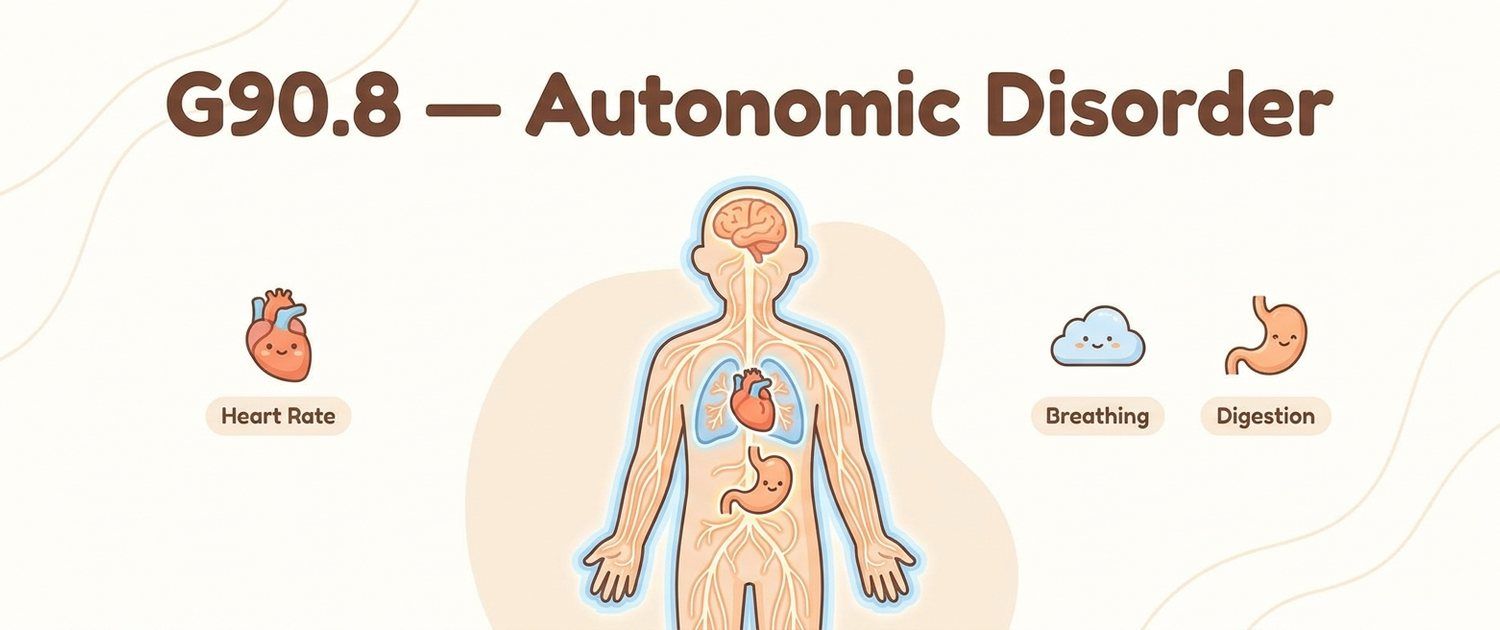
The code G90.8 usually turns up after a visit for complaints that are hard to fit into a single line: the heart races without exertion, vision greys out on standing, there are hot flushes and sweating, blood pressure swings — and the tests show nothing alarming. The doctor writes a code, and you go home feeling you have been labelled with something opaque. Let us take it apart calmly: what it literally means, what it does and does not say about your condition, how it differs from neighbouring codes and what is worth doing next.
What «other disorders of autonomic nervous system» means in ICD-10
The official wording of G90.8 is «Other disorders of autonomic nervous system». Element by element:
- G — the letter of ICD-10 Class VI: «Diseases of the nervous system» (G00–G99). Unlike administrative Class Z codes, this one comes from the disease part of the classification: it describes a condition, not a reason for contact.
- G90 — the category «Disorders of autonomic nervous system». The autonomic nervous system is the part that works without your participation: it holds heart rate and blood pressure, regulates sweating, temperature, vascular tone, the stomach and bowel, the bladder and the pupil.
- .8 — the «other specified» subcategory: the disturbance of autonomic regulation is described but does not fall under the named subcategories G90.0–G90.4 (idiopathic peripheral autonomic neuropathy, Horner's syndrome, familial dysautonomia and other defined forms).
Put together, G90.8 records: «there is a disorder of autonomic regulation, specified, but not one of the listed defined forms». The key point — the code describes the mechanism of the complaints rather than naming one disease with a known cause. It is a container code, which is exactly why the text of the conclusion written next to it matters.
Where you may have seen this code
G90.8 appears both in documents issued before an examination and in those issued after it:
| Document | Why G90.8 is there |
|---|---|
| Referral for investigations | A referral needs a code; the doctor codes the presumed mechanism — disturbed autonomic regulation |
| Outpatient visit record | The administrative record of the visit: every appointment requires a code |
| Neurologist's report or discharge note | The conclusion when no structural pathology is found but autonomic symptoms are present |
| Certificate for school, university or sport | Justification for restrictions or follow-up |
| Insurance claim | The clinic reports the service delivered; the code justifies payment |
The practical conclusion: the weight of the code depends on the stage at which it was assigned. On a referral it is a working hypothesis. In a report issued after a full work-up it is a conclusion — but a conclusion by exclusion: it means no more specific cause was found.
Is G90.8 dangerous or not
An honest answer has two parts.
Disordered autonomic regulation in itself is not life-threatening. It does not damage the heart, does not shorten life and does not turn into another disease over time. The symptoms, however, can be severe and genuinely limiting — fainting, palpitations, inability to stand for long. Severity of experience and danger to life do not coincide here. Both sides of that matter: the complaints are not «made up», and at the same time they are not a sign of a hidden catastrophe.
But G90.8 is a diagnosis of exclusion, and it is only as reliable as the work-up behind it. The same symptoms are produced by conditions treated completely differently: hyperthyroidism and hypothyroidism, iron deficiency and anaemia, cardiac arrhythmias, low vitamin B12, side effects of medication, anxiety and panic disorder, and in people with diabetes — autonomic neuropathy. If the code was assigned from the description of complaints alone, without blood tests and an ECG, it is a hypothesis to be checked rather than a final diagnosis.
Separately: G90.8 is not a psychiatric diagnosis and does not mean the doctor considered your complaints imaginary. It says exactly what it says — automatic regulation is disturbed.
Neighbouring codes: G90.8 versus G90.9, F45.3 and R55
The same complaints are coded differently by different doctors, and the code reveals the logic of whoever assigned it:
| Code | Meaning | When it is used |
|---|---|---|
| G90.8 | Other disorders of autonomic nervous system | The disturbance is described and specified but is not one of the named forms G90.0–G90.4 |
| G90.9 | Disorder of autonomic nervous system, unspecified | The same picture without further specification |
| F45.3 | Somatoform autonomic dysfunction | Class V — mental and behavioural disorders. Used when the same bodily symptoms are attributed to a psychogenic mechanism, most often anxiety |
| R55 | Syncope and collapse | Class XVIII — symptoms and signs. Codes the fact of losing consciousness while the cause is still unknown |
For a patient the difference between G90.8 and G90.9 is small: both mean «autonomic dysregulation», one specified and one not. The difference from F45.3 is more substantial — it is a second viewpoint on the same sensations, neurological versus psychosomatic. In practice the two often coexist, and the choice depends on the speciality of the doctor. Seeing both in different documents is not a contradiction.
Which examinations are usually ordered with this code
Because G90.8 is reached by exclusion, the substance lies in checking the look-alikes. The usual scope:
- Basic blood work — full blood count with haemoglobin, ferritin, glucose or HbA1c, TSH. This covers anaemia, iron deficiency, carbohydrate metabolism and the thyroid, the commonest causes of palpitations, weakness and dizziness.
- An ECG, and for episodic symptoms 24-hour Holter monitoring, to see what the rhythm does at the moment the symptoms occur.
- Blood pressure and pulse lying and standing (orthostatic test), and where needed 24-hour blood pressure monitoring. This simple test often yields more than a long list of scans.
- Assessment of anxiety and panic attacks, if palpitations arrive in episodes accompanied by fear. That link between panic attacks and blood tests matters here, and the parameters worth checking are collected in the anxiety test panel.
- Sorting dizziness by type — spinning, light-headedness, unsteadiness: these are different mechanisms and different lines of search. Covered in the article on causes of dizziness.
It is also worth reviewing your current medication: some blood pressure drugs, antidepressants and antihistamines produce autonomic symptoms themselves. That is a conversation with your doctor, not a reason to stop anything on your own.
What to do next
- Find out at which stage the code was assigned. A hypothesis before the work-up and a conclusion after it look identical on paper but mean different things.
- Turn your symptoms into specifics. What exactly, in which situation, how long it lasts, how it ends, in which body position. A two-week diary changes the conversation with your doctor more than any extra scan.
- Check the basic look-alikes. Thyroid, haemoglobin and ferritin, glucose, heart rhythm — these four directions cover most reversible causes.
- Address the role of anxiety honestly, in both directions. If episodes come with fear and breathlessness, read about panic attacks; a companion code may look different — for example F32 — depressive episode or the somatoform category F45.3.
- Do not settle for a «fatigue» code. If R53 — malaise and fatigue also appears in your record, that too is descriptive rather than explanatory: it means the cause of the weakness has not yet been named.
- Discuss the results with your doctor in person. Decisions about the diagnosis, follow-up and any treatment are theirs to make, based on the examination, the tests and your history.
The short version
G90.8 means «other disorders of autonomic nervous system» — a code from the neurological class of ICD-10 describing a failure of the automatic control of pulse, blood pressure, sweating and vascular tone. It is not about danger to life, but it is not «nothing to worry about, go home» either: it is a container code whose value is set by the completeness of the work-up behind it. What really matters is whether thyroid disease, anaemia, arrhythmia and anxiety disorder were ruled out, and what the conclusion next to the code actually says.
For informational purposes only
This article is for informational purposes only and does not constitute medical advice, diagnosis, or treatment. Please consult a healthcare professional for medical guidance.