H52.1 — Myopia in ICD-10: What This Diagnosis Code Means
Reviewed by the LabReadAI medical team
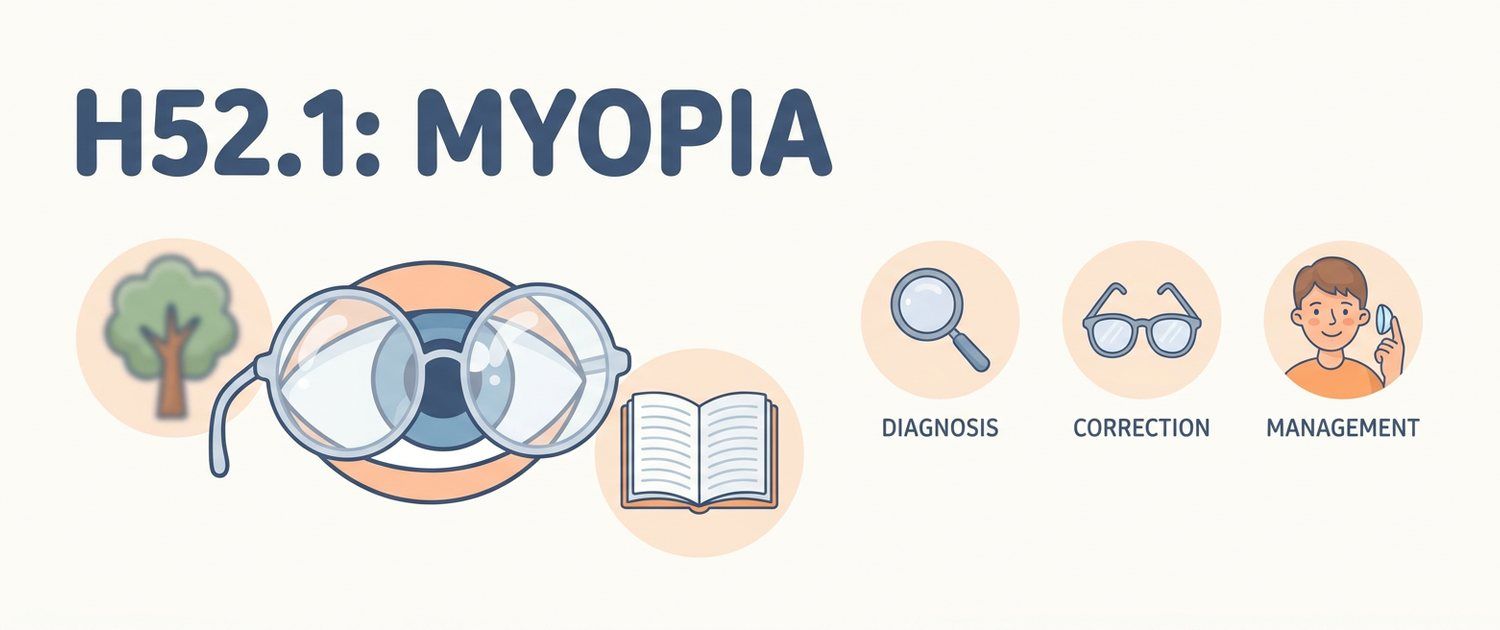
If your chart, certificate or referral contains the entry H52.1, behind it stands one of the most common conditions in the world — short-sightedness. The code looks unfamiliar, but it translates literally and carries no hidden meaning. Below we take it apart element by element, look at where it usually appears, how it differs from its neighbours in category H52, and what genuinely deserves attention together with your doctor.
What ICD-10 code H52.1 means
The official ICD-10 wording of H52.1 is «Myopia» — short-sightedness in everyday language. Element by element:
- H — the letter of ICD-10 Class VII: «Diseases of the eye and adnexa» (codes H00–H59). This class covers vision: eyelids, tear ducts, cornea, lens, retina, optic nerve, eye muscles and optics.
- H52 — the category «Disorders of refraction and accommodation». Refraction is the focusing power of the eye's optical system; a refractive error means the image is not focused precisely on the retina.
- .1 — the subcategory «Myopia»: the image converges in front of the retina. The cause is either an eye that is too long from front to back, or a cornea and lens that bend light too strongly.
Hence the practical experience: near vision is good, distance vision is blurred. People squint, hold text closer, and struggle with bus numbers or writing on a board.
It is just as important to note what the code does not contain. H52.1 says nothing about the degree in dioptres, nothing about whether one eye or both are affected, and nothing about whether the myopia is stable or progressing. All of that the doctor records separately, in words and figures next to the code.
Where you may have seen this code
H52.1 is an everyday ophthalmology code and appears in very ordinary documents:
| Document | Why H52.1 is there |
|---|---|
| Referral to a specialist | States an already known diagnosis as the reason for referral or further testing |
| Outpatient visit record | The administrative record of the visit: reason and diagnosis are coded in ICD-10 |
| Discharge note or eye report | The outcome of the examination: the code plus the degree in dioptres |
| Certificate (school, sport, work, driving licence) | The code marks a vision status relevant to clearance and recommendations |
| Insurance claim | The clinic reports the service delivered; the code justifies payment |
In a child's chart H52.1 is often entered after a routine school vision check. That does not mean a disease was «found out of nowhere» — short-sightedness is most often detected exactly this way, during a scheduled acuity test.
Is H52.1 myopia dangerous or not
Plainly, without either extreme. Myopia in itself is not a disease in the everyday sense and is not a threat to life: it is an optical property of the eye that is fully correctable with glasses, contact lenses and — in adults with stable refraction — surgery. Most people carrying the code H52.1 see normally and live without restrictions.
That said, it should not be brushed off either. Myopia varies in degree, and the degree is what shapes medical attention:
- low — up to about 3.0 dioptres;
- moderate — 3.0 to 6.0 dioptres;
- high — above 6.0 dioptres.
In high myopia the eye is anatomically longer than usual, which means its coats — above all the retina — are stretched. Statistically this raises the risk of peripheral retinal degeneration, retinal detachment, myopic maculopathy and glaucoma. The consequence is simple and not at all alarming: people with high myopia have their fundus examined regularly through a dilated pupil. That is monitoring, not cause for fear.
The second point is progression. In children and teenagers the eye is still growing, and myopia can increase year by year. It is the rate of progression, rather than the presence of myopia itself, that determines management.
And what warrants prompt attention regardless of degree: a sudden curtain across part of the visual field, flashes of light, a shower of new floaters, or an abrupt drop in vision — these mean seeing an ophthalmologist without delay.
Neighbouring codes and how they differ
Category H52 brings together all disorders of refraction and accommodation. They differ in where and how the eye focuses the image:
| Code | Wording | In plain terms |
|---|---|---|
| H52.0 | Hypermetropia | Long-sightedness: the image focuses behind the retina, near vision suffers |
| H52.1 | Myopia | Short-sightedness: the image focuses in front of the retina, distance vision suffers |
| H52.2 | Astigmatism | Uneven focusing power: the image is distorted and smeared along one axis |
| H52.4 | Presbyopia | Age-related loss of accommodation: reading up close becomes harder after 40–45 |
| H53 | Visual disturbances | A separate category: reduced acuity, double vision, field defects — not reducible to optics |
The most common mix-up is H52.0 versus H52.1. They are opposites: in hypermetropia the focus falls behind the retina, in myopia it falls short of it. Either can coexist with astigmatism (H52.2), in which case the document will carry several codes or a combined wording.
One more distinction is worth remembering: H52 describes the optics of the eye, while H53 describes visual function. A code from H53 does not say the eye focuses incorrectly — it says visual function is reduced and the cause still needs to be established.
Which examinations diagnose short-sightedness and its degree
The core of the assessment is ophthalmological and takes place in the consulting room:
- visual acuity testing — with and without correction;
- autorefractometry, in children under cycloplegia (with drops that relax accommodation): gives objective refraction in dioptres;
- dilated fundus examination — inspection of the retina, especially its periphery;
- ocular biometry (axial length) — the key measure of progression in children;
- tonometry — intraocular pressure;
- where indicated — retinal OCT and examination with a Goldmann lens.
Blood tests do not diagnose myopia — worth knowing, so as not to spend time and money in the wrong place. But blood is checked in two situations, and both make sense.
The first is a rapid or unusual change in vision. Swings in blood glucose alter the focusing power of the lens, and «drifting» refraction is sometimes the first noticeable sign of a carbohydrate metabolism disorder — a condition coded separately as type 2 diabetes. After a sudden refractive shift a doctor will often request glucose and HbA1c.
The second is the wider picture of vascular health, on which the retina depends. That includes the lipid profile, metabolic markers and, among them, homocysteine — a marker we covered in detail in the piece on homocysteine and longevity.
If such a referral has been issued, it is easier to make sense of the numbers before the appointment, calmly and without rushing.
What to do next
A practical sequence:
- Establish the degree. Ask your doctor for the refraction in dioptres for each eye — the figure the code itself does not carry.
- Find out whether it is stable. Comparison with last year's data — and with axial length in a child — shows whether progression is under way. Dynamics drive management.
- Have the retina checked. With moderate and high myopia a dilated fundus examination is done regularly, usually at least once a year.
- Discuss correction. Glasses, contact lenses, myopia-control options in children, surgical options in adults with stable refraction. The choice belongs to you and your doctor, not to a code in a chart.
- Do not confuse a refraction code with other entries. Class Z codes nearby — for instance Z01 (examination without complaints) or Z00.0 (general medical examination) — describe the reason for the visit, not a disease.
- Mention accompanying symptoms. If screen work is followed by regular headaches, say so: poorly matched correction is a common and easily fixed cause.
- Return for follow-up on schedule. With short-sightedness the value lies in monitoring over time, not in a single check.
The short version
H52.1 is the ICD-10 code for short-sightedness: the eye focuses the image in front of the retina, so distance vision is blurred. It is a refractive error, not an inflammation or a tumour, and it is correctable. The code carries neither degree nor dynamics — the doctor supplies those. Low and moderate myopia usually needs correction and routine follow-up; high myopia needs regular retinal checks. The meaning lies in the refraction figures and their trend, not in the entry in the «Diagnosis» box.
For informational purposes only
This article is for informational purposes only and does not constitute medical advice, diagnosis, or treatment. Please consult a healthcare professional for medical guidance.