J06.9 — Acute Upper Respiratory Infection Code Explained
Reviewed by the LabReadAI medical team
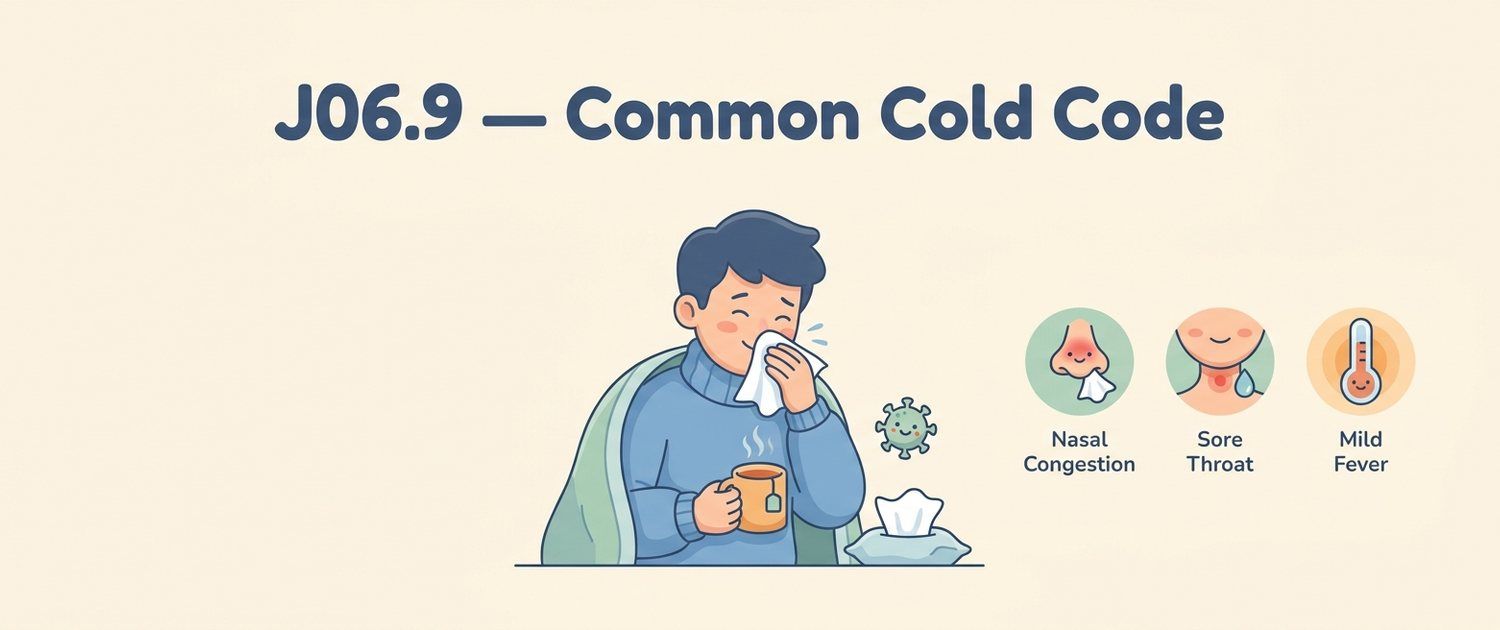
If a visit record, certificate or discharge note in your hands carries the code J06.9 while the doctor said something like «it's just a cold», there is no contradiction. J06.9 is exactly the code for that cold, written in the official language of the classification. Below we take it apart: what it literally means, why the word «unspecified» is there, how it differs from neighbouring codes and what genuinely deserves attention while you are ill.
What the J06.9 Code Means in ICD-10
The official wording of J06.9 is «Acute upper respiratory infection, unspecified». Element by element:
- J — the letter of ICD-10 Class X: «Diseases of the respiratory system». It covers everything from a runny nose to pneumonia and chronic lung disease.
- J06 — the category «Acute upper respiratory infections of multiple and unspecified sites». The key word is multiple: the inflammation involves more than one part of the airway.
- .9 — the «unspecified» subcategory. It refers not to an unclear illness but to the fact that the exact site and the causative organism were not specified.
Put together, J06.9 records: «an acute infection of the upper airway involving several sites; the specific virus was not identified». In everyday language this is a cold or a viral respiratory infection.
A word on «unspecified»: with a typical cold the virus is not tested for, and that is correct practice rather than carelessness. More than two hundred viruses cause these infections, naming them rarely changes management, and testing costs time and money. So «unspecified» is a routine wording, not an alarming one.
Where the Common Cold Code J06.9 Shows Up
J06.9 is one of the most frequent outpatient codes and shows up on several kinds of paperwork:
| Document | Why J06.9 is there |
|---|---|
| Outpatient visit record | The administrative record of the visit: the reason is an acute respiratory infection |
| School, nursery or work certificate | Confirms illness and the period of absence; the code points to a respiratory infection |
| Discharge note or consultation summary | The doctor made the diagnosis clinically, without testing for a specific virus |
| Referral for tests | Used when the course is atypical and a bacterial complication has to be excluded |
| Insurance claim | The clinic reports the service delivered; the code justifies payment for the visit |
Note that a certificate of incapacity for work carries no ICD-10 code at all — neither J06.9 nor any other. It states only a two-digit reason code, for example 01 for illness or 02 for injury. That is a separate system protecting medical confidentiality from the employer.
Is an Acute Upper Respiratory Infection Dangerous
The honest answer: in the vast majority of cases this is a condition that resolves on its own within 7–10 days and leaves no consequences. That is not a softened phrasing — it is how an ordinary viral upper respiratory infection behaves in a person without serious chronic disease.
But a code describes the state at the moment of examination, not the outcome. What matters is the trajectory. There are recognisable situations in which a doctor should be contacted without waiting:
- fever lasting longer than 4–5 days, or returning after it had already settled;
- shortness of breath, air hunger, chest pain on breathing;
- severe one-sided sore throat with difficulty swallowing and high fever — a picture closer to tonsillitis than to a cold;
- pain and pressure over the sinuses, teeth or forehead; marked ear pain;
- in a child — lethargy, refusal to drink, rapid or noisy breathing;
- existing chronic lung disease (for example asthma), heart disease, diabetes, pregnancy, or age over 65 — these call for closer observation.
The «second wave» pattern deserves a separate mention: getting better and then sharply worse is the classic sign that a bacterial complication has joined the viral infection. It is not a catastrophe in itself, but it needs an examination rather than waiting it out.
Neighbouring Codes and How They Differ
Within Class J, codes differ by which part of the airway is inflamed and whether the organism is known:
| Code | Meaning | When it is used |
|---|---|---|
| J00 | Acute nasopharyngitis (common cold) | Mainly nose and nasopharynx: congestion, discharge, sneezing |
| J02.9 | Acute pharyngitis, unspecified | The main site is the pharynx: soreness, pain on swallowing |
| J03.9 | Acute tonsillitis, unspecified | Inflammation of the tonsils |
| J06.9 | Acute upper respiratory infection, unspecified | Several sites at once, no single focus can be named |
| J11 | Influenza, virus not identified | A flu-like picture: abrupt onset, high fever, body aches |
The logic is this: if the doctor can name one site, a targeted code is used (J00 for a head cold, J03.9 for tonsillitis). If complaints are spread across the whole upper airway, J06.9 applies. If the picture resembles influenza without laboratory confirmation, J11 is used. Which of these ends up on your certificate often also depends on local coding practice — a matter of statistics, not of how ill you are.
Which Tests Are Usually Ordered With This Code
In a typical case — none. This diagnosis is made clinically, from the examination and the pattern of symptoms. That is standard care, not a shortcut.
Tests appear when something departs from the usual scenario. A doctor may then order a full blood count (helpful in separating a viral from a bacterial picture), C-reactive protein, a swab for influenza or COVID-19, a chest X-ray if pneumonia is suspected, or an ENT review for suspected sinusitis or ear infection.
While you are at home deciding whether the course is still ordinary, it helps to lay your symptoms out in order: what appeared first, what came later, how the fever changed, what bothers you most. Doing that in advance means arriving at the appointment with a clear picture instead of recalling it on the spot. An overview of which virus is going around helps place your symptoms in context.
What to Do Next
A practical sequence:
- Do not read severity into the code. J06.9 says neither «mild» nor «serious». It says only: acute upper respiratory infection, site and virus unspecified.
- Rest and drink enough fluids. The body clears a viral upper respiratory infection on its own; the task is not to obstruct it by pushing through.
- Track the trajectory day by day. Note the temperature and the main complaints. Improvement by day 4–5 is expected; worsening after improvement is a reason to see a doctor.
- Go through your symptoms in a structured way. Comparing them with which virus is going around helps, and for severe throat pain it is worth reviewing how tonsillitis differs from a cold.
- Contact a doctor at the red flags. Shortness of breath, chest pain, fever beyond 4–5 days, or lethargy in a child are situations where waiting is not appropriate.
- If exhaustion outlasts the illness, that is common; in documents it may be recorded under a separate code, R53, and is worth discussing with a doctor.
This page offers no medicines, regimens or doses: treatment decisions belong to the doctor who has examined you.
The Short Version
J06.9 is the code for an acute upper respiratory infection of unspecified site — an ordinary cold in which several parts of the airway are inflamed and the virus was not identified. It is one of the most common entries in outpatient paperwork. The meaning lies in the course, not the code: improvement by the end of the first week is expected, while worsening after improvement or breathlessness calls for a doctor.
For informational purposes only
This article is for informational purposes only and does not constitute medical advice, diagnosis, or treatment. Please consult a healthcare professional for medical guidance.