J45 — Asthma ICD-10 Code Explained in Plain Language
Reviewed by the LabReadAI medical team
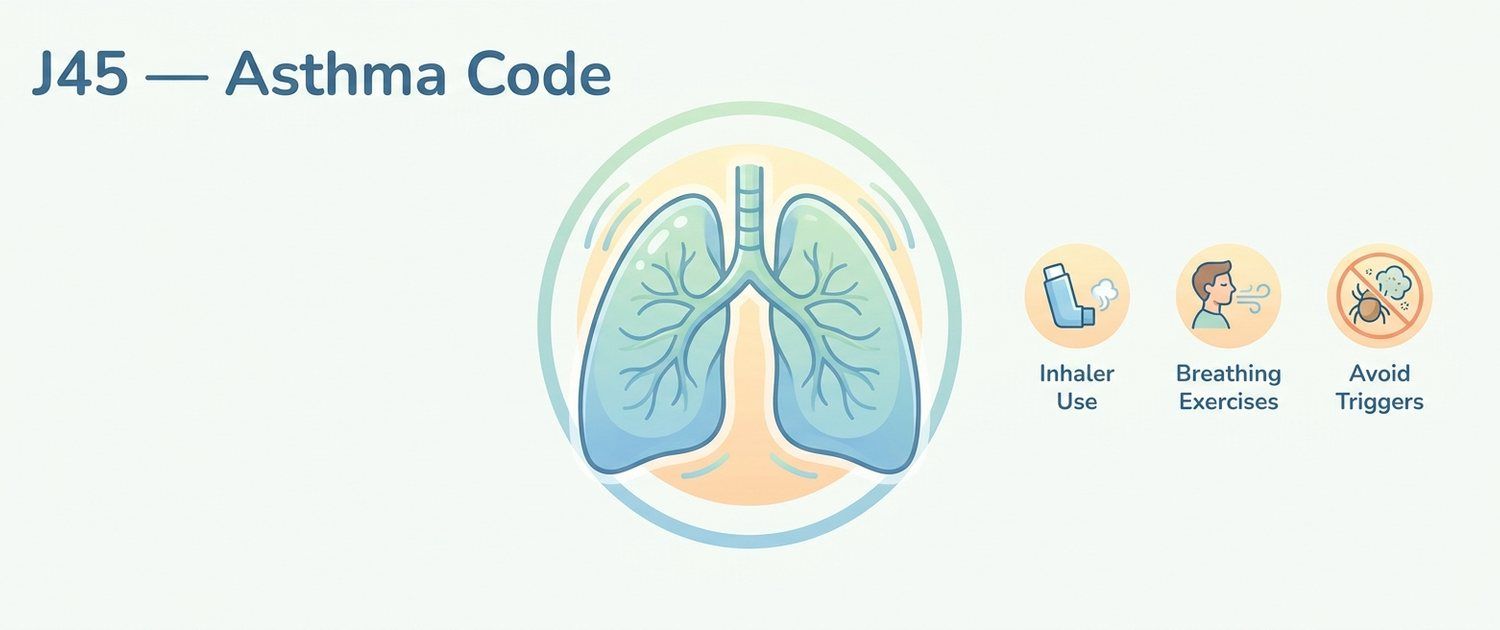
If the «Diagnosis» field of a referral, discharge note or certificate contains J45, the usual first reaction is unease: a letter and two digits look like a verdict in an unfamiliar language. Let us be precise in both directions, without dramatising and without softening: J45 is the code for asthma — a real disease code, not an administrative note about a visit. At the same time, asthma is one of those chronic conditions that respond very well to proper follow-up. Below we take the code apart: what it literally means, where it appears, what it does and does not say about your condition, how it differs from neighbouring codes and what to do next.
What the ICD-10 asthma code J45 actually means
The official ICD-10 wording of J45 is «Asthma». Element by element:
- J — the letter of ICD-10 Class X: «Diseases of the respiratory system» (categories J00–J99). The whole class covers conditions of the airways and lungs, from a common cold to chronic bronchial disease.
- 45 — the category number within the class. J45 is dedicated entirely to asthma and sits in the J40–J47 block, «Chronic lower respiratory diseases», next to bronchitis and COPD.
- The digits after the dot specify the form:
J45.0— predominantly allergic asthma,J45.1— non-allergic asthma,J45.8— mixed,J45.9— asthma, unspecified. If your document showsJ45with no dot, the doctor recorded the category without specifying a form.
What the word «asthma» means medically: chronic inflammation of the airways in which the bronchi become over-sensitive to triggers — cold air, exercise, dust, animal dander, pollen, smoke, infection. The muscular wall of the bronchus contracts, the lining swells, the lumen narrows — hence wheezing, cough, chest tightness and shortness of breath.
The feature that sets asthma apart from many other lung diseases: the narrowing is reversible. The episode ends, the airway reopens, and between episodes a person may feel entirely well. Reversibility is the basis of both the diagnosis and the whole approach to follow-up.
Where you may have seen this code
J45 appears in documents that have to record an established diagnosis:
| Document | Why J45 is there |
|---|---|
| Referral to a pulmonologist or allergist | The diagnosis is already established, and the referral is issued under it |
| Outpatient visit record | The administrative record of the visit: follow-up for an established diagnosis |
| Hospital or day-clinic discharge note | The final diagnosis after admission for an exacerbation |
| School, sports or workplace certificate | Grounds for adjusted physical load or special conditions |
| Insurance claim | The clinic reports the service delivered; the code justifies payment |
| Chronic disease follow-up record | Asthma is a condition with scheduled regular reviews |
One nuance: a certificate of incapacity for work never states the diagnosis — neither in words nor as an ICD-10 code. It carries only a two-digit reason code, which protects medical confidentiality from the employer. So if you can see J45, you are looking at a different type of document.
Is a J45 diagnosis dangerous, and what does it say about you
Accuracy matters in both directions here.
Asthma is a serious chronic disease that needs medical follow-up. Uncontrolled asthma limits physical activity, disturbs sleep and leads to exacerbations, and a severe attack is an emergency. It is not «just an allergy» and it does not resolve on its own.
And at the same time it has an excellent outlook when controlled. The modern approach rests on regular maintenance therapy selected by a doctor: with control achieved, people live ordinary lives, play sport (Olympic champions among them), do not wake at night coughing and go months without reaching for a reliever inhaler. The level of control is what really determines quality of life — and it is manageable.
What the code J45 does not tell you:
- Severity. The same code covers mild asthma with rare episodes and severe disease. Severity is described in words in the report.
- Level of control. «Controlled», «partly controlled» and «uncontrolled» form a separate assessment based on recent symptoms, not on the code.
- Prognosis. The code records the fact of a diagnosis at the moment the document was issued — nothing more.
On children specifically: a coded asthma diagnosis in a child's record often causes parents more alarm than is warranted. In a substantial share of children with infection-related wheezing the picture changes with age, and follow-up exists precisely to track that trajectory. How to read the code in a particular child's record is a question for the paediatrician and paediatric pulmonologist.
Neighbouring codes: J45 versus J44, J46, J30 and T78.4
Several codes describe overlapping symptoms — wheezing, breathlessness, cough, reaction to an allergen — and they are frequently confused. The differences are substantive:
| Code | Meaning | How it differs from J45 |
|---|---|---|
| J45 | Asthma | Chronic bronchial inflammation with reversible narrowing of the airway |
| J44 | Other chronic obstructive pulmonary disease (COPD) | The obstruction is persistent and poorly reversible; usually follows years of smoking and starts in later life — see the J44 explainer |
| J46 | Status asthmaticus (severe asthma exacerbation) | Not a separate disease but a state: a prolonged attack that does not respond to usual relief. A medical emergency |
| J30 | Vasomotor and allergic rhinitis | An allergic reaction in the nose rather than the bronchi; often accompanies asthma, but it is the upper airway |
| T78.4 | Allergy, unspecified | A general allergic-reaction code with no target organ specified; used when the nature of the reaction is not clarified |
In practice J45 and J44 are mixed up most often. The difference comes down to one word: in asthma the narrowing is reversible, in COPD it is persistent. That is why the bronchodilator reversibility test matters so much — it shows whether airflow recovers. Some people have features of both, in which case both codes may appear in their records.
It is also worth separating J45 from an ordinary respiratory infection: wheezing and cough occur in an acute upper respiratory infection too, but there they are a passing episode rather than a chronic condition.
Which tests are usually ordered with this code
An asthma diagnosis is not made from a single symptom — it is assembled from the history and objective data. What an assessment usually includes (the doctor decides the list; this is only a map of the logic behind it):
- Spirometry with a bronchodilator test — the core functional study. Exhaled volume and flow are measured before and after inhaling a bronchodilator: an improvement confirms that the obstruction is reversible.
- Peak flow monitoring — home measurement of peak expiratory flow, kept as a diary. It shows day-to-day variability and helps judge control.
- Full blood count with differential — eosinophils, the cells involved in allergic inflammation, get particular attention.
- Total immunoglobulin E (IgE) — a marker of allergic predisposition; what its values mean is covered in the guide to immunoglobulin E.
- Allergy panel — specific IgE to individual allergens — shows what the airways actually react to: pollen, house dust mite, animal dander, mould. What such testing includes and how to read it is explained in the allergy panel overview.
- Chest X-ray or CT — ordered not to confirm asthma but to rule out other causes of the symptoms.
How the allergic component works, and why the same trigger causes a runny nose in one person and an attack in another, is set out in the allergy guide.
If you already hold reports and results but cannot see how they connect to your symptoms, working through the symptoms and documents helps build a coherent picture before the appointment and turn it into specific questions for the doctor.
What to do next
A practical sequence once J45 appears in your documents:
- Clarify whether the diagnosis is established or suspected. The code is sometimes used on reasonable suspicion while the work-up is still ongoing. Ask directly: is this confirmed, or are we still testing for it?
- Ask about the form and the level of control. Have the doctor put it in words: allergic or non-allergic, and how well controlled the condition is right now. None of that is in the code.
- Complete the tests ordered. Spirometry with a reversibility test first — without it the diagnosis remains a clinical assumption. The laboratory part is outlined above: total IgE and the allergy panel.
- Identify your triggers. Record when symptoms appear: season, room, exertion, animals, smells. This is the most useful information you can bring to an appointment; see the allergy guide above for orientation.
- Agree a plan for getting worse. Anyone with asthma should have a clear written answer to «what do I do if it worsens», including the signs that mean emergency care.
- Do not change or stop what was prescribed on your own. A common mistake is dropping maintenance therapy as soon as breathing improves: the inflammation persists even when symptoms do not. Any change belongs with the doctor.
Separately: seek emergency care immediately if breathlessness is escalating, the usual relief is not working, speaking in full sentences is difficult, or lips or nails turn bluish. That situation corresponds to code J46, status asthmaticus, and it does not tolerate waiting.
The short version
J45 is a genuine disease code: asthma, chronic airway inflammation with reversible narrowing of the bronchi. It conveys neither severity, nor level of control, nor prognosis — the doctor states those in words. Asthma demands follow-up and consistency, yet with the control a doctor helps you reach, most people live without restrictions. The meaning lies not in the code on the page but in spirometry, in knowing your triggers, and in staying in contact with your doctor.
For informational purposes only
This article is for informational purposes only and does not constitute medical advice, diagnosis, or treatment. Please consult a healthcare professional for medical guidance.