ASO (Antistreptolysin O): What an Elevated Result Means
Reviewed by the LabReadAI medical team
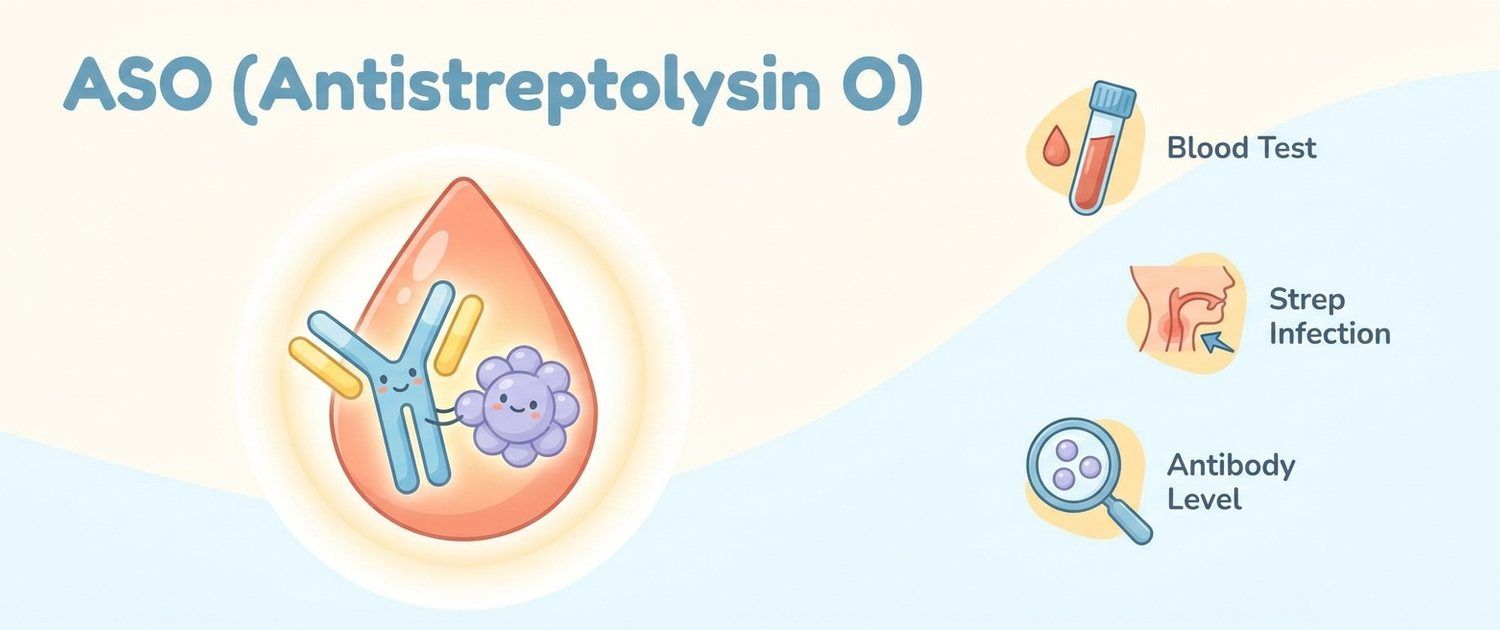
"ASO is elevated" — and immediately worry, especially if a child had the test. Relax: ASO (antistreptolysin O) is not a marker of active infection and on its own rarely means disease. These are antibodies that only tell that the body has encountered streptococcus at some point. Let us look at what ASO shows, what an elevated result means, and when it really matters.
What Antistreptolysin O (ASO) Is and Why It Is Tested
ASO is an antibody to streptolysin O, a toxin of group A beta-haemolytic streptococcus (the same that causes tonsillitis, scarlet fever and streptococcal skin infections). After a streptococcal infection the body produces these antibodies. The test is ordered not to diagnose the tonsillitis itself, but to confirm recent contact with streptococcus — usually with suspected complications of it.
What an Elevated ASO Means
An elevated ASO means the person has had a streptococcal infection recently or in the past. Importantly: this is NOT an active infection "now" and not a diagnosis on its own. The antibodies appear only 1–4 weeks after the illness, peak at 3–5 weeks, and then slowly decline over months. So an elevated ASO without symptoms of complications most often does not need treatment "by the number."
Why a Single Result Is Uninformative (Titer Dynamics)
A single ASO measurement says little. Far more informative are the dynamics: a rising titer over several tests across weeks, followed by a decline, is a more reliable sign of a past streptococcal infection than a single number. The antibodies reflect PAST events, so a single ASO cannot tell whether a person is ill now or simply a streptococcus carrier.
When ASO Really Matters (Rheumatic Fever, Nephritis)
The test is useful with suspected post-streptococcal complications: acute rheumatic fever and post-streptococcal glomerulonephritis (kidney involvement). In these diseases an elevated ASO helps confirm the link to streptococcus and is assessed together with symptoms and inflammatory markers — ESR and C-reactive protein. Outside such a context, an isolated ASO is uninformative.
ASO in Children
In school-age children streptococcal infections are common, so a moderately elevated ASO is not rare and on its own does not mean disease. This is a common cause of parental worry. What matters is not a "high number" but the presence of symptoms (joint pain, swelling, urine changes) and the titer dynamics, which a doctor assesses.
When to See a Doctor
See a doctor if an elevated ASO is combined with symptoms: pain and swelling of joints, fever after a sore throat, swelling, a change in the colour or amount of urine. In these cases a doctor assesses ASO together with a complete blood count and inflammatory markers. An elevated ASO on its own without symptoms is usually no reason for treatment, but a reason to discuss the result with a doctor.
This article is for informational purposes only and does not replace a doctor's consultation.
For informational purposes only
This article is for informational purposes only and does not constitute medical advice, diagnosis, or treatment. Please consult a healthcare professional for medical guidance.