Formula · 8.3
Brand · 7.9
La Roche-Posay · panthenol 5% · France
La Roche-Posay Cicaplast Baume B5+
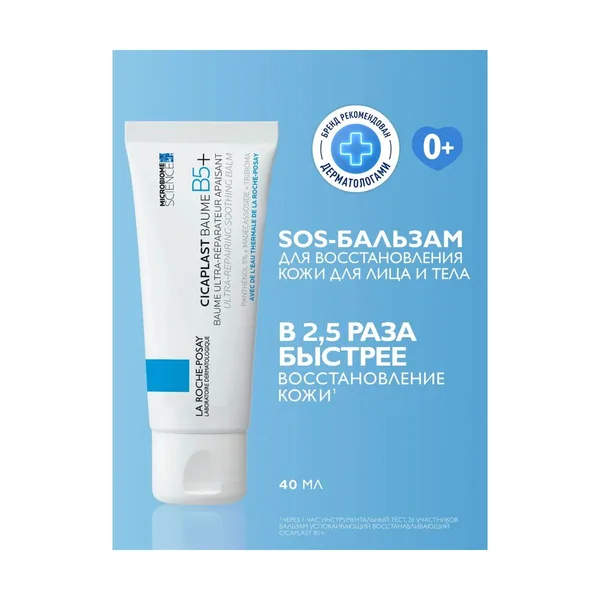
LabReadAI label score
How the score is calculated- Actives and evidence0.8Effect moderately supported
- Active concentration1.0Concentration within the working range
- Completeness for the purpose0.8For “sensitive skin and redness” — 75 %; zinc oxide; could be added without conflict: zinc oxide; a broad formula across 6 purposes
- Tolerance1.0No ingredients from irritant or allergen lists
- adults
- pregnancyallowed per the leaflet
- sensitive skin
- children
- babies
- atopic skin
Ingredients — 32 components, 1 of them active
The rest is the formula base: it holds texture, shelf life and application, and is not meant to act.
What works: 1 of 32 ingredients: panthenol. Sensitive skin needs soothing ingredients (panthenol, allantoin, bisabolol, centella, oatmeal, ectoin) and barrier ones (zinc oxide, ceramides, niacinamide) — one from each group — and as few irritants as possible: fragrance, alcohol, acids.
Strengths: active concentration, tolerance
What lowers the score: actives and evidence: effect moderately supported; completeness for the purpose: for “sensitive skin and redness” — 75 %
Questions: no debatable ingredients in the formula
- AQUA/WATER base: coating, fillers · water — the solvent and base; listed first because there is more of it than anything else; in supplements — part of the capsule shell
- HYDROGENATED POLYISOBUTENE base: coating, fillers · a synthetic oil, gives shine and slip; does not clog pores
- DIMETHICONE base: coating, fillers · form a smooth film and shine; inert and not absorbed — a preference question, not a safety one
- GLYCERIN base: coating, fillers · a humectant: coats the tablet, holds moisture in creams and shampoos; does not clog pores
- BUTYROSPERMUM PARKII BUTTER/SHEA BUTTER base: coating, fillers · the plant base: emollient oils, waxes and care extracts
- PANTHENOL works · the active ingredient — what the product is for; form: panthenol
- ZEA MAYS STARCH/CORN STARCH base: coating, fillers · filler and binder
- PROPANEDIOL base: coating, fillers · a humectant and solvent from corn sugar: it holds water and helps actives dissolve. A gentler replacement for propylene glycol.
- BUTYLENE GLYCOL base: coating, fillers · a humectant and solvent: it makes the texture lighter and helps actives spread. Better tolerated than propylene glycol.
- CETYL PEG/PPG-10/1 DIMETHICONE base: coating, fillers · form a smooth film and shine; inert and not absorbed — a preference question, not a safety one
- TRIHYDROXYSTEARIN base: coating, fillers · soften, condition and carry the actives; the backbone of the texture
- CENTELLA ASIATICA LEAF EXTRACT base: coating, fillers · the plant base: emollient oils, waxes and care extracts
- POLYMNIA SONCHIFOLIA ROOT JUICE base: coating, fillers · the plant base: emollient oils, waxes and care extracts
- ZINC GLUCONATE base: coating, fillers · amino acids, lipids and sugars akin to the skin’s own components — support for its barrier
- MADECASSOSIDE base: coating, fillers · amino acids, lipids and sugars akin to the skin’s own components — support for its barrier
- MANGANESE GLUCONATE base: coating, fillers · amino acids, lipids and sugars akin to the skin’s own components — support for its barrier
- ALPHA-GLUCAN OLIGOSACCHARIDE base: coating, fillers · skin-microbiome ferments, prebiotics and formula antioxidants
- SILICA base: coating, fillers · tune the acidity and texture; salt is a common shampoo thickener
- SODIUM HYDROXIDE base: coating, fillers · tune the acidity and texture; salt is a common shampoo thickener
- MAGNESIUM SULFATE base: coating, fillers · tune the acidity and texture; salt is a common shampoo thickener
- MANNOSE base: coating, fillers · amino acids, lipids and sugars akin to the skin’s own components — support for its barrier
- CAPRYLOYL GLYCINE base: coating, fillers · protect the product from bacteria and mould; used within the EU-permitted concentrations
- CAPRYLYL GLYCOL base: coating, fillers · a humectant that also holds bacteria back, which is why it often replaces part of the preservative.
- VITREOSCILLA FERMENT base: coating, fillers · skin-microbiome ferments, prebiotics and formula antioxidants
- CITRIC ACID base: coating, fillers · acidity regulator
- TRISODIUM ETHYLENEDIAMINE DISUCCINATE base: coating, fillers · bind hard-water metals so the formula stays stable and the foam works
- LACTOBACILLUS base: coating, fillers · skin-microbiome ferments, prebiotics and formula antioxidants
- ACETYLATED GLYCOL STEARATE base: coating, fillers · soften, condition and carry the actives; the backbone of the texture
- MALTODEXTRIN base: coating, fillers · carbohydrate filler
- POLYGLYCERYL-4 ISOSTEARATE base: coating, fillers · soften, condition and carry the actives; the backbone of the texture
- TOCOPHEROL base: coating, fillers · vitamin E at hundredths of a percent: keeps the oils of the formula (a cream or a capsule fill) from going rancid; at that share it protects the product, it is not vitamin E as an active
- PENTAERYTHRITYL TETRA-DI-T-BUTYL HYDROXYHYDROCINNAMATE base: coating, fillers · a synthetic formula antioxidant: protects the oils and actives from oxidation; hundredths of a percent, no action on the skin
- CI 77891/TITANIUM DIOXIDE questions · white coating pigment; banned as a food additive in the EU since 2022, permitted in Russia and the US
La Roche-Posay Cicaplast Baume B5+ is a product whose active ingredient is panthenol (pro-vitamin b5) at a declared 5 %. The effect is moderately supported: 1–5 %: soothes, speeds up skin recovery and holds moisture. The formula has 32 ingredients, 1 of which does the work; the rest is the formula base. Sensitive skin needs soothing ingredients (panthenol, allantoin, bisabolol, centella, oatmeal, ectoin) and barrier ones (zinc oxide, ceramides, niacinamide) — one from each group — and as few irritants as possible: fragrance, alcohol, acids. By the list, no alcohol (alcohol denat), sulfates (SLS/SLES), formaldehyde releasers, isothiazolinones (MIT/MCI), parabens, mineral oils and petrolatum, soap, fragrance, gelatin in the coating, toning dyes, tar. Suitable for: adults, pregnancy, sensitive skin, children, babies, atopic skin. Use: any time, can be applied often. When to expect an effect: soothing — days; barrier — 2–4 weeks. Label score — 8.3 out of 10 (effect moderately supported; for “sensitive skin and redness” — 75 %; zinc oxide; could be added without conflict: zinc oxide; a broad formula across 6 purposes). Per the pack: do not apply to open wounds, avoid the eye area, do not swallow. A restatement of the label, not an assessment.
Who it does not suit
Per the maker's leaflet: Per the pack: do not apply to open wounds, avoid the eye area, do not swallow. A restatement of the label, not an assessment.
Is this product right for your skin?
The score describes the formula, not your skin: the same product dries one person and saves another. Describe your skin type, reactions and goals, attach a photo of the ingredient list or the product — we will go through every ingredient and say whether it suits you, what to pair it with and what to avoid.
Similar products
Same nutrient and the same purpose — closest by form and dose. Each has its own score by the same method, so you can see whether there is an option nearby that is more honest or simpler in composition.
 Round LabRound Lab 1025 Dokdo Toner8.2
 VOISVOIS Facial Foam with Hyaluronic Acid7.9
 NIVEANIVEA Creme7.9
 CELIMAXCELIMAX Dual Barrier Creamy Toner7.7
 essenceessence hello, good stuff! 48h Hydrating Serum Stick7.6
 SOME BY MISOME BY MI Beta Panthenol Repair Gel Cleanser7.2
 CetaphilCetaphil Moisturizing Lotion6.8
 BiodermaBioderma Sébium Night Peel9.6