Changing Occupation After Forty: Ageism, Facts and What Works
Reviewed by the LabReadAI medical team
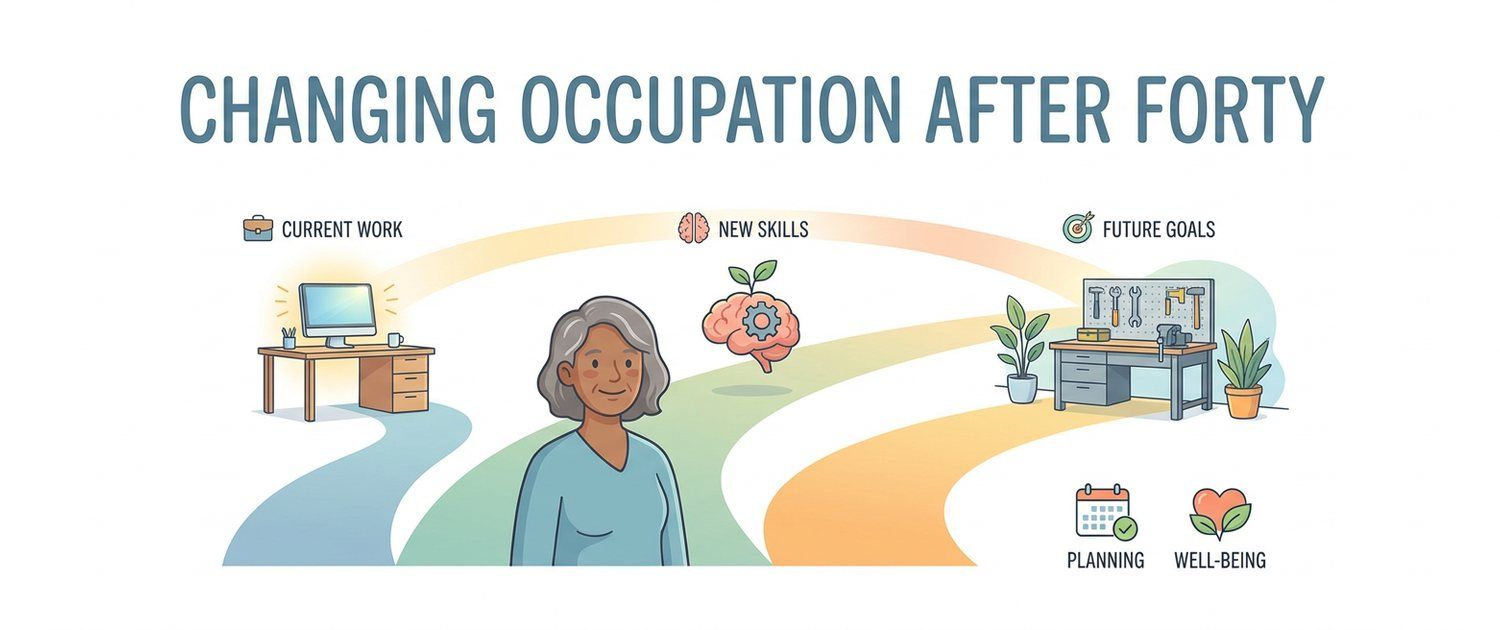
The question «is it too late to change career at forty» has two equally useless answers: «of course it is» and «age is just a number». The first ignores the data, the second ignores common sense. It is more useful to take the question apart: where age genuinely gets in the way, where it works in your favour, and what follows for the plan.
Where the bias is real
Age discrimination in hiring is not invented. In Russian surveys a notable share of people report meeting it personally, and a larger share believe employers prefer younger candidates. Economic research on Russian data (earnings analysis decomposed into explained and unexplained parts) confirms an age component — and shows it does not appear at the same point for everyone: earlier for men, later for women.
One practical conclusion follows: build the resistance into the plan rather than denying it. A plan that ignores it breaks at the first rejection — and the rejection reads as a verdict when it is merely friction.
Where age works in your favour
This is the other half of an honest answer, and it is usually stated weakly.
Interests are stable. Interests settle sharply at around twenty-two and then hold for two decades more reliably than personality traits. So a forty-year-old who has worked out what pulls them stands on firmer ground than a final-year pupil taken to a career session with the whole class. The irony is that career guidance is treated as a children's subject.
You have data about yourself. An adult carries experience showing what was done with pleasure and what was merely endured. That is the most valuable information in a choice — and a twenty-year-old simply does not have it.
Transferable things transfer. Accountability, finishing what you start, understanding how organisations work, talking to people and to clients — these carry across industries almost intact. Usually only the subject-matter part resets.
Some fields are age-neutral or better. Where clearance, experience and reliability decide — equipment maintenance, engineering networks, health and care, mentoring, roles carrying accountability — age is not the main filter.
What actually works in a move
Shorten the distance rather than jump
The most persistent mistake is a jump into the most distant industry because «that is where the future is». The longer the jump, the more resets and the longer the stretch without income.
Moving sideways is cheaper: the same industry, a different function; the same function, a different industry. There is usually a role in which your past experience is not a hindrance but the reason to hire you: between your current field and the new one there is almost always a seam, and on the seam your age stops being a minus.
Enter alongside your current job
If income cannot break — and after forty it usually cannot — the move is built in parallel, not instead: side work, a project, part of the tasks in your current role, an internal move inside your own company. An internal move is almost always cheaper than an external one: there your experience is already known and age does not act as a filter.
Show results, not years
A CV listing twenty years of titles reads as age. A CV listing what was done and with what result reads as competence. «Rejuvenating» a biography is unnecessary and harmful — what needs changing is its unit of measurement.
Do not make age the topic
If you raise age first — in an interview, in a letter, in conversation — it becomes the topic. An adult candidate most often loses not to age but to their own apologetic tone.
What not to do
Study «just in case». A course without a tested direction is several months and a feeling of movement without movement. Reconnaissance first, training second.
Assume it is too late to learn. The speed of picking up new things changes with age, but far less than commonly assumed — and it is offset by an adult understanding why they are learning and wasting less on the irrelevant.
Leave for nowhere. Quitting removes income, not uncertainty. The decision to leave comes after reconnaissance, not instead of it.
A separate check: is this about age at all
If there is nothing left in the tank, nothing looks interesting — and the question «should I change occupation» will get an equally empty answer whichever way it is answered. That is a property of the state. Then the burnout reading comes first, and weakness, poor sleep and a drop in working capacity are worth checking with a doctor: ferritin, TSH, vitamin D, a full blood count.
What an algorithm computes here
The career direction test asks for age (and sex) before you start — precisely so that it can speak about age concretely: without them the reading stays silent about it. Code then scores six interest types, six work values and five scales of your constraints — including whether income may fall — and matches candidates from a 192-occupation directory. Some entries are marked as having relatively age-neutral entry; that is our editorial assessment, and the reading presents it as exactly that.
Nearby on the same subject
Neighbouring readings in this cluster, if this is not your only question:
For informational purposes only
This article is for informational purposes only and does not constitute medical advice, diagnosis, or treatment. Please consult a healthcare professional for medical guidance.