The Midlife Crisis and Work: What Is Actually Happening
Reviewed by the LabReadAI medical team
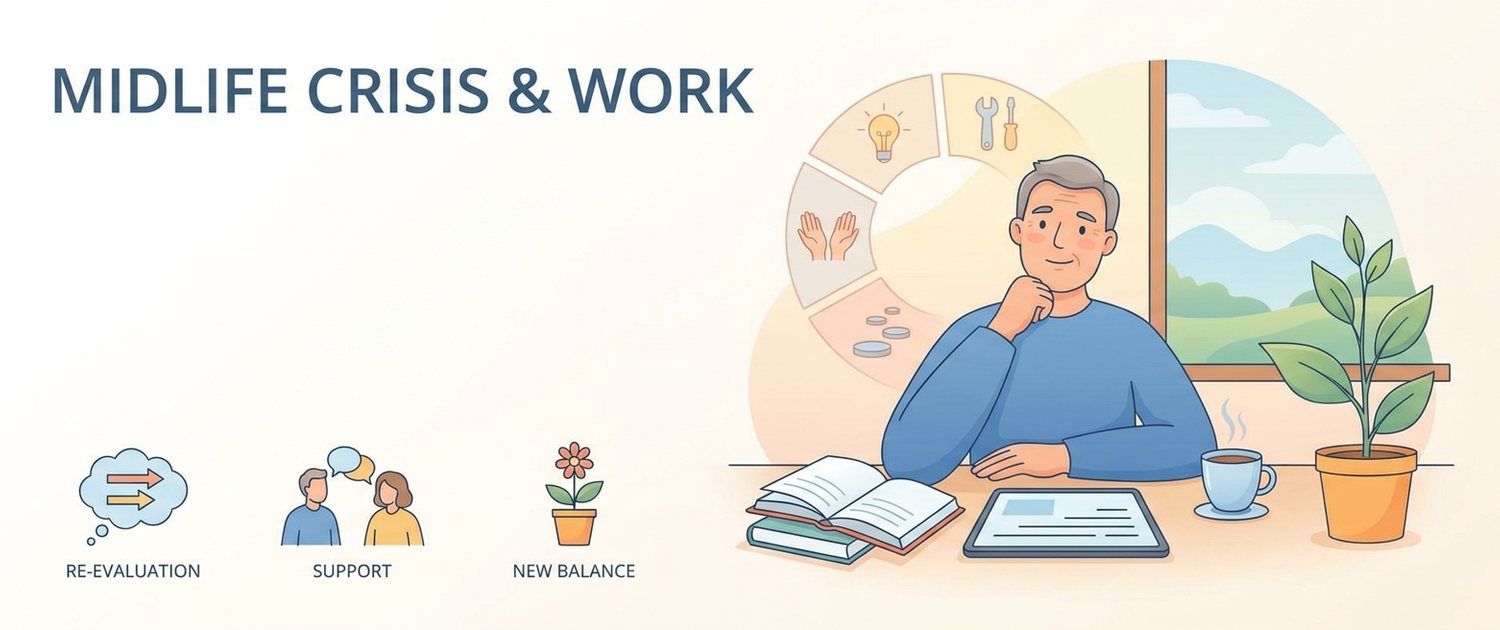
The phrase «midlife crisis» entered everyday speech long before anyone tested it, and has since been used to explain everything from a change of job to the purchase of a motorbike. Here is what sits behind it in the data and what follows practically.
⚠️ First things first: this is not a diagnosis. Current classifications contain no such category, and there is no need to treat the state as an illness. Nor is there any point in waving it away: the experience is real, and decisions made inside it can be expensive.
What happens to satisfaction in midlife
Some wellbeing research finds a dip in life satisfaction in the middle years with a later recovery. The pattern does not reproduce everywhere and depends on what is measured and where — it cannot be called a universal law.
Far more reliable is another observation: in midlife several loads converge at once. A peak of responsibility at work, children, ageing parents, a mortgage, the first noticeable changes in health. Part of what is called an age crisis is simply simultaneity.
What actually changes
The weight of values, not the person
The commonest and most underrated factor. The job was chosen for values that mattered at twenty-five: growth, recognition, status, money. By forty the weights redistribute: independence, meaning, predictability and time with family matter more. The work has not changed a gram — what changed is what is expected of it.
Hence a practical conclusion: what needs examining is values, not the occupation. It often turns out that what needs changing is not the field but the conditions, the role or the scope of responsibility inside the same field.
The horizon becomes finite
A second stable observation: in midlife the way of looking at time changes — not «how much has passed» but «how much is left». That shifts priorities: what pays off now matters more than what pays off in twenty years. In itself this is not a crisis but a normal shift — but it makes a far smaller share of meaningless work tolerable than before.
The first reckoning
A twenty-year-old judges themselves by promises, a forty-year-old by what is done. The gap between plan and fact becomes visible, and that is what feels like «I am not where I should be». It helps to remember that the plan was drawn up by someone who did not have your data.
Which decisions are later regretted
What causes regret is not the change itself but two of its properties.
A decision at the peak of emotion. Leaving in a day, without reconnaissance, «to finally change something». Emotion supplies energy but not information; a month later the energy is gone and the information is still missing.
A decision in one step. Burning everything at once: resigning, spending savings, relocating. The mistake becomes irreversible, and that is not about courage but about the absence of a way back.
The opposite — decisions people do not regret — usually looks boring: reconnaissance first, then a small parallel step, then expanding whatever worked.
The check people do last and should do first
Three things look like a midlife crisis and are not:
- Being spent. Nothing brings joy, including what used to; rest does not restore. Then the burnout reading and a doctor come first.
- Bodily causes. Weakness, poor sleep and a drop in working capacity come from iron deficiency, thyroid trouble, vitamin D deficiency. Checked with routine tests: ferritin with a full blood count, TSH, vitamin D. Existing results can be read in a lab report reading.
- Hormonal and age-related changes, which also begin around this age and produce fatigue and irritability.
None of the three is cured by changing occupation, and all three feel like «I am stuck».
What to do practically
- Examine values, not the occupation. What mattered before, what matters now, and which of it the current job supplies.
- Break the job into four pieces — tasks, people, meaning, conditions — and see whether all of it sagged or one part.
- Check your state and your body before drawing career conclusions.
- Make no irreversible decisions at the peak. Give yourself a rule: a parallel step first, a decision after.
- Scout two or three directions in real life, if the conversation really is about changing.
What an algorithm computes here
The feeling «I am not where I should be» is a lump in which values, interests, state and circumstances are mixed. The career direction test takes it apart by code: six work values are scored separately from six interest types, the current job is broken into tasks, people, meaning and the whole, and the state runs as its own branch overriding everything else. The outcome comes from the gates of four branches — and one of them says outright «no need to change, the current job needs reshaping».
Nearby on the same subject
Neighbouring readings in this cluster, if this is not your only question:
For informational purposes only
This article is for informational purposes only and does not constitute medical advice, diagnosis, or treatment. Please consult a healthcare professional for medical guidance.