Burnout at Work: The Six Areas of Working Life That Burn You
Reviewed by the LabReadAI medical team
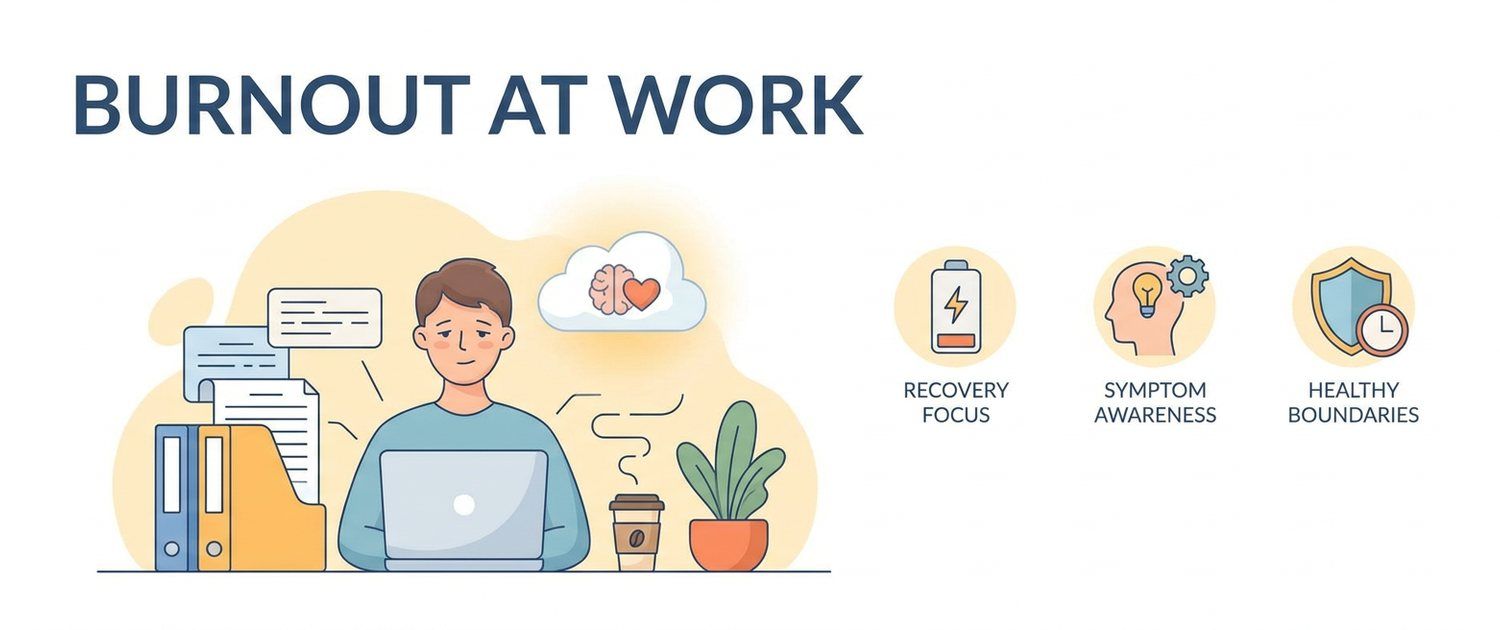
Burnout is the one state on this list that the World Health Organization tied directly to work: the term is deliberately limited to the occupational context and should not be applied to other areas of life. How exactly that is written into the classification is unpacked in the article on burnout in ICD-11.
A practical thing follows from it: if the state grew at work, it should be examined through the structure of the work, not through the character of the person.
What burnout at work is, and its signs
In the WHO definition it is a syndrome resulting from chronic workplace stress that was not successfully managed, and it has three parts: exhaustion, growing mental distance from one's job and a sense of reduced effectiveness. The general frame is in the article on what burnout is.
The signs are usually noticed in this order: patience goes first, then interest, then quality. Along come counting the hours to the end of the day, irritation at ordinary requests, autopilot instead of engagement, and the thought «I don't want to work», which is stronger in the morning than in the evening. The full walk-through is in the article on the signs of burnout.
Occupational burnout is still not a diagnosis: it cannot be «given», and this article gives nothing either.
The six areas of working life
The most useful frame for causes is the six areas of working life model (Maslach and Leiter). The idea is simple: burnout forms where a lasting mismatch appears between the person and the job — and there are exactly six places for it.
| Area | What the mismatch looks like |
|---|---|
| Workload | The volume is steadily larger than what fits into the time given |
| Control | You answer for the result but do not decide how to reach it |
| Reward | Effort comes back neither as money, nor recognition, nor a visible result |
| Community | The relationships around you cost energy instead of giving it |
| Fairness | Rules are applied differently; decisions are opaque |
| Values | You do what you consider pointless or wrong |
Below, area by area: what happens there and what can actually be changed.
Workload and overtime
Workload is the most visible area and the most overrated as a sole cause. In a meta-analysis of sixty-five longitudinal studies it is indeed the factor most strongly related to exhaustion, but the relationship is moderate: volume alone does not explain the picture.
What matters more than the number of hours is the absence of recovery between them. Regular overtime is dangerous not because you work more but because the evening that was meant to return your energy also goes into work. That is also why work-life balance is not about equal shares but about whether the unburnt part of the day has any content left.
A word on workaholism: it is not a synonym for burnout and not a cause in itself. The difference is that a workaholic cannot stop even when they can — which is precisely why recovery happens less often, so spending steadily exceeds return.
What can be changed: agree on priority rather than pace («which of these do we not do»), make the load visible in numbers, protect at least one evening as a commitment.
Control: when you decide nothing
A sense of powerlessness makes the same load noticeably more expensive: a hard task you are steering is one thing, a hard task you were simply handed is another. This area often holds a hidden reserve: even without formal authority you can usually influence order, deadlines within the day and the way the work is done.
Reward: when effort does not come back
In the meta-analysis reward acts protectively: where it is missing, the same load costs more. And this is not only about money — recognition belongs here, and so does a visible result, which often matters more. Work with no visible end and no visible consequences drains more than hard work with a clear outcome.
The people around you: a toxic workplace
Here is the most counterintuitive fact of the whole subject. A survey of fifteen thousand employees across fifteen countries found that the strongest predictor of burnout is toxic behaviour nearby, by a large margin over everything else. Among those who meet it often, the risk of burnout symptoms was almost eight times higher.
The practical conclusion is unpleasant but useful: if a person or a norm of communication nearby steadily costs you energy, optimising the calendar will not solve it. A toxic workplace and abuse at work are not «quirks of character» but a factor that in the data outweighs the volume of tasks.
Fairness: when the rules differ
Unfairness at work is about predictability rather than offence. When identical situations are resolved differently and the criteria are unknown, energy goes into guessing instead of into the work. In the meta-analysis fairness is one of the protective factors: where it exists, exhaustion is lower.
Values: a job you dislike
The last area is the quietest. A job you dislike does not necessarily lead to burnout — but a job where you regularly do what you consider wrong drains the resource constantly and invisibly. The tell for this area is single: the tiredness comes from the content, not from the volume.
What Russian surveys show
The Russian numbers match the general picture. In a survey of three thousand working Russians, 58% had met burnout: 61% of women, 54% of men, and 69% among people with higher education. Half of those affected eventually changed jobs, and only about a quarter discussed the state with management.
A second survey of nearly three thousand respondents puts the average burnout level at 3.28 out of 5, with one in four choosing the maximum. The level is highest in IT and banking (3.82), then HR (3.68) and medicine (3.67). The named causes: pressure from management and lack of resources at 40% each, monotony of tasks 37%, overtime 34%. Four out of four point at the areas above rather than at personal stamina.
One caveat belongs here: decisions about leaving, paperwork and employment disputes are not the subject of this article. We do not give legal advice; questions of that kind belong with a specialist in the field.
How to avoid burning out at work
Prevention is not a list of habits but a regular check of those same six areas: where the mismatch is growing and what in that area is within your reach. Plus two levers that work almost always: recovery between working days and psychological detachment from work outside its hours.
One popular bet is worth removing: «I will hold out until the holiday» does not work — a holiday returns your energy and fades about a week after you come back, and a long one is no better than a short one. In detail in the article on why a holiday does not help. The order of evidence-backed steps is gathered in the article on how to come out of burnout.
And one more thing: the same mechanics work where there is formally no job at all. Domestic load has no end of shift — that is the subject of the text on parental burnout.
When it is not only about work
There is a picture in which changing tasks and even changing employers moves nothing: interest and pleasure fail to return anywhere, not only in the office. Then «it is the job» stops explaining what is happening — the fork is unpacked in the article burnout or depression, and a specialist settles it.
The second version is bodily: hypothyroidism (a shifted TSH), iron deficiency (low ferritin) and a lack of vitamin B12 give the same picture. What to check and in what order is in the article on blood tests for emotional burnout; results you already have the service will help you read in plain language.
What to do with your own picture
The first move is to find which of the six areas is out of balance, not how tired you are. A quick bearing on the level comes from the short burnout test. The full burnout test scores two lines apart — your own state and what the environment around the work demands — and their combination shows where to apply effort: to recovery or to the conditions themselves.
This article is informational; it does not diagnose and gives no legal or employment advice. In the WHO classification burnout is not an illness.
For informational purposes only
This article is for informational purposes only and does not constitute medical advice, diagnosis, or treatment. Please consult a healthcare professional for medical guidance.