Burnout: What It Actually Is and Why It Is Not an Illness
Reviewed by the LabReadAI medical team
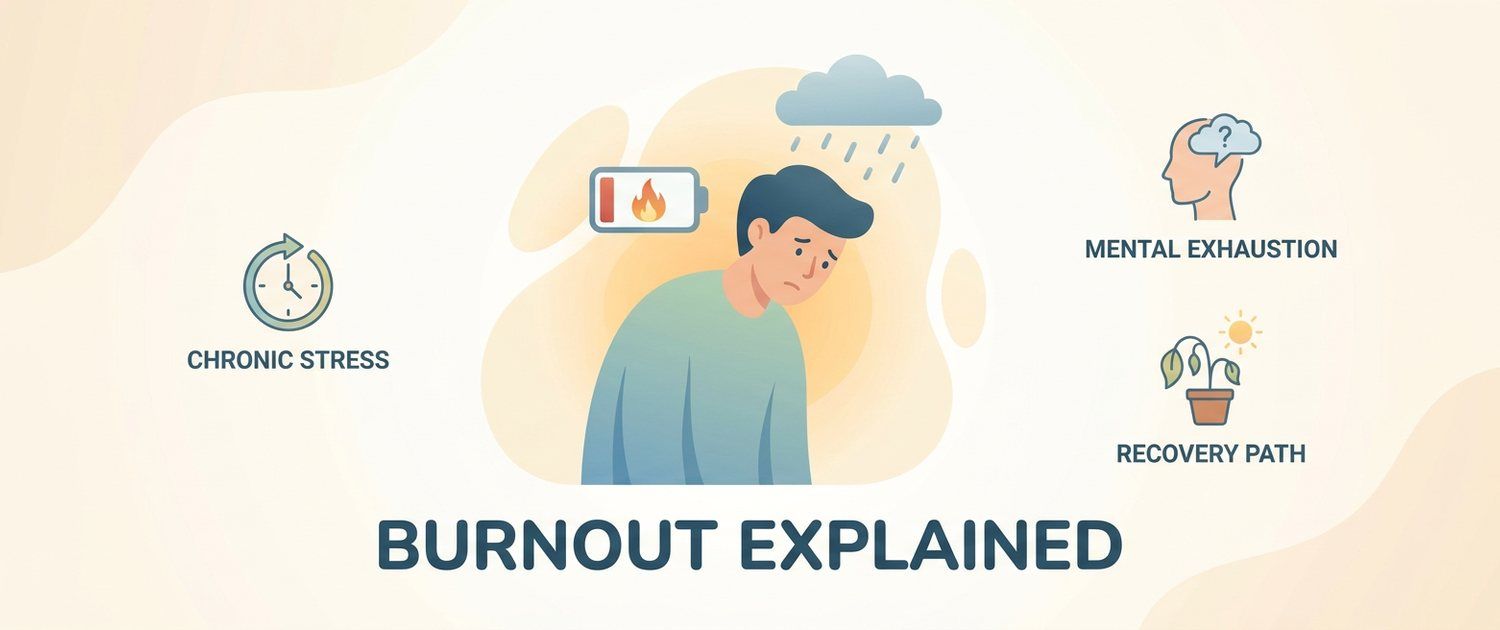
The word "burnout" is used so often that it has lost its edge: it names a hard month, a reluctance to go to work on Monday, and a state in which a person cannot get out of bed. Yet it has a fairly precise description — and it is not built the way most people assume.
What burnout is in plain words
Put simply: the resource has run out, and rest has stopped bringing it back. Not "tired" but "tired and not recovering". The person keeps doing their work, but every action costs more than it did a year ago, and the result brings no pleasure.
The World Health Organization puts it more strictly: it is a syndrome resulting from chronic workplace stress that has not been successfully managed. The key phrase is "not been successfully managed": burnout describes not the load itself but the outcome of a long struggle with it.
Three dimensions: what it is made of
In the WHO definition burnout breaks into three parts, and these are not shades of one thing:
| Dimension | How it feels from inside |
|---|---|
| Exhaustion | No energy from the morning, rest does not restore, the body joins in: sleep, head, back |
| Mental distance | A smirk instead of interest, "what does it matter", autopilot, counting hours |
| Reduced effectiveness | A sense that effort disappears and you do worse than you used to |
You can check this on yourself in more than one way. The fastest is the short burnout test of six questions: it gives a single level from 0 to 100. What stands behind each dimension is unpacked in the article on the signs of burnout.
Why it is not an illness
Burnout entered the eleventh revision of the International Classification of Diseases, and many read that as "the WHO has recognised burnout as a disease". The truth is the opposite: it sits in the chapter of factors influencing health status — the section listing reasons for contacting health services that are not themselves illnesses. The classification says so explicitly.
Two consequences follow, and they matter more than they seem. First: there is no diagnosis called burnout, and nobody — no test and no clinician — can give one. Second: there are no diagnostic criteria either. A review covering more than fifteen thousand publications states that concrete criteria for categorising burnout as a disorder under DSM or ICD standards do not exist to this day, and that the literature holds over a hundred and forty definitions. The wording is unpacked in the article on burnout in ICD-11.
How burnout differs from tiredness
The most practical separator is not the intensity of the feeling but reversibility.
- Tiredness goes away after sleep and a weekend. The resource returns and you feel it.
- Burnout is the state where rest stopped working: the days off pass and by their end you are just as wrung out.
The second separator is distance. A tired person wants to rest and come back; a burnt-out one does not want to come back. That is why asking "am I very tired" is not enough: the fork is unpacked in the article on constant tiredness, and the states that sound similar are covered in the piece on nervous exhaustion and asthenia.
A separate trap is having no energy while the load is perfectly ordinary. What gets checked first in that case is in the article no energy for anything. And the state where it is not so much energy as desire that disappears is covered in the text on apathy.
Causes of burnout: why volume alone rarely explains it
"Too much work" is the most common explanation and the most incomplete. A meta-analysis of sixty-five longitudinal studies shows several sides of working life relate to exhaustion, and that fairness and reward act as protection rather than as a pleasant extra: where they are missing, the same load costs more.
More surprising still is a cross-country survey of fifteen thousand employees: the strongest predictor of burnout was not the volume of tasks but toxic behaviour nearby, by a wide margin over everything else. How to break this down into concrete areas is in the article on burnout at work.
It also matters that people burn out outside jobs. Formally the WHO classification limits the term to the occupational context, but the same picture forms wherever the load has no end of shift — that is the subject of the text on parental burnout.
Why burnout is dangerous and what to do about it
The danger is not the exhaustion itself but two other things. The first is cost: the quality of the work, relationships and health all suffer, and the longer it runs the more it takes. The second is substitution: the word "burnout" easily hides a state that needs a different approach. In roughly half of the people who called their state burnout, a mental disorder stands behind it or is mixed into it — which is why the fork with depression is unpacked separately in the article burnout or depression.
As for "how far along am I" — the popular twelve-stage schemes look convincing, but no phase model of burnout has been confirmed by research. Why that is so is unpacked in the text on the stages of burnout. And a holiday, contrary to expectation, helps reliably and wears off just as reliably — the subject of the article on why a holiday does not help.
Finally, the main practical step: start not with "look after yourself" but with the answer to the question what exactly is spending the resource. The levers with evidence behind them — sleep, genuine detachment from the work outside its hours, rest that restores, and changing specific conditions — are gathered in the article on how to come out of burnout.
How to look at your own picture
A single score says how bad it is but not what to do. The full burnout test scores two independent lines — your own state and what the environment around the work demands — and shows a point on a map that makes the next move visible. One case a single score hides: heavy exhaustion with a calm environment is a reason to look for the cause not in the work but in sleep, the body or mood.
That is exactly why the bodily side is worth a look too. Hypothyroidism (a shifted TSH), iron deficiency (low ferritin), a lack of vitamin B12 and vitamin D produce the very same picture — and, unlike burnout, they are fixable. What to check and in what order is in the article on blood tests for emotional burnout; results you already have the service will help you read in plain language.
This article is informational and does not diagnose. In the WHO classification burnout is not an illness, and what is happening to you is decided by a specialist, not by a text on the internet.
For informational purposes only
This article is for informational purposes only and does not constitute medical advice, diagnosis, or treatment. Please consult a healthcare professional for medical guidance.