The Stages of Burnout: Why They Do Not Actually Exist
Reviewed by the LabReadAI medical team
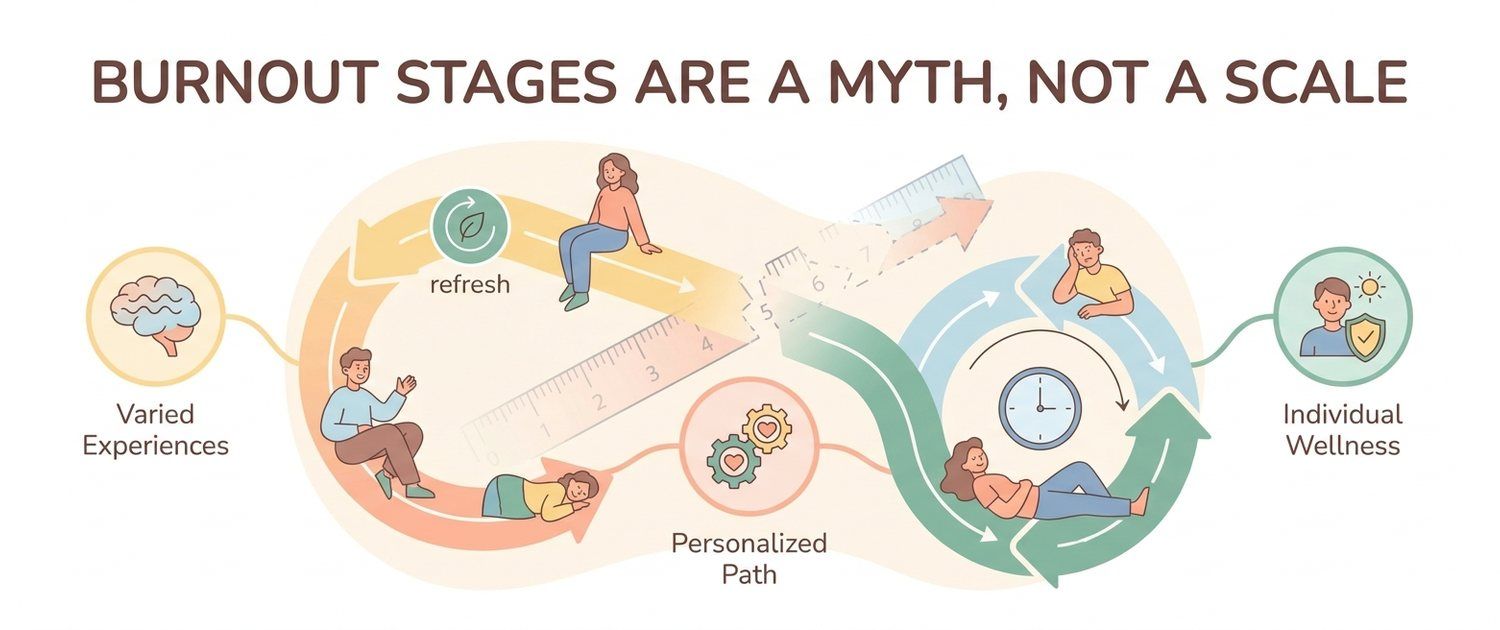
A search for "the stages of burnout" almost always means one thing: the person wants to know how far along they are. The honest answer is an uncomfortable one — no confirmed ladder exists. Schemes do exist, plenty of them, elegant and convincing, but not one has survived research scrutiny. Below: where they came from, what is genuinely useful in them, and what to replace the question "which stage am I at" with.
Where the stages came from
The notion of burnout was born in practitioners' observations in the 1970s: psychologists described what they saw in people working in the helping professions. Observation naturally takes the form of a story — first it was like this, then it became like that. Phase schemes grew out of that story.
The trouble is that a story and a model are different things. A model has to be checked: you must confirm that the steps come in the stated order, that they can be measured, and that a person can be placed on them. With burnout phases none of that ever happened. What actually stands behind the word is unpacked in the article on what burnout is.
The twelve stages: the Freudenberger and North model
The best-known scheme is attributed to Herbert Freudenberger and Gail North. It has twelve steps: a compulsion to prove oneself → working harder → neglecting one's own needs → displacing conflicts → revising values → denying emerging problems → withdrawal from contact → visible behavioural change → depersonalisation → inner emptiness → dejection → complete exhaustion.
It reads like a biography, and that is its strength: almost everyone recognises a couple of items. But the scheme has no questionnaire, no boundaries between steps and no studies in which people actually went through them in that order. Its authors never intended it as a diagnostic instrument.
Three-phase models and "levels"
A shorter version — tension, resistance, exhaustion — lives its own life in articles and slide decks, often with no source cited at all. The same three stages are sometimes served as "mild, moderate and severe levels".
That is no longer a model but a retelling of common sense: first it is hard, then it is harder. Such a scale adds nothing to the plain question "how bad is it right now" and manufactures a false sense of precision.
Why the stages do not exist
The wording is not ours. A review covering more than fifteen thousand scientific publications on burnout concludes that regular burnout processes do not exist: phase models have not been validated, and the stages themselves are almost nowhere operationalised — that is, never translated into measurable markers that would say where a person stands.
A deeper reason sits underneath. Burnout has no diagnostic criteria, and the scientific literature holds more than a hundred and forty definitions. Stages are steps of something definite; when the something is defined a hundred and forty ways, the ladder hangs in mid-air. How the official wording looks and why burnout is not counted as an illness is in the article on burnout in ICD-11.
What is wrong with the "final stage"
People search for the final stage of burnout regularly, and an understandable fear sits behind it: is there a point of no return? There is no answer in the form of a stage — and that is better news than it sounds.
Three things are wrong with the idea of a last step. First, it encourages waiting: as long as it is "not the last one", one can endure a bit more. Second, it attributes an inevitable downward movement to the state, which the data do not show. Third, behind the words "I have reached the edge" there often stands something that needs a different conversation: in a study of six hundred and twenty-two people who had labelled their own state burnout, 57% had a history of, or a concurrent, mental disorder. So the question "which stage is this" is less useful here than "what else is present besides tiredness" — and that one is worth answering with a specialist.
What to measure instead of a stage
The useful question is not "how far have I gone" but "what is happening and what does it depend on". In practice that is two separate quantities:
| What we measure | What it gives |
|---|---|
| State — exhaustion, distance from the work, sense of effectiveness | shows which of the three dimensions has dropped furthest |
| Environment — load, fairness, reward, relationships, autonomy | shows what exactly is spending the resource |
The breakdown into three dimensions with concrete wording is in the article on the signs of burnout. A meta-analysis of sixty-five longitudinal studies shows that on the environment side workload and work-family conflict relate to exhaustion, while fairness and reward act as protection. In fairness it should be said: most of those associations are weak, and no single lever exists.
What to do instead of hunting for your step
Start with a quick picture. The short burnout test gives one level from 0 to 100 in a minute — not a rung, just a mark for "how bad right now".
Then a fuller reading is more useful. The burnout test scores state and environment as two independent lines and shows a point on a map — one that reveals not "how much is left until the end" but where exactly to act. The bodily side deserves a separate check: exhaustion with a calm environment more often points not to the job but to sleep, the thyroid (TSH), iron (ferritin) or a lack of vitamin D — what to look at is unpacked in the article on blood tests for emotional burnout, and results you already have the service will help you read in plain language.
And the steps with evidence behind them — sleep, genuine detachment from the work outside its hours, rest that restores and changing specific conditions — are gathered in the article on how to come out of burnout. They are tied to no stage and work wherever the person is right now.
This article is informational and does not diagnose. In the WHO classification burnout is not an illness, and what is happening to you is decided by a specialist, not by a text on the internet.
For informational purposes only
This article is for informational purposes only and does not constitute medical advice, diagnosis, or treatment. Please consult a healthcare professional for medical guidance.