Signs of Burnout: How to Tell Them From Ordinary Tiredness
Reviewed by the LabReadAI medical team
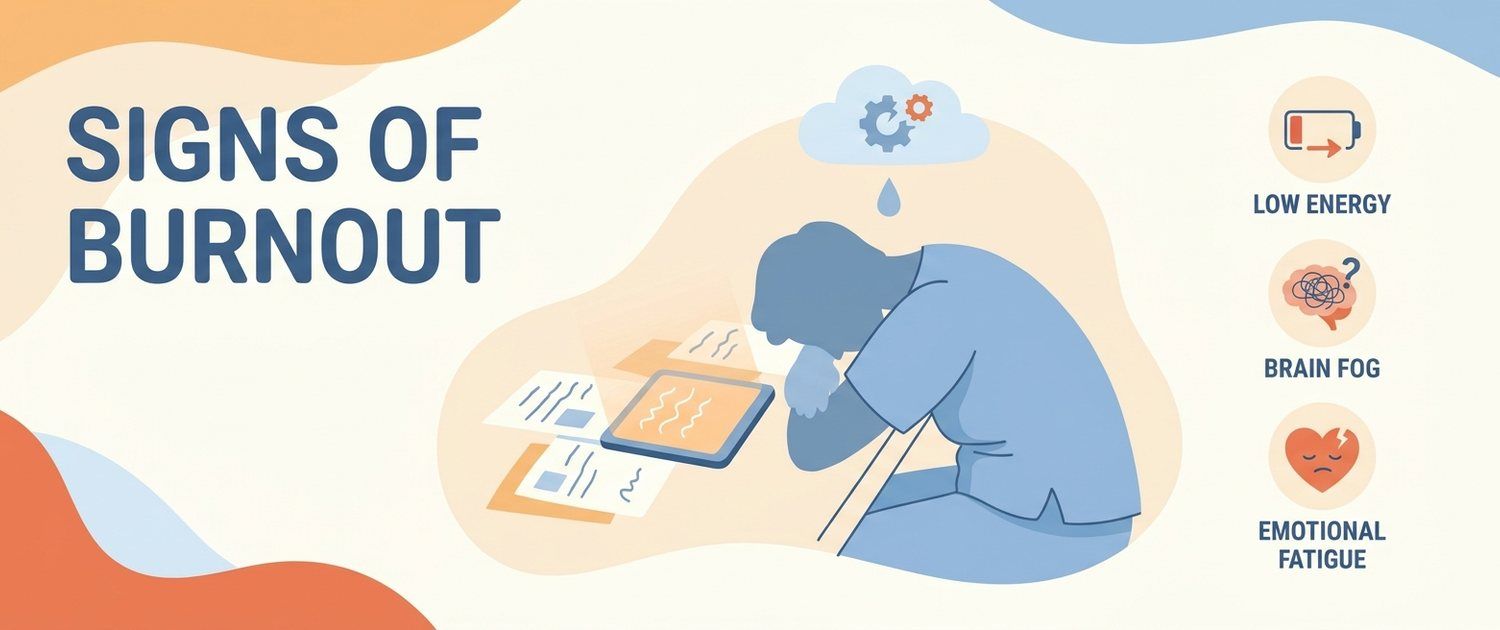
The word "signs" usually drags a twenty-item list behind it, and everyone finds themselves in such a list. With burnout that gets in the way: irritability, poor sleep and reluctance to go to work come from a dozen different causes. It is more useful to sort the signs into the three dimensions burnout is made of in the WHO definition — and to see whether all three add up at once.
What counts as a sign of burnout
The World Health Organization describes burnout as a syndrome resulting from chronic workplace stress that has not been successfully managed, and names three dimensions: exhaustion, growing mental distance from one's work or cynicism towards it, and a sense of reduced professional effectiveness. The general frame is unpacked in the article on what burnout is.
One caveat before anything else. Burnout has no diagnostic criteria: a review covering more than fifteen thousand publications states that the literature holds over a hundred and forty definitions, and that criteria for categorising it as a disorder do not exist. So no list of signs — this one included — delivers a verdict. It exists to name what is happening more precisely and to show what is missing.
Exhaustion: the first dimension
This is not "tired by the evening" but a background that holds for weeks. How it shows up:
- The morning starts tired: there was sleep, there was no recovery.
- Simple tasks need a run-up — answering an email costs what a meeting used to cost.
- Irritation arrives faster and from less, and by the end of the day there is no patience left at all.
- The head runs slower: words go missing, attention slides off, mistakes return that had not happened in years.
- The body joins in: broken sleep, a heavy head, back, stomach, frequent colds.
If only this dimension is clear out of the three, look wider than the job. States where exhaustion comes first and is not tied to work are unpacked in the piece on nervous exhaustion, and the situation of having no energy while the load is perfectly ordinary is in the article no energy for anything.
Mental distance and cynicism: the second dimension
This is the most recognisable part and the most unpleasant to notice in yourself. Work that used to be yours moves an arm's length away.
- Interest gives way to a smirk: "what does it matter", "nothing will change anyway".
- Counting starts — hours until the end of the day, days until Friday, weeks until the holiday.
- People turn into tasks: colleagues, clients and patients start to irritate by the mere fact of asking.
- The work gets done on autopilot, with no inner participation, and it shows in the quality of small things.
This dimension depends on the environment far more than on character. How to break the environment down into concrete areas — load, fairness, reward, relationships — is in the article on burnout at work.
Reduced effectiveness: the third dimension
The third part is the sense that effort disappears into nothing. The person does the same things, the result feels worse, and they are the first to notice.
- Tasks that took an hour stretch across a day.
- Doubt about one's own competence grows, while objectively nothing has changed.
- Everything requiring a decision gets postponed: ten small things are easier than one important one.
- The thought "I no longer cope with this job" appears, though the job is being done by the same person as before.
The main marker: rest stopped restoring
If one line has to survive from this whole text, it is this one. Ordinary tiredness is reversible: sleep and a weekend bring the resource back and you feel it. Burnout is the state where that mechanism stopped firing.
| What to look at | Ordinary tiredness | Looks like burnout |
|---|---|---|
| After the weekend | noticeably lighter | Sunday evening is just as heavy |
| Attitude to the work | want to rest and return | do not want to return |
| Reach | energy drops | energy, interest and confidence drop together |
| Duration | days and weeks | months |
A holiday is a story of its own here. It almost always helps and almost always wears off within a few weeks, because it changes not the conditions but only the pause inside them.
How burnout shows up in the body
The bodily part is real, but it is not specific: the same set comes from states that have nothing to do with work. Hypothyroidism (a shifted TSH), iron deficiency (low ferritin), a lack of vitamin B12 and vitamin D, sleep loss and apnoea produce exactly the same heavy head, the same irritability and the same absence of energy.
Hence the honest answer about the laboratory: no biomarker of burnout exists. A systematic review checked thirty-eight candidates, cortisol among them, and found none that worked. Blood tests here are not there to confirm anything but to rule out the imitators — states that are treatable and go away. What to check and in what order is in the article on blood tests for emotional burnout; results you already have the service will help you read in plain language.
Signs of burnout in women and in men
No separate "female burnout" with its own set of symptoms has been described. The difference lies elsewhere: in a survey of three thousand working Russians, 61% of women reported having met burnout against 54% of men, and among people with higher education the figure was 69%. That is a difference in how often the state gets named and in what conditions people work, not in how the state is built. In men the signs are the same three dimensions, and the one that usually shows first is the second — cynicism and distance.
Early signs, and what this list will not tell you
The early signs of burnout are almost always dull: anticipation disappeared, Sunday evening became worse than Monday, things that used to be enjoyable outside work stopped appealing. A dramatic beginning is rare.
For exactly that reason there is no "step" to place yourself on. The popular twelve-stage schemes look convincing, but no phase model has been confirmed by research — why that is so is unpacked in the article on the stages of burnout.
And a second line this list does not draw: burnout and depression share a great deal of territory, and by symptoms they are in places indistinguishable. A text on the internet does not tell one from the other and does not rule the second one out — the fork is handled honestly in the article burnout or depression.
What to do with this set
A quick orientation comes from the short burnout test of six questions: one level from 0 to 100 in a minute. It says how bad things are; it does not say what to do about it.
The full burnout test scores two independent lines — your own state and what the environment around the work demands — and shows a point on a map from which the next move is visible. One case a single score hides: heavy exhaustion with a calm environment is a reason to look for the cause not in the job but in sleep, the body or mood.
After that the conversation stops being about signs and becomes one about levers: what exactly is spending the resource and what of that can be changed. It is gathered in the article on how to come out of burnout.
This article is informational and does not diagnose. In the WHO classification burnout is not an illness, and what is happening to you is decided by a specialist, not by a text on the internet.
For informational purposes only
This article is for informational purposes only and does not constitute medical advice, diagnosis, or treatment. Please consult a healthcare professional for medical guidance.