Burnout or Depression: Where the Real Difference Lies
Reviewed by the LabReadAI medical team
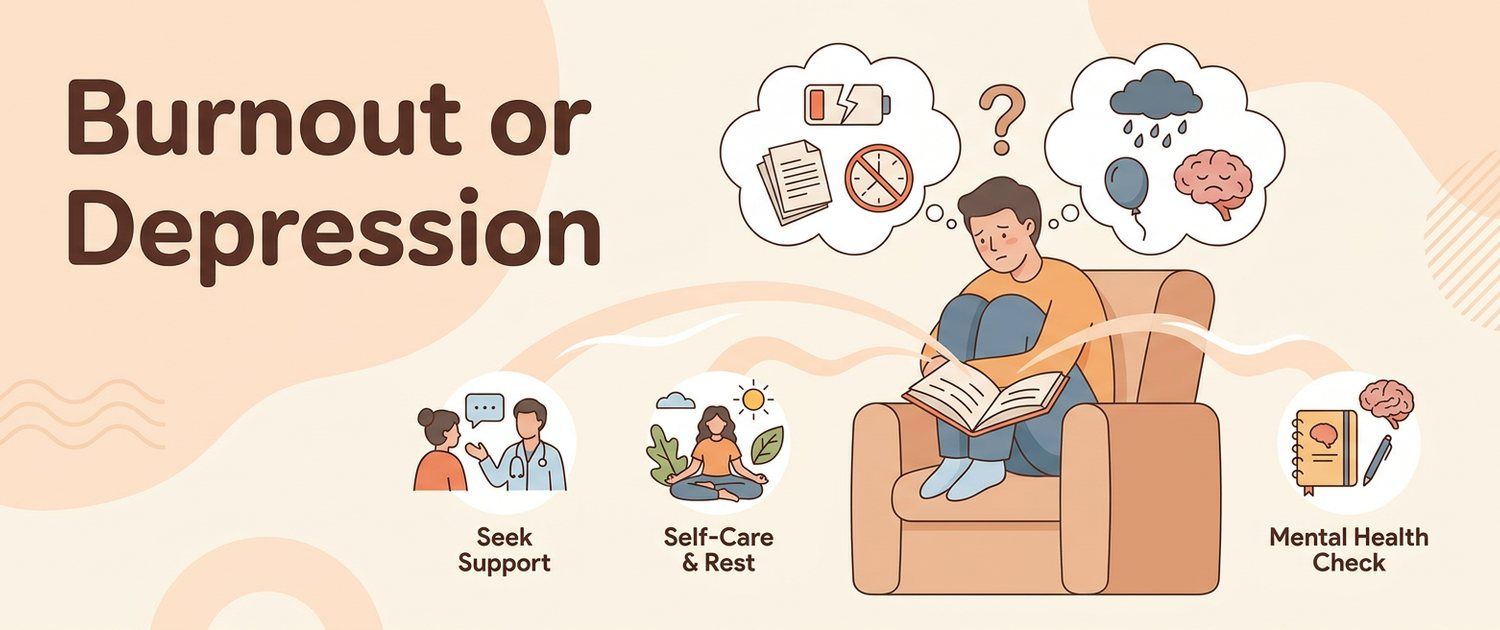
This is the most common question around burnout and the only one whose honest answer starts with "unknown". Not because the topic is hard, but because the line has not been drawn — not by the reader, by science. Below: what is known for certain, which marker works in practice, and the point at which self-observation should stop.
Why this question is so hard to close
Burnout is not an illness and not a diagnosis: the WHO describes it as a state arising from chronic workplace stress and files it under factors influencing health. Depression is a diagnosis with criteria, made by a clinician. Already that shows two things of different orders being compared: one is described, the other defined. The general frame of the first is in the article on what burnout is.
It gets worse: burnout has no diagnostic criteria at all, and the literature holds over a hundred and forty definitions. Comparing a state without criteria against a diagnosis with criteria is a shaky operation, and every figure below should be read with that correction in mind.
What the numbers show
Research is not silent — it says different things, and both sides are worth knowing.
- A meta-analysis comparing the constructs directly puts burnout's correlation with depression at r = .52 and with anxiety at r = .46, and concludes that these are different constructs sharing features.
- A study on a sample of 12,417 people, correcting for measurement error, found exhaustion and depression correlated at r = .80 and concluded there is no syndromal unity to burnout.
Put simply: in one reading these are two circles with a large overlap, in another almost a single circle. Formally the classification separates them completely: mood disorders are explicitly excluded from the burnout category QD85, and if the picture fits them, depression is what gets coded. What the classification actually says is in the article on burnout in ICD-11.
The practical marker: attachment to the work
The one marker that holds up in both clinical practice and common sense is attachment to context.
Burnout grows around a specific activity. It is about the job — or about caring for another person, a load with no end of shift — and away from that activity it usually eases: a holiday lightens it, weekends quieten it, a conversation about something else brings the person back to life. What this looks like area by area is in the article on burnout at work.
Depression does not work that way. It is not tied to a source and does not lift with a change of scenery: pleasure disappears where it used to be too — with people you love, in food, in music, in rest. Which is why the observation "the holiday helped, and two weeks after coming back it was all the same" separates nothing — holidays help and wear off for nearly everyone, the subject of the article on why a holiday does not help.
This has to be said plainly: the marker is not a test and not a criterion. It helps you phrase the question, not answer it.
What diverges and what does not
| What to look at | More like burnout | More like depression |
|---|---|---|
| Attachment | to the work and the load | to nothing in particular |
| Away from the work | noticeably lighter | unchanged |
| What happened to pleasure | gone at work, intact outside it | gone everywhere, including old favourites |
| Attitude to oneself | "I no longer cope with this job" | "I am bad in myself" |
| Exhaustion | present in both | present in both |
| Disturbed sleep | present in both | present in both |
| Irritability | present in both | present in both |
The bottom three rows matter more than the top ones: the most visible symptoms are shared. Nobody separates the two by those — no person and no text. The three dimensions of burnout are unpacked separately in the article on the signs of burnout.
"Masked depression": what sits behind the phrase
The phrase usually names a state where what comes first is not sadness or tears but the body: insomnia, heaviness, aches, no energy, a cotton-wool head. The person may well conclude that they are simply tired or burnt out, and look for the cause in the workload.
The data justify caution here. In a study of 622 people who had labelled their own state burnout, 57% had a history of a mental disorder or a concurrent one. That does not mean burnout "is always depression"; it means the self-label "I have burnout" closes the question too early.
A bodily mask is also a reason to look at the body literally: hypothyroidism (a shifted TSH), iron deficiency (low ferritin), a lack of vitamin B12 and vitamin D produce the same picture. States where bodily exhaustion comes first are unpacked in the article on nervous exhaustion.
Apathy or depression: what the difference is
Apathy is a symptom, not a diagnosis: what disappears is not energy but wanting — the impulse to start anything. It occurs in burnout, in depression, and in states with nothing psychological about them.
The difference between apathy and depression is not intensity but reach and company. Apathy in burnout is usually selective: it is this particular work you do not want, while outside it the wanting survives. Depression brings apathy together with other things — persistently low mood, self-blame, changes in sleep and appetite — and all of it holds for weeks on end. The symptom itself is unpacked in the article on apathy, and the state where the absence of energy comes first in no energy for anything.
How to tell depression from tiredness
Tiredness is reversible: sleep and a weekend bring the resource back and you feel it. If recovery has stopped working, the question is no longer "am I tired" but "what is blocking recovery" — and there are three forks here at once: burnout, depression and a bodily cause. One sensation does not separate them; how the tiredness fork is built is unpacked in the article on constant tiredness.
Burnout and anxiety
The third participant, usually forgotten. In the same meta-analysis burnout correlated with anxiety at r = .46 — lower than with depression, but far from nothing. Anxiety and fear-related disorders and adjustment disorder are likewise explicitly excluded from QD85.
In practice anxiety and burnout often travel together and feed each other: exhaustion lowers the capacity to cope, anxiety blocks recovery, and the circle closes. The short GAD-7 scale gives an orientation along that line in a minute.
What questionnaires can and cannot do
Without softening it: a questionnaire does not rule out depression. It makes no diagnosis, tells no state from another and replaces no appointment. All it does is turn a vague sensation into a number and a structure that are easier to think and speak with.
In that role scales are useful. The short burnout test gives one level from 0 to 100 across six questions. PHQ-9 is the standard screening scale for depressive symptoms, GAD-7 for anxious ones. Three marks side by side say more than one, but none of them is a conclusion.
The full burnout test adds something else to a score: it computes your state and the demands of the environment as two independent lines. The practical value sits in the gap between them — heavy exhaustion with a calm environment is precisely the case where the cause is worth looking for outside the job.
Where to go from here
One marker matters more than every table above. If pleasure is gone everywhere — not on holiday, not with the people you love, not in what you always enjoyed — then the question "is this burnout or not" stops being the main one. That is a reason to see a specialist, and the earlier the shorter the road. The same holds for thoughts about life being pointless or about harming yourself: self-observation is the wrong tool there, help is the right one.
If it does come down to load and conditions, the things that work are dull and checkable: sleep, genuine detachment from the work outside its hours, rest that restores, changing specific conditions. They are gathered in the article on how to come out of burnout. In parallel it is worth closing off the bodily versions — what to check and in what order is in the article on blood tests for emotional burnout; results you already have the service will help you read in plain language.
This article is informational and does not diagnose. It does not tell burnout from depression and does not rule depression out — only a specialist, in person, can do that.
For informational purposes only
This article is for informational purposes only and does not constitute medical advice, diagnosis, or treatment. Please consult a healthcare professional for medical guidance.