Why a Holiday Does Not Fix Burnout and What Actually Helps
Reviewed by the LabReadAI medical team
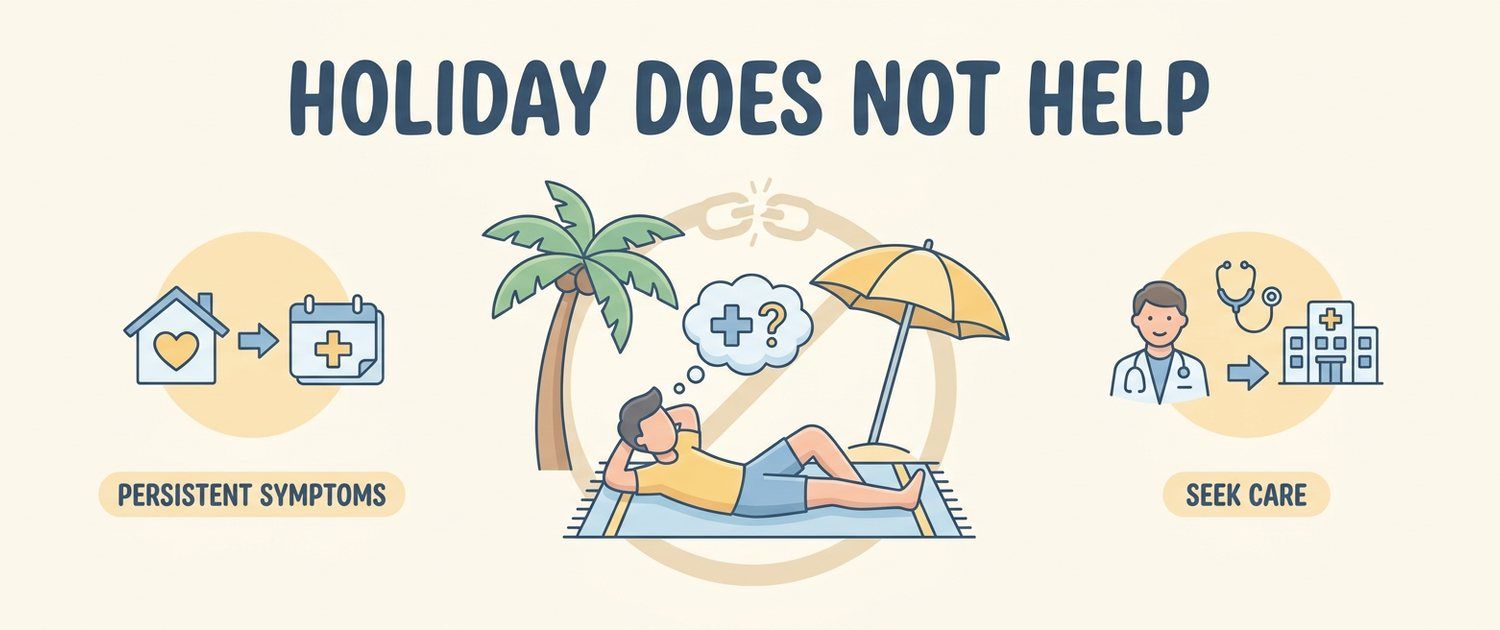
The expectation is almost universal: once I get to my holiday, everything will settle. A week or two after coming back the person finds themselves exactly where they left off and concludes "so something is wrong with me". In fact that is how holidays work, not how you are broken.
A holiday does help — and it has been measured
Start with the honest part: holidays work. A meta-analysis of vacation studies shows that during a holiday and immediately after it, well-being, health complaints and energy genuinely improve. This is not novelty and not self-persuasion.
Then the unpleasant part begins. The same meta-analysis shows that the effect fades fast — about a week after returning to work the measures no longer differ from the pre-holiday level. And a second finding ruins the most popular plan: a longer holiday gives no stronger effect than a short one. Breaks longer than two weeks did not beat four or five days.
Hence the practical conclusion that carries the whole article: breaks are necessary, but planning your recovery only around a holiday makes no sense.
Why a holiday does not fix burnout
A holiday pauses the spending and leaves untouched the thing that spends. You return to the same load, the same people and the same conditions — and therefore to the same bill at the end of the day. A state the WHO describes as the result of chronic workplace stress that was not successfully managed is not cancelled by two weeks by the sea; the frame is unpacked in the article on what burnout is.
Three familiar things pile on top:
- The sprint before. Two weeks of work squeezed into one, so the person boards the plane already empty and spends the first days just sleeping.
- The pile after. Accumulated mail and shifted deadlines eat the gain within the first week back.
- A holiday that was not rest. Flights, an unfamiliar city, the work chat kept on the phone "just in case" — the spending never stopped, it only changed shape.
A separate fork is when the holiday did not lighten a single day. Tiredness that did not shift at all is closer not to overload but to a state where rest stopped restoring at all; that scenario is the subject of the article on constant tiredness.
What works instead of a holiday
Recovery is studied not only through holidays but through what people do on ordinary evenings and weekends. A large meta-analysis of these "recovery experiences" — hundreds of studies and nearly a hundred thousand participants — gives a fairly clear picture.
| Recovery experience | What it looks like in practice | What stands behind it |
|---|---|---|
| Detachment | Outside work hours the head is not occupied with work | Linked to less exhaustion and less work–family conflict |
| Relaxation | A state with no task and no assessment: a walk, music, quiet | Linked to well-being |
| Mastery | Something for yourself where you grow: a language, an instrument, sport | Linked to engagement and well-being |
| Control | Being the one who decides how a free hour is spent | Keeps the sense that the life is yours |
The key difference from a holiday: all of this is available often and in small amounts — so it does not fade in a week, because it repeats every week.
Psychological detachment is the main lever
The most studied of the four is psychological detachment from work: not "not working physically" but not being mentally occupied by work. A person can sit on the sofa all evening replaying a conversation with their manager — the body is not at work, but the head is not at home either.
What helps in practice:
- A boundary instead of willpower. Not "I will try not to think about it" but a concrete line: work notifications go off at a set hour.
- A transition ritual. A walk home, a shower, changing clothes — any action that separates one part of the day from another.
- Unloading the unfinished. A written list of what is still open, made before the day ends, removes part of the night-time replaying.
If the head will not let go because of the environment — constant urgency, no influence, the relationships around you — the place to start is the conditions themselves, unpacked area by area in the article on burnout at work.
How to rest properly: often and in small doses
"I will hold out until the holiday" loses not because holidays are bad but because the whole bet rides on one event a year. A resourced state is held by something else — regularity:
- Short pauses during the day — a few minutes with no screen and no task, rather than a "break" spent scrolling.
- One free evening protected like a meeting. Not "if time is left over" but in the calendar.
- A weekend with one real thing for yourself. One beats a list of six, which turns into load of its own.
- Shorter but more frequent holidays instead of one long one, when the choice is yours: the data show no advantage for length.
Sleep: the recovery nothing replaces
At night the nervous system does work that cannot be moved to the weekend. While sleep is broken, every rest technique runs at half power — and this is the one place where "fix this first" is meant literally.
In practice that means a roughly fixed wake-up time, limits on screens and work conversations before bed, and — if trouble falling asleep or night waking has lasted weeks — treating insomnia as a problem in its own right rather than a side effect. What can stand behind it and what gets checked first is in the article on the causes of insomnia.
"I cannot rest" — when rest does not land
A common complaint sounds like this: there is time, but resting does not happen. Usually one of three things sits behind it.
First, guilt. Rest is treated as something to be earned, so it spoils from the inside. Second, speed. After months in urgency mode a calm activity feels empty, and the person reaches for fast stimulation rather than recovery. Third, emptiness instead of tiredness: not «no energy to rest» but «nothing appeals». That is no longer about a spent resource, and no rest schedule settles it.
How to get energy back in that state is not a matter of one technique: the levers with evidence behind them and an honest order of steps are gathered in the article on how to come out of burnout.
When rest is not the issue
There is a picture in which neither a holiday nor pauses move anything for months: neither energy, nor interest, nor pleasure in what used to please returns. That does not mean you rest badly — it means "just tired" has stopped explaining what is happening. The fork with depression is unpacked separately in the article burnout or depression; the article does not settle it — a specialist does.
The second version is bodily. Hypothyroidism (a shifted TSH), iron deficiency (low ferritin), a lack of vitamin B12 and vitamin D produce exactly the same picture: I do not recover whatever I do. What is worth checking and in what order is in the article on blood tests for emotional burnout; results you already have the service will help you read in plain language.
How to look at your own picture
Before rebuilding your rest, it helps to know what is spending the resource. A quick orientation comes from the short burnout test — six questions and one level from 0 to 100. The full burnout test scores two lines apart: your own state and what the environment around the work demands. That split answers the question of this article — if the demands are high, no technique will restore you between holidays until the environment itself changes.
This article is informational and does not diagnose. In the WHO classification burnout is not an illness, and what is happening to you is decided by a specialist, not by a text on the internet.
For informational purposes only
This article is for informational purposes only and does not constitute medical advice, diagnosis, or treatment. Please consult a healthcare professional for medical guidance.