Constant Tiredness and Sleepiness: Causes and What to Do
Reviewed by the LabReadAI medical team
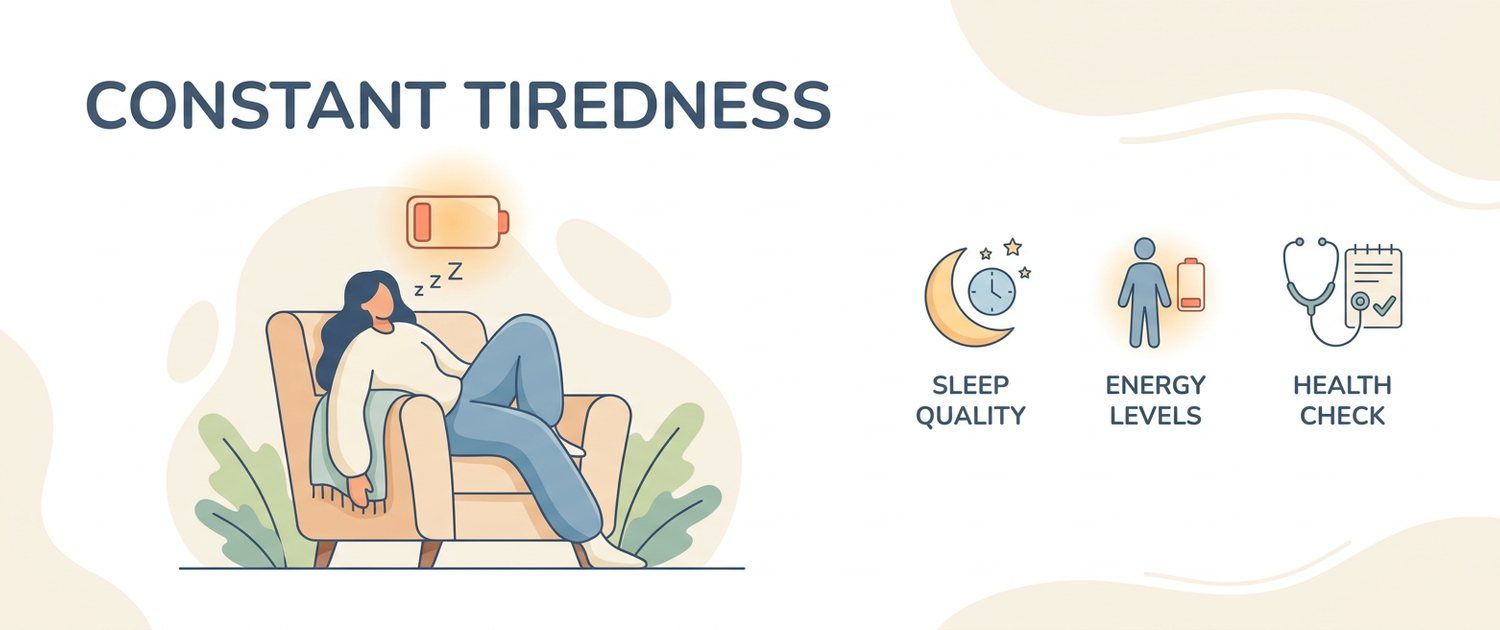
Rest is a dependable thing: after sleep and a weekend the strength comes back, and you feel it. Constant tiredness is what happens when that stops being true. Until one day it does not. A person sleeps, takes days off, goes away — and comes back just as wrung out. That is the point where "I'm tired" stops being a description and becomes a question that needs answering.
The line runs along reversibility
The most practical separator is not how strong the feeling is but whether the resource returns.
- Tiredness is reversible. After sleep, days off, a pause, you feel it ease. The body answers rest.
- What is no longer tiredness does not answer rest. The sleep happened, the weekend happened, and Monday morning feels the same.
The second marker is accumulation, and it is what makes tiredness constant rather than occasional. Ordinary tiredness is tied to an event: a hard week, a flight, a renovation. Constant tiredness stops being tied to anything: it is simply always there, and "what happened, though?" has no answer.
From here the road forks. If rest is not working, there are exactly two options: either the rest is not real, or the cause is not the load. The first is more common than people think — why rest that looks like rest returns nothing is unpacked in the article on why a holiday does not help.
Constant tiredness and sleepiness are different complaints
They get named in one breath and investigated differently. The distinction is simple: does sleep pull at you.
| Sleepiness | Tiredness | |
|---|---|---|
| What happens | eyes close, you doze off in a quiet room | no pull to sleep, but nothing has any fuel behind it |
| Does sleep help | yes — given a proper night, things improve | no — after sleep it is much the same |
| Where to look first | sleep itself: duration, schedule, apnoea | body, mood, load |
If the picture sits in the left column, the conversation is about sleep: debt, a drifting schedule, night awakenings, snoring with pauses in breathing. Sleep apnoea is confirmed by a study, not by a description, and it is worth mentioning in plain words. Treating "tiredness" while unrecognised apnoea is in the way leads nowhere. What stands behind poor sleep is in the article on the causes of insomnia and what to test.
Easily fatigued: when the fuel lasts an hour
A separate wording with a picture of its own. Being easily fatigued is not "no strength in the morning" but "the strength runs out suspiciously fast": half an hour of work, a short flight of stairs, one conversation — and the tank is empty.
Increased fatigability with falling tolerance for a familiar load is worth telling a doctor about separately, especially if it is growing. Its causes are both bodily and psychological, and some of them are visible in ordinary blood work.
"Chronic fatigue syndrome" is not a synonym for "I'm always tired"
Precision matters here, because the phrase gets used far too broadly. Myalgic encephalomyelitis (also known as chronic fatigue syndrome, ME/CFS) is a distinct condition rather than a severe degree of tiredness, and it is recognised by a clinician.
Its hallmark is worsening after exertion — post-exertional malaise: the state deteriorates not during the effort but after it, often with a delay of hours, and in 84% of people it lasts a day or longer. The exertion can be entirely domestic — a trip to the shop, an hour of conversation, a film.
Two clarifications matter. First, that kind of crash is not characteristic of psychiatric conditions — one of the reasons it is singled out. Second, suspecting is not diagnosing. The symptoms are non-specific, nothing can be settled from them alone, and the diagnosis is clinical and made after other causes are excluded.
The practical takeaway is one line: if an ordinary effort leaves you worse the next day, say so to your doctor in explicit words. That sign is easily lost inside a general "I'm tired".
What gets checked when tiredness has lasted for months
The order is almost always the same — from what a test settles to what a specialist discusses:
- Sleep — amount, quality, schedule, snoring with pauses in breathing.
- The body — thyroid (TSH), iron stores (ferritin with a full blood count), vitamin B12, vitamin D. A detailed walk-through is in the article on the causes of weakness and fatigue, and what is looked at after long overload is in the text on blood tests for emotional burnout.
- Mood — a lowered baseline, loss of pleasure, guilt. The fork is unpacked in burnout or depression; neither a text nor a questionnaire settles it.
- Load and environment — how much is demanded and what comes back in return.
One thing people search for deserves saying plainly: no laboratory test can show burnout. A systematic review of thirty-eight biological markers, cortisol included, found none fit for the purpose. Blood work is there for the opposite job — ruling out states that give the same picture and can be treated. Results you already have the service will help you read in plain language.
When tiredness is tied to the work and when it is not
If the strength is missing specifically for the job while everything else somehow finds fuel, the picture is closer to the description of burnout: exhaustion joined by mental distance and a sense of falling effectiveness. What that state is and why it is not an illness is in the article on what burnout is.
If instead the flatness is even and picks no favourites, "it's the job" gets weaker as an explanation. Then it pays to walk the list of causes in order — gathered in the article no energy for anything. And if what disappeared is less the energy than the desire and the joy, the conversation is about apathy, which is a different list.
There is a third case too — the words used for this state in everyday speech and in medicine: "nervous exhaustion", asthenia, neurasthenia. What stands behind them and where the borders run is unpacked in the text on nervous exhaustion and asthenia.
What to do about chronic tiredness
While the cause is still unknown, some things have evidence behind them, do not interfere with the search, and make life easier.
- Sleep first. A steady wake-up time matters more than a perfect bedtime.
- Real detachment from the work outside its hours. A meta-analysis of recovery experiences — over three hundred studies, nearly a hundred thousand people — links psychological detachment with less exhaustion, along with relaxation and activities that give a sense of mastering something new.
- Load matched to strength, not to ambition. If an effort leaves you worse the next day, pushing the pace regardless is a poor idea; that is a case to plan with a doctor.
- One demand removed instead of ten intentions.
What not to do: prescribe yourself anything for alertness, or explain it all by character. A full walk-through of the steps that have grounds behind them is in the article on how to come out of burnout.
See a doctor without delay if weight is dropping, if fever, swollen lymph nodes, breathlessness or chest pain have appeared, or if the tiredness has been growing for weeks and interferes with ordinary tasks.
How to look at your own picture
A quick orientation comes from the short burnout test — six questions and one level from 0 to 100. It diagnoses nothing and rules nothing out.
After that it helps to split the picture in two. The full burnout test scores your own state and the demands of the environment around the work separately. The combination "heavy inside, calm outside" is exactly the signal to look for the cause not in the load but in sleep, the body or mood.
This article is informational and does not diagnose. What is happening to you is determined by a doctor, not by a text on the internet.
For informational purposes only
This article is for informational purposes only and does not constitute medical advice, diagnosis, or treatment. Please consult a healthcare professional for medical guidance.