No Energy for Anything: the Causes and Where to Get Energy
Reviewed by the LabReadAI medical team
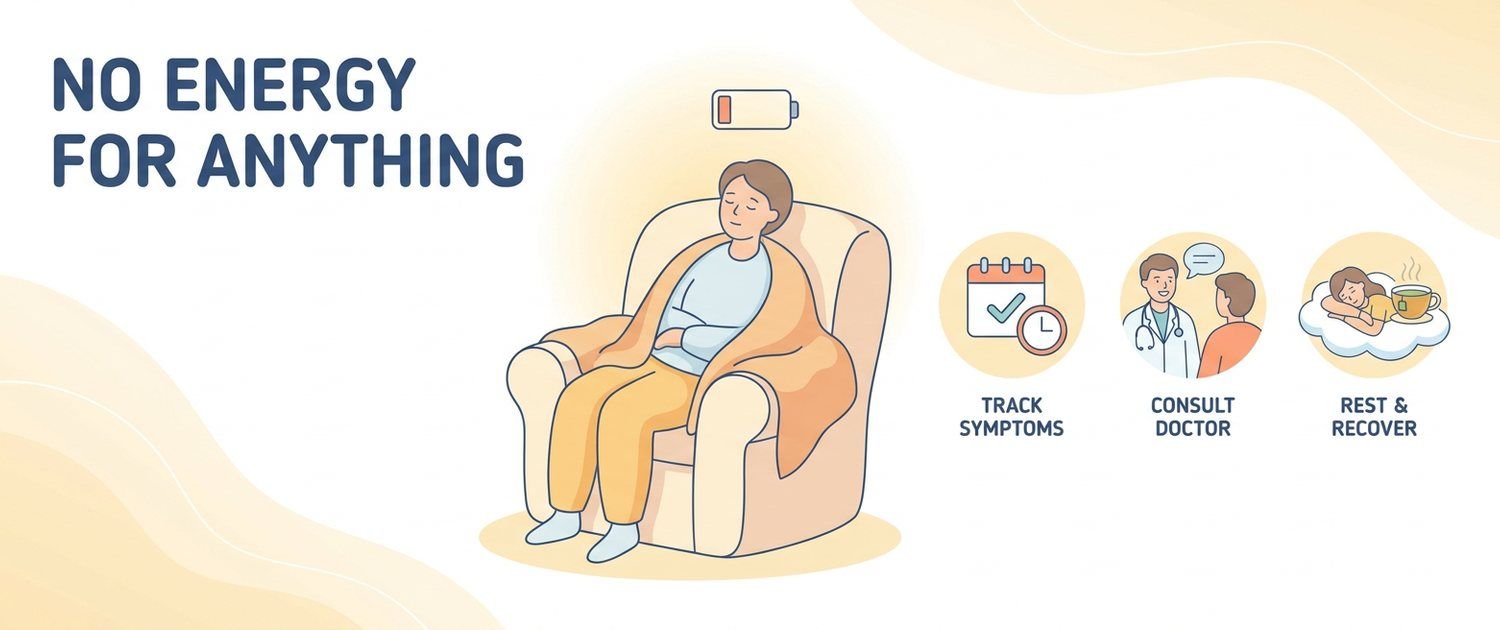
You wake up already tired, the resource runs out by lunch, and in the evening there is nothing left for the people close to you or for yourself. Usually this gets explained with one word — "busy" — and the thinking stops there. Too early: the state has a short list of checkable causes, and half of them show up in an ordinary blood panel.
"No energy" is a symptom, not a diagnosis
A loss of energy is a complaint, not an illness. It means one thing: the body or the mind is short of something. What exactly is a separate question, and the answer is rarely single — usually two or three factors stack up, each tolerable on its own.
A practical consequence follows. Asking yourself "why do I have no energy" in general is useless; walking the list in order is not, from the most common and fixable to the most complex. That order is what this article is about.
One more distinction, without which it is easy to get lost. "No energy" and "I don't want anything" are different complaints. In the first the desire is there and the fuel is not. In the second the desire itself disappears — the subject of the separate text on apathy. They get confused constantly, though their cause lists only partly overlap.
First: sleep — why it tops the list of causes
Sleep is checked before anything else, because it is the most frequent culprit and the easiest to fix.
Three things matter more than the hour count:
- Is there enough of it. An hour of debt a night accumulates, and a month later it looks like "low energy for no reason".
- Is it any good. Waking wrecked after eight hours is a signal in itself. Snoring with pauses in breathing, night awakenings, morning headaches — worth telling a doctor about: sleep apnoea is confirmed by a study, not by a guess.
- Is it regular. A drifting bedtime costs more energy than people expect.
Insomnia deserves its own line: it does not merely accompany exhaustion, it holds it in place. In studies of emotional exhaustion insomnia roughly tripled the odds that the exhaustion would persist, and in internet-CBT work sleep turned out to be the link through which improvement arrived. What stands behind poor sleep is in the article on the causes of insomnia and what to test.
Second: the body — blood work behind weakness and low energy
Here self-observation ends and numbers begin. Weakness with no energy is a typical picture for several states at once, each confirmed or removed by a test rather than by a conversation:
| What is checked | With what | Why it is on the list |
|---|---|---|
| Thyroid | TSH, free T4 if it is off | a slowed metabolism brings sluggishness, feeling cold, a heavy head |
| Iron stores | ferritin and a full blood count | low iron drains you before haemoglobin ever falls |
| Vitamin B12 | B12 | deficiency brings weakness, brain fog, tingling in hands and feet |
| Vitamin D | vitamin D | low values often travel with muscle weakness and feeling wrecked |
This is not "test everything": the list is short and reasoned. A detailed walk-through of what to look at and in what order is in the articles on blood tests for emotional burnout and the causes of weakness and fatigue. Results you already have the service will help you read in plain language, showing what stands out and what deserves a conversation with a doctor.
An important caveat. No laboratory test can show burnout: a systematic review of thirty-eight biological markers — cortisol included — found not one fit for the purpose. Blood work here serves the opposite job: ruling out what produces the same picture and can be treated.
Third: mood — when motivation and energy drop together
Energy is not only a bodily matter. With lowered mood the shortage is literal: harder to start, harder to sustain, harder to enjoy what got done. Honesty is required here, because "I'm just tired" is the most convenient explanation available.
A simple marker: if low energy has been joined by dejection, guilt and a loss of pleasure, and this holds almost every day for more than two weeks, writing it off to workload is not safe. The fork is unpacked in burnout or depression. Neither a text nor a questionnaire tells one from the other or rules either out — a clinician does.
Fourth: load and environment — no strength to work
Only now, the job. Not because it is innocent, but because the first three points are faster to check and explain the picture more often than people expect.
When the cause really is the work, the state has recognisable features: no strength for that particular work while energy for everything else is somehow found; growing mental distance and irritation; a sense that effort disappears. This is what gets described as burnout — the definition and the limits of the term are in the article on what burnout is, and the concrete manifestations in the text on the signs of burnout.
The volume of tasks is rarely the whole story. In a survey of three thousand working Russians, 58% had met burnout and half of those changed jobs because of it — numbers that speak of conditions, not of laziness.
Loss of energy after work: drained under an ordinary load
This is the turn the whole article is built on, and it is the one most often skipped.
When a person is wrung out under a heavy load, everything adds up. But if the load is even, the holiday happened, and there is still no energy for anything, then "I just work a lot" stops explaining the picture. That is exactly when it pays to go back to the first three points: sleep, body, mood. Weakness in a calm life is not something to endure but something to investigate.
A separate trap is being drained after work while work itself is fine. The culprit there is usually not volume but the absence of real recovery: the evening is formally free while the head is still in the tasks.
Where to get energy: what works
Recovery has data behind it, not only advice. A meta-analysis of recovery experiences covering more than three hundred studies and nearly a hundred thousand people found less exhaustion where there was psychological detachment from work outside its hours, relaxation, and activities that give a sense of mastering something new.
In practice that comes down to:
- Sleep as a priority, not as leftovers. While it is broken, everything else works at half strength.
- Detachment, not merely non-working hours. Not thinking about the work is a separate skill; a transition ritual helps — a walk, a shower, changing clothes.
- Movement in small doses. Not "start running" but twenty minutes on foot — with low energy that beats heroics.
- Dropping one concrete demand rather than "sorting everything out". One duty removed does more than ten intentions.
What not to do: prescribe yourself anything for alertness. If a deficiency is the cause, it is found by a test first, and the decision belongs to a doctor.
If the exhaustion has run for months and days off no longer clear it, the conversation is a different one — see constant tiredness and nervous exhaustion and asthenia.
Always tired and exhausted: when to see a doctor without delay
Some pictures make home reasoning inappropriate:
- the weakness has been growing for weeks and interferes with ordinary tasks;
- it has been joined by breathlessness, chest pain, fainting, noticeable weight loss or fevers;
- there are thoughts of harming yourself — that is a reason to ask for help today.
How to look at your own picture
A quick orientation comes from the short burnout test: six questions and one level from 0 to 100. It diagnoses nothing — it shows how heavy things are right now.
To see where the resource is going, the full burnout test scores your own state and the demands of the environment around the work separately. The combination "heavy inside, calm outside" is precisely the signal to look for the cause away from the job.
This article is informational and does not diagnose. What is happening to you is determined by a doctor, not by a text on the internet.
For informational purposes only
This article is for informational purposes only and does not constitute medical advice, diagnosis, or treatment. Please consult a healthcare professional for medical guidance.