Apathy: What It Is, Where It Comes From and What to Do
Reviewed by the LabReadAI medical team
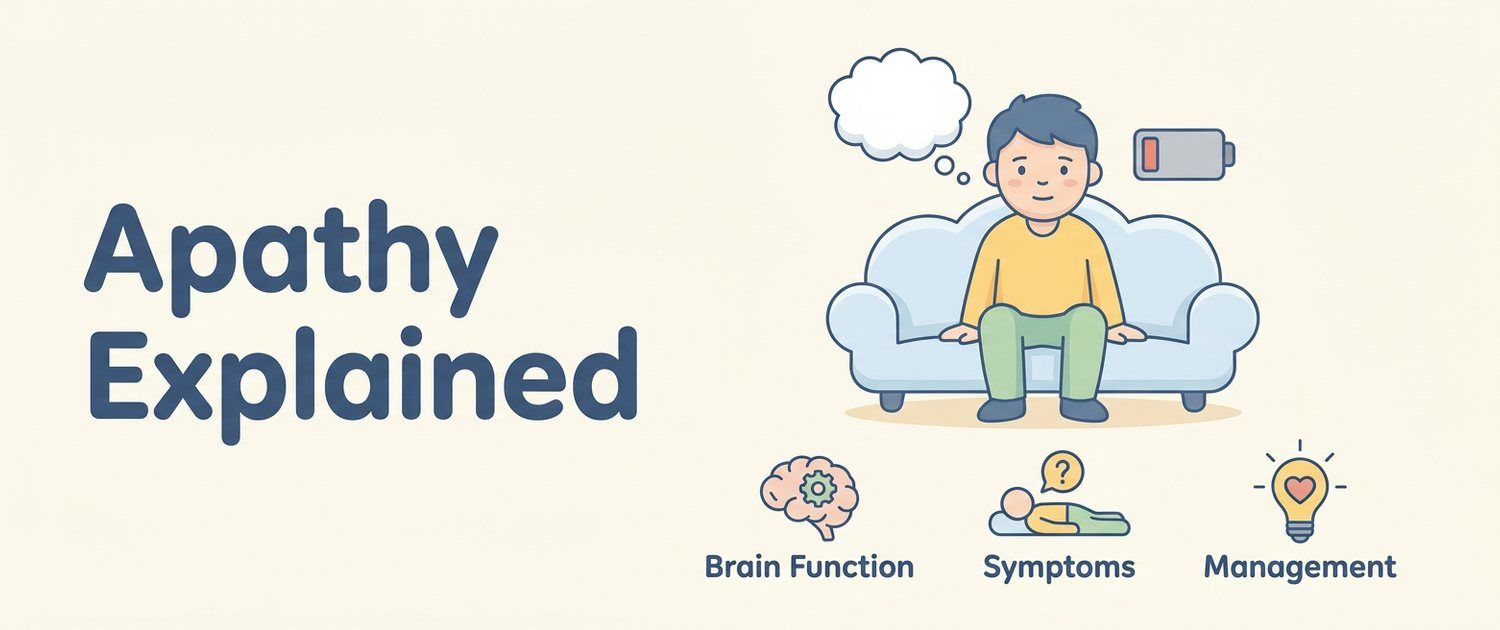
"I don't want anything" hides very different states: an ordinary wrung-out month, and something worth taking to a doctor. They can be told apart — not by how bad the feeling is, but by one plain question people rarely reach.
What apathy is
Apathy is a state in which the impulse disappears. A person knows what has to be done, considers it important, and cannot start. It is not that the attempt fails — the urge to begin never arrives.
Two misunderstandings are worth clearing at once. First: apathy is not a diagnosis. It is a description, like "fever" or "headache": it says something is going on, not what. Second: it is almost never about character. Apathy has a short list of checkable causes, and most of them have nothing to do with willpower.
Its signs are recognisable: interest fades, the circle of activity narrows to the strictly necessary, conversations and plans feel like a waste, decisions get postponed not out of fear but out of indifference. Often a sense of having no energy comes along with it — but those are two different complaints, and separating them pays off.
Anhedonia: when it is joy itself that goes
In plain words, anhedonia is when what used to please no longer pleases. The word is built from the Greek "an-" (without) and "hēdonē" (pleasure), and it means exactly that — a lost capacity for enjoyment.
The difference from apathy is subtle but practical. With apathy the person does not go. With anhedonia they go — and feel nothing. Favourite food becomes just food, music just sound, an evening with friends an item in the calendar. Clinicians split anhedonia in two:
- anticipation — no pull towards it in advance: "why bother, it won't do anything";
- the experience itself — you went, you did it, and inside there is nothing.
Anhedonia is neither weakness nor a whim. It sits at the core of how depressive states are described, which is exactly why it should not be explained away as tiredness when it lasts for weeks.
The fork that changes everything: only in the work, or everywhere
Here is the question. Not "how bad do I feel", but where exactly the joy went. Answer it honestly and two different roads open.
| Joy gone only from the work | Joy gone from everything | |
|---|---|---|
| What still pleases | life outside work is alive: people, food, music, plans | nothing pleases, including what always did |
| Days off | noticeably easier, heavy again by Monday | almost no difference between weekdays and weekends |
| What it resembles | the description of burnout: narrow, tied to the work | the description of anhedonia: continuous, without borders |
| Where to look | at load, environment, the conditions of that one job | at sleep and the body first, then a clinician |
If joy has narrowed to one area, the cause is more likely around that area than inside you. What exactly spends the resource is unpacked in the article on what burnout is.
If joy has gone from everywhere, this is no longer about work. Here you should not decide alone — and here the mix-up is costly: in roughly half of the people who called their state burnout, a mental disorder stands behind it or is mixed into it. The fork has its own article — burnout or depression.
Apathy and laziness are not the same thing
They get confused constantly, and the confusion is expensive: a person starts shaming themselves instead of looking into it. The distinction rests on two things — desire and suffering.
- Laziness: you don't want to do this, but you do want something else — to lie down, to watch a series, to do nothing. And it feels fine. The desire is there, just pointed elsewhere.
- Apathy: you want nothing, pleasant things included. And it feels bad — the person wants to want and cannot. Suffering is a compulsory part of the picture.
One question separates them: is there anything you would get up for right now? If something turns up, this is more likely exhaustion in one area. If nothing does — not even what always worked — it is not laziness.
When not to postpone
There is a point where articles on the internet end. See a doctor or a therapist without deliberating and without "after the holiday" if:
- the state holds almost every day for more than two weeks and days off change nothing;
- it has reached daily life: washing, eating and answering messages are hard;
- interest in life as such has gone — the thought "what is all this for";
- there are thoughts of harming yourself or of not being here. That is a reason to ask for help today, not someday.
No text and no questionnaire replaces a person here — and none of them can tell you what is happening to you.
What is worth checking
The causes are easiest to walk through in the order a clinician walks through them — from the common and fixable to the complex.
- Sleep. Not only its length but its quality: snoring with pauses in breathing, waking unrested, a drifting schedule. Sleep debt hits the impulse before it hits the strength.
- The body. A shifted thyroid (TSH), iron deficiency (low ferritin), a lack of vitamin B12 or vitamin D produce the very same picture — and, unlike "character", they show up in a blood test. What to check and in what order is in the article on blood tests for emotional burnout.
- Mood. If joy has gone everywhere and stays gone, this is a clinician's territory, not self-help.
- Load and environment. Long overload without return exhausts predictably. And not only at work: wherever the load has no end of shift the same picture forms — the subject of the text on parental burnout.
Two complaints are worth separating, because they blur together in the head. "I can't" and "I don't want to" are different: when it is energy that is missing, a different list applies, and it is gathered in the article no energy for anything. And when tiredness has lasted for months and rest stopped removing it, that is constant tiredness, with a checking order of its own.
What actually helps
"Pull yourself together" fails by the very design of apathy: it demands precisely what is currently absent. The reverse order works.
- Action before desire. Waiting to feel like it is pointless — the wanting usually arrives mid-process. So the step is made embarrassingly small: not "go to the gym" but "put the shoes on"; not "meet friends" but "answer one message".
- Sleep as the base. While sleep is broken everything else runs at half strength, and the impulse is the last thing to return.
- Genuine detachment from the work outside its hours. A meta-analysis of recovery experiences covering over three hundred studies and nearly a hundred thousand people links psychological detachment after hours with less exhaustion and less negative affect. Detachment is not "keeping the laptop shut" — it is no longer thinking about the work.
- Bringing back one source of pleasure. Not all of them. One — the one that used to work most reliably.
- A conversation with a specialist if joy has gone everywhere. That is a normal next step, not a last resort.
What not to do: prescribe yourself anything, or explain the state by laziness. The first is dangerous, the second steals time.
How to look at your own picture
A quick orientation comes from the short burnout test — six questions and one level from 0 to 100. It gives no diagnosis and can remove none; it shows how heavy things are right now.
After that it helps to break the picture apart. The full burnout test scores two independent lines — your own state and what the environment around the work demands — and puts a point on a map. That is where the fork becomes visible: heavy exhaustion with a calm environment is a signal to look for the cause not in the work but in sleep, the body or mood.
The bodily part is checked with blood work: the service will help you read results you already have in plain language and show what stands out in them.
This article is informational and does not diagnose. What is happening to you is determined by a specialist, not by a text on the internet.
For informational purposes only
This article is for informational purposes only and does not constitute medical advice, diagnosis, or treatment. Please consult a healthcare professional for medical guidance.