Parental Burnout and Burnout on Maternity Leave: What Is Known
Reviewed by the LabReadAI medical team
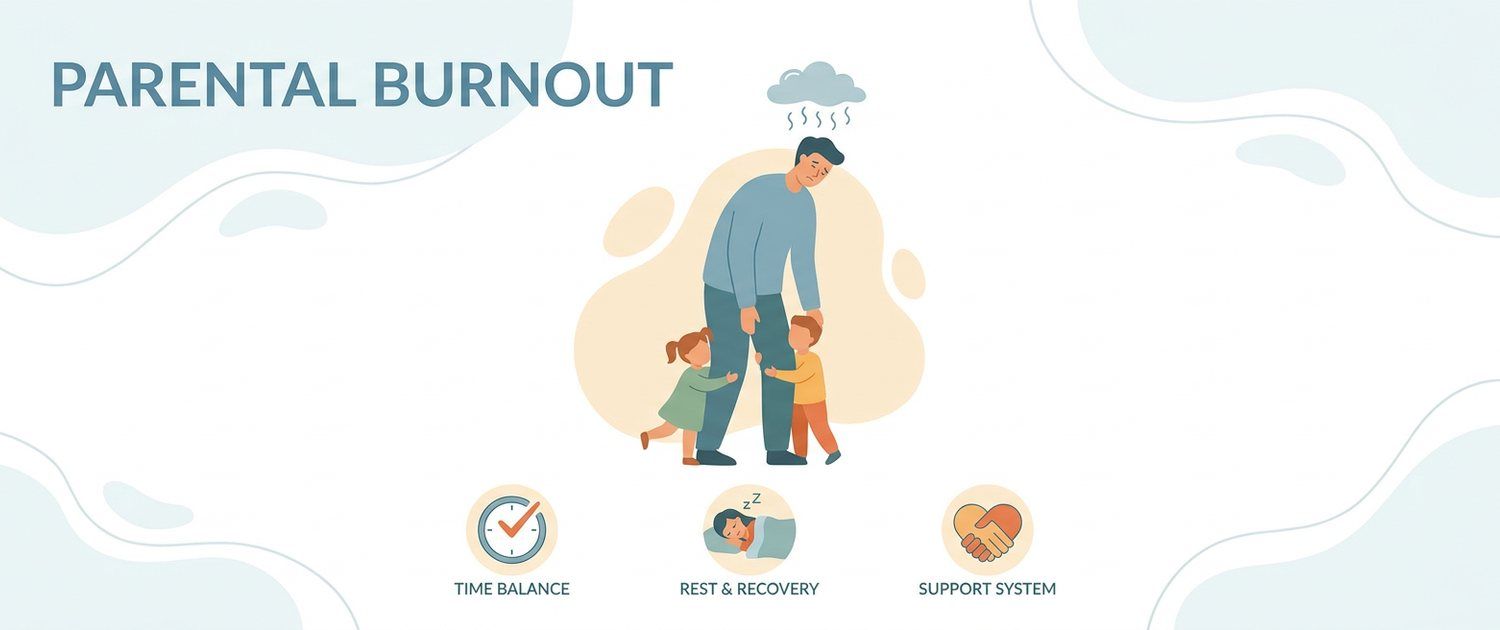
«I am tired of my children» is a sentence almost nobody says out loud: the conclusion about being a bad parent follows it instantly. Yet it describes a recognisable state that has research behind it, instruments to measure it and data from dozens of countries.
What parental burnout is
It is exhaustion grown out of prolonged parenting stress: no energy from the morning, care running on autopilot, irritation appearing where there was none. The mechanics are the same as in any burnout — spending steadily exceeds return; the general frame is unpacked in the article on what burnout is.
The difference is the environment. A job has an end of shift, weekends and holidays. Caring for a child has none, and that difference makes the picture quieter and more persistent: it does not arrive after a crunch, it accumulates over years.
Why this is not «burnout by the classification»
An honest caveat belongs here. The World Health Organization limited the term «burn-out» to the occupational context deliberately: by its wording it should not be applied to other areas of life. Formally, parental burnout is not what the classification describes.
That does not mean the state does not exist. It means it is studied separately and with its own instruments rather than by transplanting work scales onto family life. It also explains why nobody will «diagnose parental burnout» in a consulting room: no such diagnosis exists, just as no diagnosis of burnout exists at all.
Four dimensions: how it is described
Researchers describe parental burnout through four parts — useful not as a test but as a language in which the state can be named more precisely than «I am a bad mother».
| Dimension | How it sounds from inside |
|---|---|
| Exhaustion in the role | Getting up is already an effort; the day starts with emptiness, not energy |
| Contrast with the former self | «I used to be a different parent — I do not recognise myself» |
| Feeling fed up | Not «I do not love» but «I cannot take any more»: one more request and that is it |
| Emotional distancing | Mechanical care: the tasks get done, the warmth is no longer in them |
Notice that three of the four are about the relationship with oneself, not with the child. That is exactly why the state feels from inside like a verdict on the person, although what it describes is a spent resource.
Burnout on maternity leave and the «exhausted mother» state
Burnout on parental leave is the same mechanism in the densest possible conditions: the load runs around the clock, sleep is broken, and the result is invisible because it never ends. Three things rarely said out loud pile on: a narrowed circle of contact, the loss of familiar sources of recognition, and the sense that days have become indistinguishable.
What people call the exhausted mother state, or stay-at-home burnout, is not a separate illness and not weakness but a description of an environment: where the load has no end of shift, recovery has to be obtained rather than received on schedule. Being tired of being a mother is about the regime, not about love for the child.
A note on burnout after childbirth: tiredness in the first months is expected, but persistently low mood, anxiety and an absence of interest in that period are not the same as exhaustion, and they belong with a specialist rather than with endurance.
How common it is: 42 countries
The largest cross-country study — more than seventeen thousand parents in forty-two countries — produced an unexpected result. The prevalence of parental burnout differs radically: from almost zero to 9.8%. In Russia it was 6.6%.
More interesting still is what explains the differences. Not economic inequality, not the number of children and not working hours, but the individualism of the culture: in countries that prize independence and personal responsibility, parental burnout is markedly more common than where childcare is spread across a wider circle of adults.
The practical conclusion: loneliness in parenting is not a side detail but one of the main factors. This is about how the environment is arranged, not about character.
Emotional distancing from a child: the guilt is aimed wrong
This is the hardest part, and it deserves to be said plainly. When the resource is spent, warmth goes first: the actions remain — feed, dress, take to school — and inside them there is nothing. The person notices this before anyone around them and concludes that they have stopped loving their child.
The data say otherwise: emotional distancing is a dimension of exhaustion, not of affection. It appears at the moment there is nothing left and it recedes as the resource returns. The guilt at this point is aimed at the wrong place: it punishes a person for a state produced by load rather than by a lack of feeling.
If something else has taken the foreground instead of exhaustion — nothing appeals, nothing pleases, and it has lasted for weeks — that is a different conversation, covered in the text on apathy.
What helps
There will be no «just get some rest» here: in an environment with no end of shift that advice cannot be followed and lands as a reproach. Other things are more useful.
- Recovery built into the week rather than postponed. Not «when it gets easier» but a specific hour protected the way a medical appointment is.
- Redistributing the load rather than speeding it up. Handing any part of the care to another adult changes the picture more than any time-management technique.
- Sleep as a priority where that is possible at all. It is rarely fully in your control, but even partial repair of night sleep changes how the day is carried.
- Coming out of isolation. Regular contact with people who understand the context works as an environmental factor — the very one that explains the cross-country differences.
- Precise naming instead of self-assessment. «My resource has run out» and «I am a bad parent» describe different things and lead to different actions.
The order of evidence-backed steps — sleep, detachment, rest, changing conditions — is unpacked in the article on how to come out of burnout. And how the same mismatches work in paid employment (load, control, reward, fairness) is in the article on burnout at work — useful when you are carrying both.
When to talk to a specialist
Some signals mean the conversation should happen soon rather than someday: the state has not changed for months; not only energy but interest and pleasure in everything have gone; thoughts appear that you might harm your child or that you do not want to live; or you lose control more and more often in ways you yourself find unacceptable. The last point is not a reason for shame but a reason to ask for help: it speaks about the size of the load, not about your worth as a parent.
The bodily side is worth a look too, especially after childbirth and with broken sleep. Hypothyroidism (a shifted TSH), iron deficiency (low ferritin), a lack of vitamin B12 and vitamin D produce exactly the same picture: I do not recover whatever I do. What to check and in what order is in the article on blood tests for emotional burnout; results you already have the service will help you read in plain language.
How to look at your own picture
The service has no separate parental burnout test — the validated instruments for it are research tools. But your overall level of exhaustion and what is happening in the environment around your main load can be looked at: a quick bearing comes from the short burnout test, and the full burnout test scores two lines apart — your own state and the demands of the environment. If your main load right now is care, answer about it: the combination of the two lines is what shows what is missing — recovery, or help with the load itself.
One of the commonest triggers is weeks of infant crying — see infant colic.
This article is informational and does not diagnose. In the WHO classification burnout is not an illness, and what is happening to you is decided by a specialist, not by a text on the internet.
For informational purposes only
This article is for informational purposes only and does not constitute medical advice, diagnosis, or treatment. Please consult a healthcare professional for medical guidance.