Infant Colic: How Long It Lasts and How to Help a Baby
Reviewed by the LabReadAI medical team
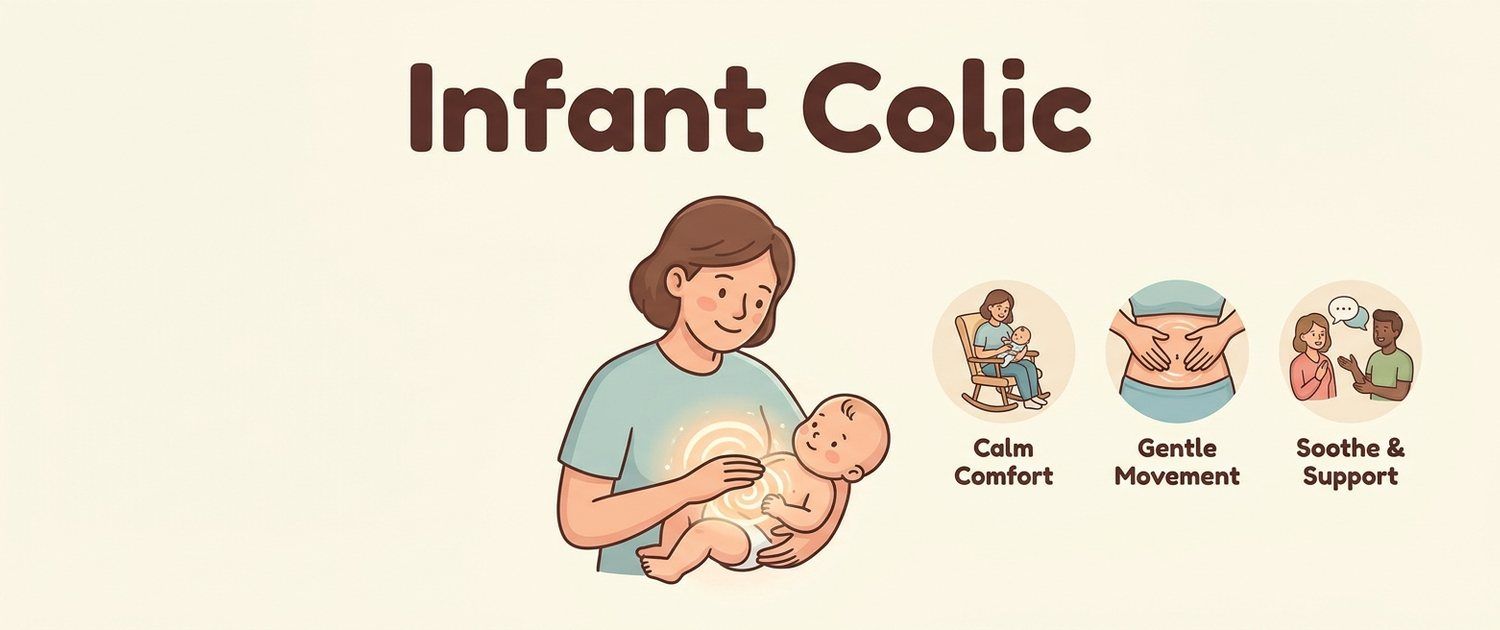
Evening crying that nothing stops: the baby is fed, dry and looks healthy — yet screams for two or three hours with legs drawn up. By the third week parents are desperate and start searching for a disease. Usually there is none. But usually is not always, and the whole value of this article is separating a normal stage from what imitates it.
What infant colic is and why it is a diagnosis of exclusion
Colic is not a bowel disease and not a diagnosis in the usual sense. It is a description of behaviour in a healthy infant in whom no other cause of crying was found. The key word is healthy: the child must gain weight, feed and develop normally. If that is not the case, the word colic becomes dangerous, because it closes the search.
The international reference is Wessel's rule of three: inconsolable crying at least 3 hours a day, at least 3 days a week, for at least 3 weeks, in an infant who is otherwise growing and developing normally. Modern criteria relaxed the duration requirement but kept the essence: colic is what remains once everything else is excluded.
How long colic lasts: when it starts and when it ends
| Age | What happens |
|---|---|
| 0–2 weeks | Colic is uncommon; crying at this age needs a cause to be found |
| 2–3 weeks | Onset: crying builds up, usually in the second half of the day |
| 6–8 weeks | Peak: maximum crying time |
| 3 months | Clear improvement in most infants |
| 4 months | Colic has ended in the vast majority |
This curve is the single most useful thing a parent can know. Colic is not cured — it ends on its own, and any remedy started at the peak will look effective simply because crying was about to decline anyway. That is precisely why so many remedies fail to beat placebo in trials.
Why colic happens: what is known and what is not
No single cause has been found. Several mechanisms are seriously discussed, and different ones probably operate in different infants:
- Immature regulation: the infant cannot yet move from arousal to calm; evening crying discharges the excitation accumulated during the day.
- Gut microbiota: infants with colic show a different microbial profile with lower diversity. Hence the interest in probiotics — how the gut relates to overall state is covered in the article on the microbiome.
- Cow milk protein allergy: not colic itself, but a condition that imitates it. It differs by adding skin involvement, mucus or blood in stool, and poor weight gain.
- Air swallowing during feeding and ineffective passage of gas.
What did not hold up: enzyme immaturity, dysbiosis that must be treated, and lactase deficiency as a common cause. Stool testing for dysbiosis has no diagnostic value in colic — see the article on stool dysbiosis testing.
Red flags: when this is no longer colic
This list matters more than anything else here. With any of these, set the word colic aside and have the child examined:
- poor or stalled weight gain — check against growth norms by age;
- projectile vomiting, especially after every feed and with weight loss — see vomiting in children;
- blood or mucus in stool, black or pale stool — see stool colour;
- fever in an infant under 3 months is always an immediate-assessment situation — see fever in children;
- lethargy, feed refusal, an unusual high-pitched cry;
- crying that starts suddenly after 4 months — an atypical age for colic;
- rash and persistent skin findings — see rash in children and atopic dermatitis.
How to help with colic: massage, simethicone and probiotics
| Measure | Evidence |
|---|---|
| Lactobacillus reuteri DSM 17938 | Works in breastfed infants; data in formula-fed infants are inconsistent |
| Trial dairy-free maternal diet (2–4 weeks) | Justified when cow milk protein allergy is suspected, not for everyone |
| Holding, rocking, white noise, swaddling | Helps get through an episode; does not shorten colic overall |
| Simethicone for gas | Did not beat placebo in trials |
| Tummy massage, tummy time, bicycle legs | Safe, unproven, but harmless |
| Fennel-based herbal products | Weak data, non-standardised composition |
| Dysbiosis testing and treating dysbiosis | Not indicated |
If you do choose a probiotic, what matters is the specific strain and dose rather than the word probiotic — the reasoning is set out in the article on choosing a probiotic.
Are tests needed in colic?
In typical colic with good weight gain — no. Testing becomes meaningful when a red flag is present or the picture does not fit: a doctor may order a complete blood count (paediatric ranges differ — see CBC in children), a urinalysis to exclude urinary tract infection as a hidden cause of crying, and stool studies when food allergy is suspected. With strong family atopy, eosinophils may be checked — though interpretation in infants is limited, see immunoglobulin E.
Which tests make sense for a child at all, and at what age, is collected separately: tests for children.
Parents are part of the picture
Colic is the one childhood condition where the adult suffers first. Hours of crying over weeks are exhausting: sleep breaks down, irritability grows, guilt appears. That is not weakness but a predictable reaction — the mechanism and signs are described in the article on parental burnout. A practical safety rule: if you feel you are about to snap, put the baby on their back in the cot and step out for five minutes. A crying infant in a cot is safe; shaking is not.
If you cannot put the crying into words a doctor will understand, it helps to lay out the whole picture — what, when, and what accompanies it: the symptom analysis service turns a description into a structured picture and suggests what to clarify at the appointment.
This article is informational. Diagnosis and treatment are the paediatrician's task.
For informational purposes only
This article is for informational purposes only and does not constitute medical advice, diagnosis, or treatment. Please consult a healthcare professional for medical guidance.