CBC in Children: Normal Ranges by Age and Interpretation
Reviewed by the LabReadAI medical team
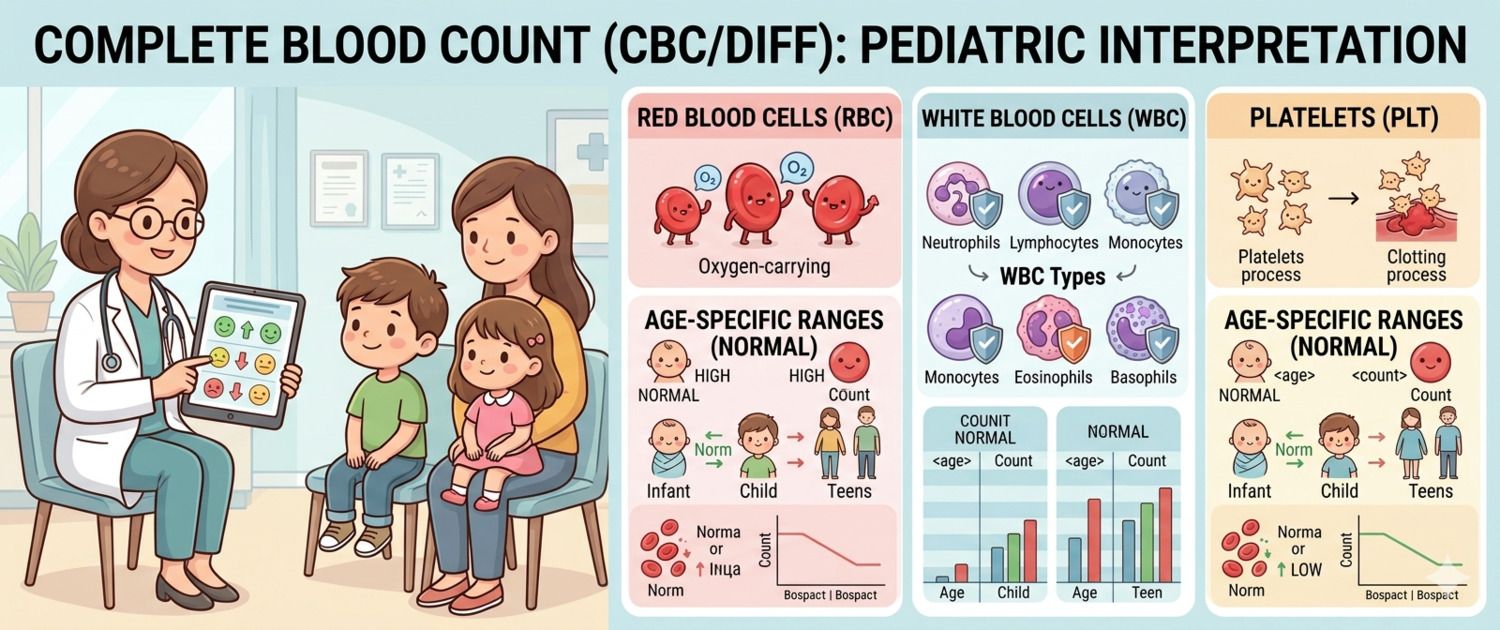
When parents get their child's blood test back, the alarm bells often go off: "WBC elevated," "not enough neutrophils." But comparing a child's results to adult reference ranges is a fundamental mistake. A child's blood follows its own rules: the composition changes rapidly in the first years of life, and what is pathological in an adult is completely normal in a three-year-old. Let's go through the complete blood count norms by age group and explain the physiological phenomena that most often cause unnecessary worry.
Why Children's Norms Differ From Adults
At birth, a newborn's blood carries the imprint of intrauterine life: high hemoglobin (fetal HbF), large red cells (MCV above adult range), and very high WBC — a response to birth stress. Over the first years of life these values reorganize, passing through predictable physiological peaks and crossovers. This is why every result must be evaluated strictly against age-specific norms — preferably from the reference ranges of the specific laboratory used.
Hemoglobin in Children: Normal Ranges by Age
Hemoglobin is the parameter that changes most intensively in children.
| Age | Normal hemoglobin (g/L) |
|---|---|
| Newborns (1–3 days) | 145–225 |
| 1 month | 100–180 |
| 3–6 months | 95–135 |
| 6 months – 2 years | 105–135 |
| 2–6 years | 110–140 |
| 6–12 years | 115–145 |
| 12–18 years (boys) | 120–160 |
| 12–18 years (girls) | 112–152 |
Physiological anaemia of infancy is a normal occurrence at 2–3 months of age. After birth, fetal hemoglobin is replaced by adult hemoglobin, erythropoiesis temporarily "pauses," and hemoglobin physiologically drops to 95–115 g/L. This is not iron deficiency and not a disease — it is normal physiology. The way to distinguish it from true anaemia is ferritin: in physiological anaemia ferritin is normal or elevated; in iron deficiency anaemia it is low.
After 6 months, iron stores acquired from the mother are depleted, and the risk of true iron deficiency anaemia rises — especially in breastfed infants without introduced complementary foods.
Red Cells and MCV in Children
| Age | RBC (×10¹²/L) | MCV (fL) |
|---|---|---|
| Newborns | 4.0–6.6 | 98–118 |
| 1–6 months | 3.4–5.2 | 85–105 |
| 6 months – 2 years | 3.7–5.3 | 70–86 |
| 2–12 years | 3.9–5.3 | 75–87 |
| 12–18 years | 3.9–5.6 | 78–95 |
High MCV in newborns is normal — not a sign of B12 or folate deficiency. MCV below 70 fL in a child older than 6 months is a warning sign of microcytosis, with iron deficiency anaemia as the most likely cause.
WBC in Children: Norms and the Physiological Crossover
The most common reason for parental alarm — "high WBC." Normal WBC counts in children are significantly higher than in adults and gradually decrease with age.
| Age | Normal WBC (×10⁹/L) |
|---|---|
| Newborns | 10.0–30.0 |
| 1 month | 9.0–18.0 |
| 6 months – 2 years | 6.0–17.0 |
| 2–6 years | 5.0–15.5 |
| 6–12 years | 4.5–13.5 |
| 12–18 years | 4.5–11.0 |
Neonatal leukocytosis up to 30×10⁹/L in the first days of life is a physiological response to birth stress, not a sign of infection.
The Physiological WBC Differential Crossover
In adults, neutrophils make up 50–70% of WBC and lymphocytes 20–40%. In children this ratio reverses twice during development:
First crossover — occurs on days 4–5 of life: neutrophils fall, lymphocytes rise, and they equalize (~45% each).
After the first crossover, lymphocytes dominate: in children under 4–5 years lymphocytosis is normal. Lymphocytes at 50–70% in a two-year-old are physiology, not a sign of viral infection.
Second crossover — occurs at 4–6 years of age: neutrophils and lymphocytes equalize again, after which neutrophils resume adult-pattern dominance.
This explains why the rule "many lymphocytes = virus, few neutrophils = problem" simply does not apply to preschool-age children.
Neutrophils and Lymphocytes: Normal Ranges by Age
| Age | Neutrophils (%) | Lymphocytes (%) |
|---|---|---|
| Newborns | 60–70 | 20–30 |
| Days 5–7 | 40–50 | 40–50 |
| 1 month – 4 years | 25–45 | 45–65 |
| 4–6 years | 40–55 | 35–50 |
| 6–12 years | 45–65 | 25–45 |
| 12–18 years | 50–70 | 20–40 |
Pathological neutrophilia in children (neutrophils > 70–80% with a left shift) is a sign of bacterial infection. Pathological lymphopenia (lymphocytes < 15–20%) at any age warrants exclusion of immunodeficiency.
Eosinophils in Children
Eosinophils normally make up 1–5% in children. Mild elevation (5–10%) without symptoms is often linked to helminth infections or atopy. Eosinophilia above 10% is a reason for parasitological investigation and allergology consultation.
Platelets in Children
Normal platelet counts in children are essentially the same as in adults throughout life:
| Age | Normal platelets (×10⁹/L) |
|---|---|
| Newborns | 150–400 |
| Children of all ages | 150–400 |
Thrombocytopenia (platelets below 100×10⁹/L) in a child warrants urgent haematology consultation. The most common cause in children is immune thrombocytopenic purpura (ITP), typically developing after a viral infection.
How to Collect a Blood Sample in a Child
In children under 3, blood is usually taken from a fingertip (capillary); in older children from a vein. Venous blood gives more accurate results — especially for platelets and differential.
Key conditions: fasting for children over 1 year; calm state — crying and stress produce transient leukocytosis. In infants, time of day and feeding have less impact.
After acute infection, values recover gradually: leukocytosis may persist 1–2 weeks after recovery, ESR up to 3–4 weeks.
When to Seek Urgent Medical Attention
Immediately if: hemoglobin below 70 g/L at any age; WBC above 30×10⁹/L in a child older than one month; platelets below 50×10⁹/L; blast cells in the differential — possible leukaemia.
Routine paediatric or haematology referral: hemoglobin below age-specific norm on repeat tests; eosinophilia above 10%; neutrophilia with left shift without clinical infection signs; thrombocytopenia below 100×10⁹/L.
Summary
Reading a child's blood test without age-specific norms is like measuring a child's height with an adult ruler. Physiological lymphocytosis, high MCV in newborns, and wide WBC ranges are all normal stages of haematopoietic development. If a value falls outside the age-specific norm — exclude physiology first, then look for pathology. The complete blood count is a powerful tool in children, but its value depends entirely on age-appropriate interpretation.
When a blood count is actually worth taking during fever is covered in fever in children.
Two lines of the paediatric differential alarm parents more than any others, and both are covered separately. The age-related crossover and the response that lingers for weeks after a virus are explained in high and low lymphocytes. The other one is high eosinophils — in children it comes down to atopy or a helminth infection, and what separates them is not the percentage on the form but the absolute count and the circumstances.
This article is for informational purposes only. Interpretation of test results and treatment decisions are the responsibility of a physician.
For informational purposes only
This article is for informational purposes only and does not constitute medical advice, diagnosis, or treatment. Please consult a healthcare professional for medical guidance.