CBC with Differential: White Cell Formula Explained
Reviewed by the LabReadAI medical team
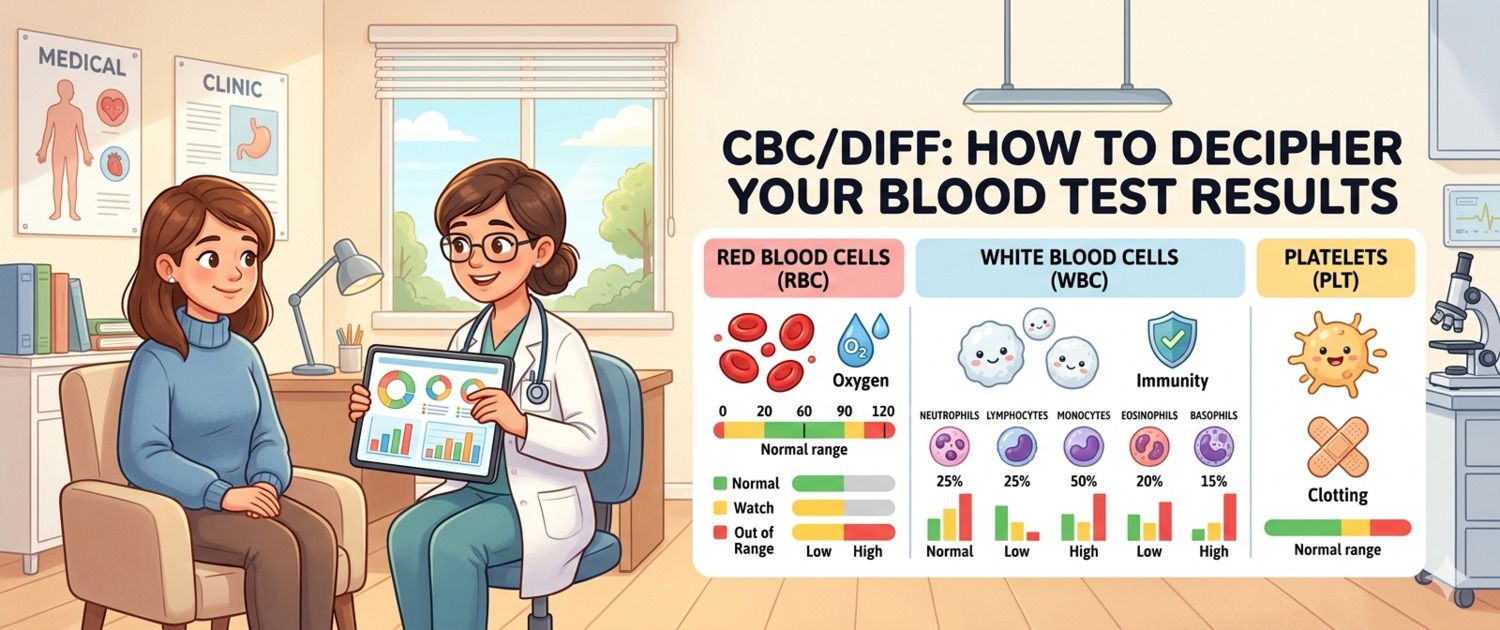
The doctor ordered a "complete blood count with differential" — and the report came back with unfamiliar words: neutrophils, lymphocytes, monocytes, left shift. A standard complete blood count counts cells; CBC/Diff goes one level deeper: it adds the white cell formula showing exactly which leukocytes are present and in what ratio. This is a fundamental difference — like the difference between counting people in a crowd and knowing which ones are doctors and which are police officers. In this article every part of the formula is explained with normal ranges, clinical meaning and practical tips for reading your results.
What Is the CBC Differential Formula and How It Differs From a Standard CBC
A standard complete blood count includes haemoglobin, red cells, WBC, platelets, and MCV. CBC with differential adds the white cell formula — the percentage and absolute count of five white blood cell populations.
Why this matters: WBC 12×10⁹/L tells you "how many." The formula answers "which ones": neutrophilia from a bacterial infection, lymphocytosis from a viral one, and eosinophilia from allergy or parasites are three entirely different clinical situations at the same elevated WBC count.
Key Rule: Absolute Counts Matter More Than Percentages
The most common mistake when reading a differential is looking only at percentages. A percentage is a relative value that depends on the total WBC count. What matters is the absolute count of each population.
Example: lymphocytes 15% with WBC 3×10⁹/L means lymphopenia (0.45×10⁹/L — very low). Lymphocytes 15% with WBC 20×10⁹/L means a normal absolute lymphocyte count (3.0×10⁹/L). The same percentage — opposite interpretations.
Neutrophils: The Primary Defense Against Bacteria
Neutrophils make up 50–70% of all leukocytes in adults and are the first cells to arrive at the site of bacterial infection. They engulf and destroy bacteria by phagocytosis.
| Marker | Normal (adults) |
|---|---|
| Neutrophils % | 50–70% |
| Absolute count | 1.8–7.5 × 10⁹/L |
| Segmented (mature) | 47–67% |
| Band (immature) | 1–5% |
Neutrophilia (> 7.5×10⁹/L) — classic sign of bacterial infection, inflammation, stress, corticosteroid use, or physical exertion.
Neutropenia (< 1.8×10⁹/L) — reduces resistance to infections. Causes: viral infections (influenza, COVID-19), autoimmune diseases, certain medications, aplastic anaemia.
Left Shift: What It Means
"Left shift" means the appearance of immature neutrophil forms in peripheral blood. Normally, bone marrow releases only mature segmented neutrophils. In severe bacterial infection, the supply of mature cells is depleted and the marrow releases immature forms — band neutrophils (> 5–6%) and, in very severe cases, even earlier forms — metamyelocytes and myelocytes.
A band shift is not simply "more neutrophils." It signals that the body is working at the limit of its reserves against a serious infection or inflammatory process. Combined with elevated CRP and WBC > 15×10⁹/L, it is a compelling reason for urgent consultation.
Lymphocytes: The Memory of the Immune System
Lymphocytes are the adaptive immune cells: B-lymphocytes produce antibodies, T-lymphocytes destroy infected cells, and NK cells are the first line of antitumour defence.
| Marker | Normal (adults) |
|---|---|
| Lymphocytes % | 20–40% |
| Absolute count | 1.0–3.5 × 10⁹/L |
Lymphocytosis (> 3.5×10⁹/L) — viral infections (EBV mononucleosis, cytomegalovirus, whooping cough), chronic lymphocytic leukaemia in the elderly. Important: in children under 4–5 years, lymphocytosis is a physiological norm — see the CBC in children article.
Lymphopenia (< 1.0×10⁹/L) — severe viral infections (COVID-19, HIV), corticosteroids, immunodeficiency, sepsis. Lymphopenia in COVID-19 correlates with disease severity.
Atypical lymphocytes in the differential (> 10%) are a characteristic sign of infectious mononucleosis: EBV-infected B-lymphocytes acquire an unusual appearance.
Monocytes: Long-Lived Scavengers
Monocytes are the largest blood cells, migrating into tissues and transforming into macrophages. They participate in chronic inflammation, phagocytose cellular debris, and present antigens to lymphocytes.
| Marker | Normal |
|---|---|
| Monocytes % | 3–11% |
| Absolute count | 0.2–0.8 × 10⁹/L |
Monocytosis (> 0.8×10⁹/L) — chronic infections (tuberculosis, brucellosis, endocarditis), autoimmune diseases, inflammatory bowel disease, recovery period after acute infections. Persistent monocytosis without an obvious cause warrants exclusion of chronic myelomonocytic leukaemia.
Eosinophils: The Signal for Allergy and Parasites
Eosinophils specialise in fighting parasites and participate in allergic reactions — in health their numbers are low.
| Marker | Normal |
|---|---|
| Eosinophils % | 1–5% |
| Absolute count | 0.05–0.5 × 10⁹/L |
Eosinophilia — the degree of elevation has different clinical implications:
- Mild (0.5–1.5×10⁹/L) — allergic diseases (atopic dermatitis, asthma, hay fever), mild helminth infections
- Moderate (1.5–5.0×10⁹/L) — invasive helminthiases (toxocariasis, migrating ascariasis), drug reactions
- Severe (> 5.0×10⁹/L) — rare hypereosinophilic syndromes with organ involvement; urgent consultation required
Basophils: Rare but Informative
Basophils are the least numerous leukocytes, participating in immediate-type allergic reactions through histamine release.
| Marker | Normal |
|---|---|
| Basophils % | 0–1% |
| Absolute count | 0–0.1 × 10⁹/L |
Basophilia (> 0.1×10⁹/L) is uncommon. Causes: allergic reactions, hypothyroidism, chronic myeloproliferative diseases — basophilia is a classic feature of chronic myeloid leukaemia.
The Formula Explained: Differential Pattern in Common Conditions
| Condition | Neutrophils | Lymphocytes | Monocytes | Eosinophils |
|---|---|---|---|---|
| Bacterial infection | ↑↑ (left shift) | ↓ | normal/↑ | normal |
| Viral infection | ↓ or normal | ↑ | normal/↑ | normal |
| Allergy / parasites | normal | normal | normal | ↑↑ |
| Chronic inflammation | normal/↑ | normal | ↑ | normal |
| Stress / corticosteroids | ↑ | ↓ | normal | ↓ |
This table is a guide, not an algorithm. Every result is interpreted together with clinical data, CRP, and ESR.
How to Prepare for the Test
Fasting — 8–12 hours without food, morning draw. Avoid intense exercise the day before — it causes leukocyte redistribution. Stress, infections, corticosteroids, and smoking all affect the differential. For serial monitoring: draw blood under the same conditions, ideally at the same laboratory.
When to Seek Urgent Medical Attention
Immediately: neutrophils < 0.5×10⁹/L (agranulocytosis — life-threatening); blast cells in the differential — possible leukaemia; WBC > 30×10⁹/L in an adult without a known cause.
Routine referral: persistent neutropenia < 1.5×10⁹/L; lymphocytosis > 5×10⁹/L in an adult without infection; eosinophilia > 1.5×10⁹/L without allergy or parasitic disease; monocytosis > 1.0×10⁹/L for more than 3 months.
Summary
CBC/Diff is a standard blood count plus the white cell formula — a breakdown of "who exactly" among the leukocytes. As explained above, neutrophilic left shift points to bacterial infection, lymphocytosis to viral, eosinophilia to allergy or parasites, and monocytosis to chronic inflammation. The formula must be read in absolute numbers, not percentages alone — and always in the context of the clinical picture and other inflammatory markers.
Each population has its own story once it moves, and each is covered separately: high and low neutrophils — left shift and the neutropenia people panic about too early; high and low lymphocytes — the lymphocytosis that lingers for weeks after a viral illness; high monocytes — chronic inflammation versus the harmless recovery phase; high eosinophils — where allergy ends and a parasite begins; high basophils — the rarest finding in the differential, and usually the one with the simplest explanation.
This article is for informational purposes only. Interpretation of test results and treatment decisions are the responsibility of a physician.
For informational purposes only
This article is for informational purposes only and does not constitute medical advice, diagnosis, or treatment. Please consult a healthcare professional for medical guidance.