Basophils in Blood: Normal Levels, High and Low Causes
Reviewed by the LabReadAI medical team
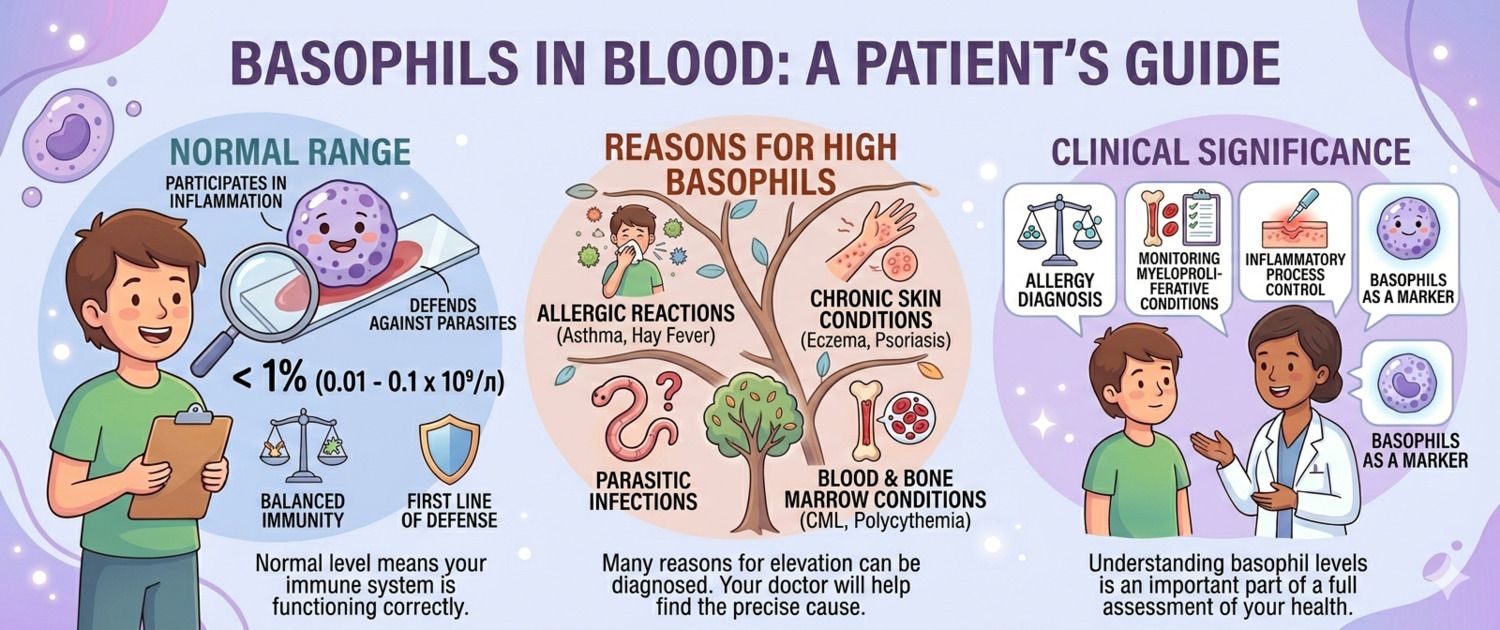
Picture this: out of the entire white blood cell army, basophils account for less than one percent. It sounds insignificant — but these rare cells trigger anaphylactic shock, orchestrate the acute allergic response, and are among the first to react when parasites invade. If your complete blood count came back with an unfamiliar basophil result, this article will explain what it means, what normal looks like, and when a deviation warrants medical attention.
What Are Basophils and What Do They Do?
Basophils are granulocytes — a subtype of leukocytes — named for the dark blue granules that stain readily with basic dyes. Inside those granules is a powerful chemical arsenal: histamine, heparin, serotonin, and leukotrienes.
When the body encounters an allergen or parasite, basophils "explode" — releasing granule contents directly into surrounding tissue. Histamine dilates blood vessels and triggers itching. Heparin prevents clotting, stopping infections from walling themselves off. The result is a rapid, somewhat chaotic, but highly effective first wave of immune response.
Beyond emergency reactions, basophils participate in chronic inflammation, regulate the activity of other immune cells, and — according to recent research — may play a role in antitumor immunity.
How to Get Tested: Preparation and What the Test Includes
Basophils are measured as part of the differential white blood cell count — an expanded complete blood count with differential. There is no separate test for basophils alone.
Preparation guidelines:
- Blood is drawn in the morning on an empty stomach — no food for at least 8–12 hours beforehand.
- Avoid alcohol and intense physical activity for 24 hours before the test.
- Do not smoke for 30 minutes before the draw.
- If you take antihistamines or glucocorticoids, inform your doctor — these medications significantly alter the results.
Results are expressed two ways: as a percentage of total leukocytes (relative value) and in absolute numbers — ×10⁹/L. The absolute value is more diagnostically useful because it is not affected by changes in other cell populations.
Normal Basophil Range: Table for Adults, Children, and Pregnant Women
Basophils are the smallest fraction of the leukocyte differential. Their count is so low that many hematology analyzers simply report 0%.
| Category | Normal (%) | Normal (×10⁹/L) |
|---|---|---|
| Adults | 0–1% | 0–0.08 |
| Infants under 1 year | 0–0.5% | 0–0.04 |
| Children 1–12 years | 0–0.75% | 0–0.06 |
| Adolescents | 0–1% | 0–0.08 |
| Pregnant women | 0–0.5% | 0–0.04 |
Reference ranges may vary slightly by laboratory — always check the reference values printed on your results sheet.
During pregnancy, basophils naturally decrease — this is a normal immune adaptation that requires no treatment.
High Basophils (Basophilia): Causes and What It Means
Basophilia is defined as basophils exceeding 1% or 0.1 ×10⁹/L. On its own, this is a laboratory finding — not a diagnosis.
Physiological causes (no treatment needed):
- First days of the menstrual cycle
- Ovulation period
- Mild iron deficiency
- Chronic stress and poor sleep
Pathological causes — require further evaluation:
- Allergic reactions — urticaria, bronchial asthma, atopic dermatitis. Basophils and eosinophils form the primary allergic duo in the blood.
- Hypothyroidism — reduced thyroid function slows clearance of basophils from the bloodstream.
- Chronic inflammatory conditions — ulcerative colitis, rheumatoid arthritis.
- Parasitic infections — giardiasis, ascariasis.
- Myeloproliferative disorders — chronic myelogenous leukemia, polycythemia vera. These are rare but serious causes of persistently elevated basophils above 0.5 ×10⁹/L.
Isolated mild basophilia (1–2%) in the setting of allergic symptoms is a common, non-alarming finding. Persistent basophilia above 2% without a clear cause warrants a hematology consultation.
Low Basophils (Basopenia): When Does It Matter?
Basopenia refers to basophils falling below the lower limit of normal. Since normal is already close to zero, the diagnostic significance of basopenia is considerably lower than that of basophilia.
Situations where basopenia occurs:
- Acute allergic reactions — cells migrate rapidly into tissues
- Use of glucocorticoids (prednisone, dexamethasone)
- Hyperthyroidism — accelerated metabolism speeds up cell turnover
- Cushing's syndrome
- Acute infections — temporary redistribution of leukocytes
- Pregnancy (physiological norm)
Complete absence of basophils (0%) in an otherwise normal blood count with no symptoms is a normal variant. This is not analogous to neutropenia or thrombocytopenia, where zero values are clinically critical.
Basophils and Allergy: The Direct Connection
If you have allergies, basophils are the primary culprits behind acute symptoms. Together with mast cells in tissues, they store histamine and release it the moment an allergen arrives.
The mechanism is straightforward: allergen → IgE antibodies on the basophil surface → degranulation → histamine and leukotrienes → swelling, itching, redness. The entire cycle takes minutes.
This is why antihistamines work so well — they block histamine receptors after basophils have already released their payload. For a deeper look at allergy mechanisms and types, see the complete allergy guide.
In chronic allergy, basophils may be mildly elevated during flares and return to normal in remission. This is expected and not concerning.
When High Basophils Require Urgent Medical Attention
Most basophil abnormalities are moderate and explainable. But some situations require prompt consultation:
- Basophils persistently above 2% on two or more tests taken 2–4 weeks apart
- Basophilia combined with a leukocyte count above 15 ×10⁹/L
- Unexplained fatigue, night sweats, enlarged lymph nodes or spleen
- Basophils above 10% on any single test — a red flag for myeloproliferative disease
- A child with basophilia above 1% without obvious allergy or infection
Remember: basophils are one value among many. A doctor always interprets them in the context of the full leukocyte differential, symptoms, and medical history.
Conclusion
Basophils are a tiny but powerful component of the immune system. Their normal range is below 1%, and a result of 0% is not pathological. A mild rise during allergy or inflammation is entirely expected. Persistent basophilia without a clear explanation — especially combined with other blood count abnormalities — deserves specialist attention.
Do not interpret your blood results in isolation. Laboratory values are always read alongside the clinical picture. If something concerns you, consult a general practitioner or hematologist.
This content is for informational purposes only and does not replace professional medical advice.
For informational purposes only
This article is for informational purposes only and does not constitute medical advice, diagnosis, or treatment. Please consult a healthcare professional for medical guidance.