Vomiting in Children: What to Do, Fluids and Dehydration
Reviewed by the LabReadAI medical team
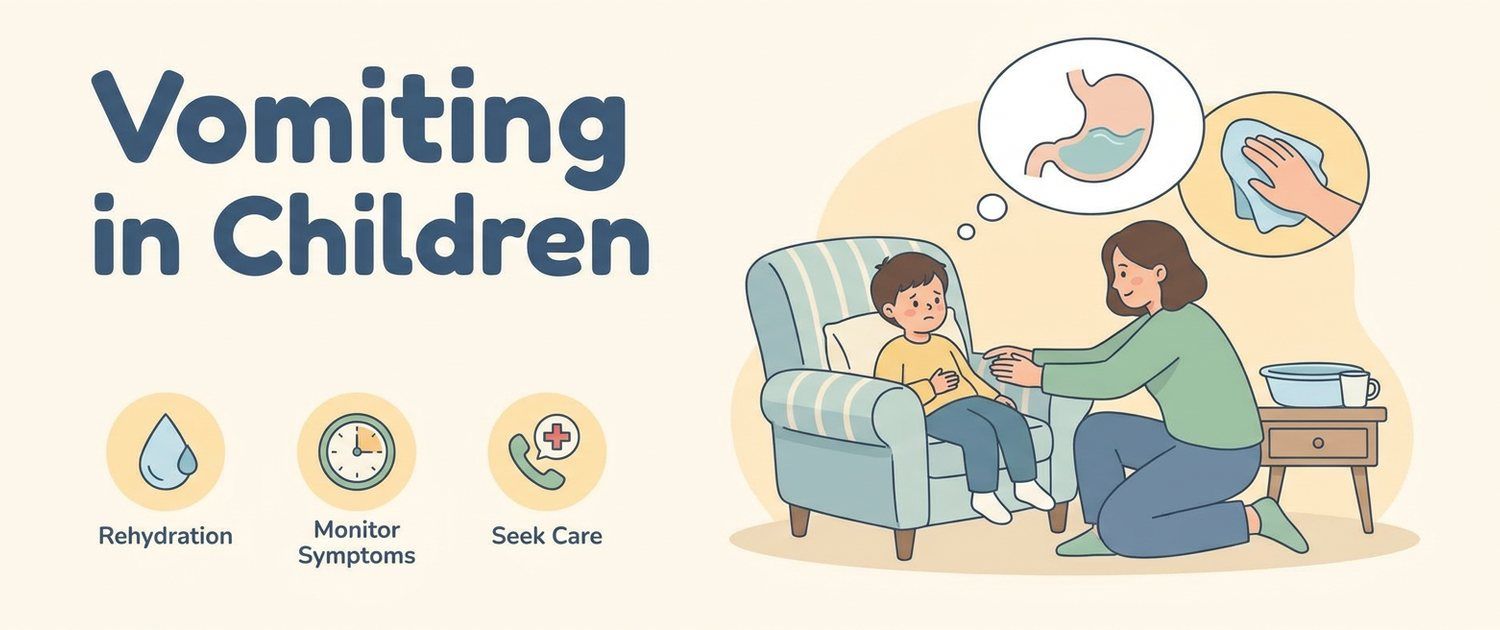
A parent's first thought when a child vomits is how to stop it. The right first thought is how much fluid has been lost and how much is being kept down. Vomiting itself almost never threatens a child; dehydration does, and it develops faster in children than in adults — the younger, the faster.
Vomiting with and without fever: what the difference tells you
| Picture | What is usually considered |
|---|---|
| Vomiting + diarrhoea + fever | Acute gastroenteritis, viral in the vast majority |
| Vomiting + fever without diarrhoea | Infection outside the gut: ear, urinary tract, onset of any febrile illness |
| Vomiting without fever or diarrhoea | A separate scenario: head, surgical abdomen, metabolic causes, poisoning |
| Vomiting + severe abdominal pain | Surgical alertness, see abdominal pain in children |
| Vomiting + headache + photophobia | Neurological alertness, urgent assessment needed |
This is why "vomiting" without qualifiers is a poor question: management differs across these rows.
Vomiting and diarrhoea in children: acute gastroenteritis
The commonest situation. It usually starts with vomiting, loose stool joins hours later, fever is moderate. Viral causes dominate — above all rotavirus and norovirus; bacterial causes are suspected with blood in stool and high fever, see intestinal infection and salmonellosis.
What matters: vomiting in gastroenteritis usually stops within 12–24 hours, while diarrhoea lasts longer — covered separately in diarrhoea in children.
Signs of dehydration in children that actually count
Assessment goes by specific signs rather than impressions:
| Degree | Signs |
|---|---|
| None or minimal | Drinks and passes urine as usual, tears present, active |
| Moderate | Thirst, dry mouth, less frequent urination, few tears, lethargy, sunken eyes |
| Severe | Will not drink, no urine for 8–12 hours, crying without tears, sunken fontanelle, slow skin recoil, drowsiness |
The most practical home counter is wet nappies or trips to the toilet. None in 8 hours moves the situation into "needs a doctor now". The second marker is behaviour: a child limp and unresponsive between episodes is more worrying than one who plays between them.
Fluids for a vomiting child: the rehydration technique
This is the key practical skill, and it is counter-intuitive: the smaller the volume at once, the more is absorbed.
- For the first 10–15 minutes after an episode, give nothing and let the stomach settle.
- Then 5 ml (a teaspoon) every 5 minutes. A needleless syringe or spoon works better than a cup.
- If it stays down for 30–60 minutes, increase the volume gradually.
- If vomiting returns, go back to step 1 — do not abandon rehydration.
What to give: oral rehydration solutions are preferred because they carry the right salt-to-glucose ratio. Sweet fizzy drinks and juices are unsuitable — high osmolarity worsens diarrhoea. Breastfeeding is not stopped; feeds are made shorter and more frequent.
Antiemetics in children are used only on medical advice: trials show they reduce vomiting frequency and the need for intravenous fluids, but unsupervised use masks the picture.
Projectile vomiting in infants: reflux or pyloric stenosis
Reflux means a small amount of milk flows out without effort while the baby gains weight well and is not distressed. That is normal in the first months, the same territory as infant colic.
A different picture is concerning: vomiting under pressure, projectile, after every feed, in a baby aged 2–8 weeks, with stalled weight gain and constant hunger. This may be pyloric stenosis, a surgically treated condition needing urgent diagnosis. Waiting is not an option.
The acetone smell when a child vomits
Children have small glycogen stores. Once a child has vomited several times and stopped eating, the body switches to fat and ketones form — hence the acetone smell on the breath and ketones on a urine dipstick. A vicious circle follows: ketones themselves irritate the vomiting centre and worsen vomiting.
Practically this means that during rehydration glucose matters as much as salts — small sweet drinks break the circle. The mechanism is covered in ketotic (acetonaemic) syndrome, and what ketones in urine mean is explained separately.
Repeated vomiting in children: when it is not an infection
Be alert if vomiting recurs without diarrhoea and without fever:
- morning vomiting with headache — neurological alertness;
- vomiting after a head injury — mandatory review even if the child is conscious;
- green (bilious) vomit — possible bowel obstruction, urgent;
- vomiting blood or coffee-ground material — urgent;
- vomiting in a child with diabetes — possible ketoacidosis, immediate;
- stereotyped attacks recurring every few weeks — the cyclic vomiting pattern, needing planned workup.
When vomiting is dangerous and tests are needed
Emergency care for green or bloody vomit, vomiting after head injury, signs of severe dehydration, inability to give fluids, drowsiness; and in an infant under 3 months, any persistent vomiting with fever — see fever in children.
Tests are not needed in ordinary gastroenteritis — the diagnosis is clinical. They are ordered for protracted vomiting, dehydration or an unclear cause: electrolytes, above all sodium and potassium, whose losses drive severity; glucose, which falls with fasting in children; a complete blood count with differential, whose paediatric ranges are covered in CBC in children; and a urinalysis for ketones and to exclude urinary tract infection as a cause.
This article is informational. Assessment and treatment belong to a doctor.
For informational purposes only
This article is for informational purposes only and does not constitute medical advice, diagnosis, or treatment. Please consult a healthcare professional for medical guidance.