Ketones in Urine: Causes, Normal Levels and What to Do
Reviewed by the LabReadAI medical team
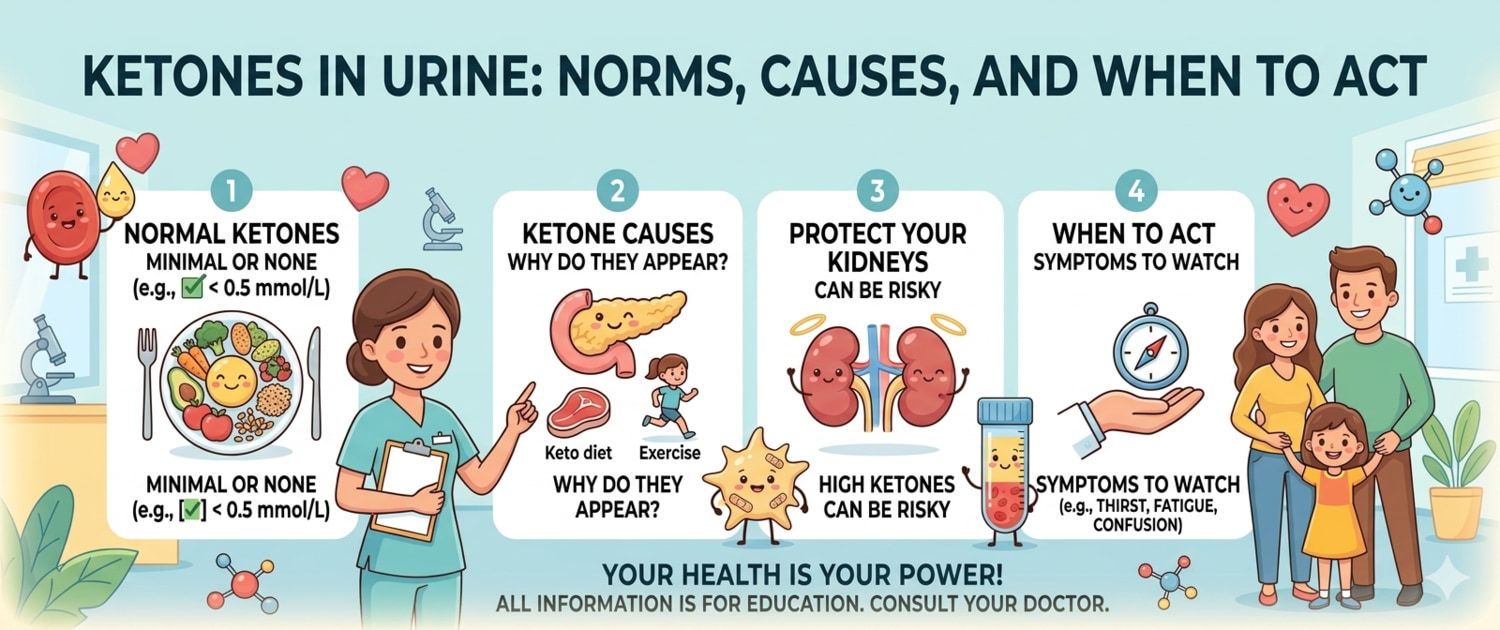
Acetone breath, unexplained fatigue, and an unusual result on a urinalysis — that's often how ketones are first discovered. Sometimes it's simply a consequence of skipping meals or following a strict diet. But sometimes it signals a dangerous condition requiring urgent care. Let's break down what ketone bodies in urine actually are, where they come from, and when the numbers in your results should genuinely concern you.
What Are Ketone Bodies and Why Do They Appear in Urine
Ketone bodies are three organic compounds: acetone, acetoacetate, and beta-hydroxybutyrate. They are produced in the liver when the body switches from glucose to fat as its primary energy source.
Under normal conditions this process runs slowly and at low volume. Ketones are consumed by tissues — the brain, muscles, and heart. The kidneys excrete the remainder in urine, and in small amounts this is entirely physiological.
The problem starts with ketonuria — when ketones are produced faster than the body can use them. The surplus accumulates in the blood and is actively cleared by the kidneys. The higher the blood ketone concentration, the more pronounced the acetone odor on the breath and the higher the level in urine.
Think of it like a furnace burning the wrong fuel: instead of clean combustion, you get acrid smoke. Ketones are that metabolic "smoke."
Normal Ketone Levels in Urine: When Results Are Fine
In healthy people, urine contains either no ketones or a concentration too low to register on standard tests.
| Method | Normal | Abnormal |
|---|---|---|
| Dipstick (qualitative) | Negative (neg) | Trace, +, ++, +++ |
| Nitroprusside test | < 0.5 mmol/L | ≥ 0.5 mmol/L |
| Quantitative (lab) | < 1 mmol/L | 1–3 mmol/L moderate; > 3 mmol/L high risk |
A single "+" on a dipstick corresponds to roughly 1.5 mmol/L; "++" to about 4 mmol/L; "+++" to 8–16 mmol/L. A "+++" result in a person with diabetes carries a high risk of diabetic ketoacidosis — a life-threatening emergency.
In a healthy person without diabetes, a single faint "+" after fasting or heavy exercise is not catastrophic. But context always matters — it shouldn't be ignored.
How to Collect Urine Correctly for Ketone Testing
Ketones are chemically unstable. Poor collection or prolonged storage can produce both false-positive and false-negative results.
Key rules:
- Collect the first morning midstream urine — it is the most concentrated
- Use a sterile pharmacy container
- Deliver to the lab within 1–2 hours — ketones evaporate on standing
- Do not leave the sample at room temperature longer than 30 minutes
For rapid home testing, pharmacy dipsticks give a result in 60 seconds. They are less reliable at very low concentrations but work well for significant ketonuria.
What Causes Ketones in Urine
Fasting and low-carbohydrate diets. The most common everyday cause. On a ketogenic diet or after skipping several meals, the body switches to fat for fuel — ketones appear predictably. This is not a disease, but a signal to review your diet.
Intense physical exercise. Marathon running or prolonged training on an empty stomach depletes glycogen stores rapidly, triggering hepatic ketogenesis.
Vomiting and diarrhea. During acute gastrointestinal illness with repeated vomiting, the body is deprived of carbohydrates and turns to fat. In children this shift happens especially fast — ketones in urine can appear within hours of a fever.
Alcohol intoxication. Ethanol impairs hepatic glucose synthesis and drives ketogenesis. Alcoholic ketoacidosis is a real and underrecognized diagnosis.
Diabetes mellitus. The most dangerous cause — covered separately below.
Hyperthyroidism and other endocrine disorders. Excess thyroid hormones accelerate fat breakdown, increasing ketone production. Blood glucose is often unstable in parallel.
Pregnancy with severe morning sickness. Repeated vomiting creates a caloric deficit that drives the body into ketogenesis.
Ketones in Urine with Diabetes: When It Becomes Dangerous
In type 2 diabetes — and especially in type 1 — ketones in urine are a warning marker. The reason: when insulin is deficient or its action is impaired, cells cannot absorb glucose. The body interprets this as starvation and launches ketogenesis — despite glucose being abundant in the bloodstream.
Rising ketones lead to diabetic ketoacidosis (DKA) — one of the most serious complications of diabetes:
| DKA severity | Urine ketones | Blood pH | Clinical picture |
|---|---|---|---|
| Mild | + (trace–1+) | 7.25–7.30 | Nausea, weakness |
| Moderate | ++ (2+) | 7.10–7.24 | Vomiting, abdominal pain |
| Severe | +++ (3+) | < 7.10 | Altered consciousness |
For long-term glucose monitoring in diabetes, glycated hemoglobin measures average blood sugar over 3 months and helps prevent crises before they develop.
People with diabetes should test urine for ketones when blood glucose exceeds 13–14 mmol/L, during any acute illness with fever, and after missed insulin doses.
Ketones in Urine During Pregnancy
Pregnancy is a special context. The maternal metabolism reorganizes: glucose is prioritized for the fetus, and the mother increasingly relies on fat. This creates physiological "accelerated starvation" — ketogenesis is triggered faster during pregnancy than outside it.
Moderate ketonuria with early morning sickness (up to 12 weeks) is common and typically resolves as nausea improves and food intake normalizes.
When it crosses the line:
- Ketones "++" and above — sign of significant dehydration and energy depletion
- Ketones alongside elevated glucose — possible gestational diabetes
- Persistent ketonuria in the 2nd–3rd trimester — hospitalization required
Prolonged ketone exposure can impair fetal neurological development. Even a single "+" during pregnancy warrants an OB-GYN consultation within a few days. It is worth noting that ketonuria in pregnancy often coincides with protein in urine — which requires differential diagnosis with preeclampsia.
When to Seek Urgent Help and How Ketonuria Is Treated
Call emergency services immediately if:
- Ketones "+++ " with blood glucose > 14 mmol/L in a diabetic patient
- Confusion, disorientation, or sudden severe weakness
- Uncontrollable vomiting — unable to keep water down
- Deep, labored, rapid breathing (Kussmaul breathing) — sign of severe acidosis
- You are pregnant with "++" or higher and vomiting continues
Managing moderate ketonuria without alarming symptoms:
A faint "+" from fasting or diet — restore normal eating with complex carbohydrates (oatmeal, bread, potatoes) and drink plenty of fluids. Ketones usually clear within 12–24 hours.
"+" or "++" from a gastrointestinal infection — oral rehydration therapy, small sips every 10–15 minutes. Escalate to a hospital if symptoms worsen.
In diabetes — the approach depends on diabetes type and the treating physician's instructions: typically an additional insulin dose, increased fluid intake, blood glucose checks every 2–4 hours, and repeat ketone testing.
In children ketones appear far faster than in adults and form a distinct picture — see ketotic syndrome in children.
This article is for informational purposes only and does not replace professional medical advice. Consult a general practitioner or endocrinologist if ketones are detected in your urine.
For informational purposes only
This article is for informational purposes only and does not constitute medical advice, diagnosis, or treatment. Please consult a healthcare professional for medical guidance.