Teething in Children: Timing, Symptoms and What Helps
Reviewed by the LabReadAI medical team
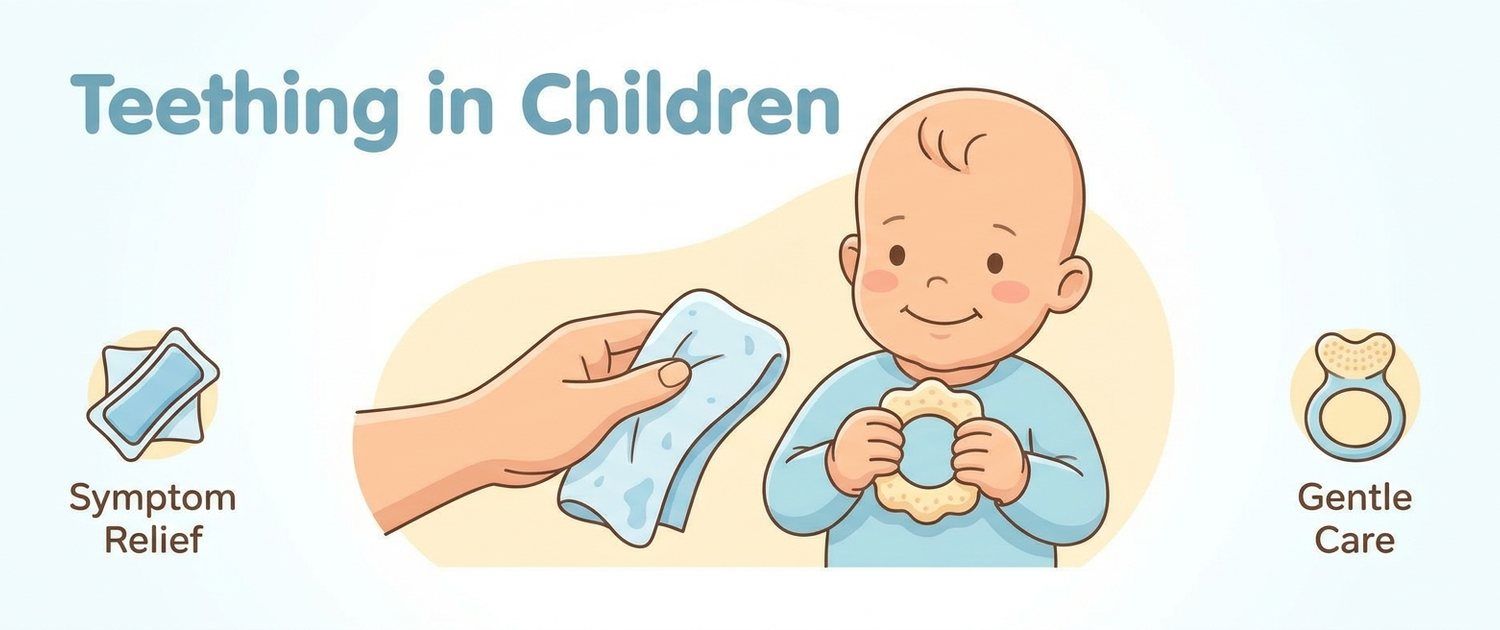
Teething is a rare case where the harm comes not from the condition but from what gets blamed on it. While a parent waits for "it's just teeth", time passes that should have gone into finding the real cause of a fever or diarrhoea. So the most useful knowledge is not which gel to buy but where the line runs between teeth and everything else.
Timing of tooth eruption and the order it follows
| Teeth | Usual age |
|---|---|
| Lower central incisors | 6–10 months |
| Upper central incisors | 8–12 months |
| Upper and lower lateral incisors | 9–16 months |
| First molars | 13–19 months |
| Canines | 16–23 months |
| Second molars | 23–33 months |
The full set of 20 primary teeth is complete by roughly 2.5–3 years. The spread is wide and almost always normal: a first tooth may arrive at 3 months or at a year. The only practical threshold is 18 months with no teeth at all, which warrants a paediatric dentist rather than a calcium supplement.
The order of eruption matters more than exact timing: teeth usually come in pairs and symmetrically, lower before upper. Broken symmetry is easier to spot than a deviation in timing.
Teething symptoms: what genuinely happens
Systematic reviews converge on a short list of what is actually linked to teeth:
- irritability and fussiness, especially in the evening;
- heavy drooling and, as a result, skin irritation around the mouth;
- wanting to chew and putting objects in the mouth;
- a swollen, tender gum over the emerging tooth;
- disturbed sleep for a few nights;
- a slight temperature rise — up to 38 °C, no higher;
- temporarily reduced appetite.
All of this usually lasts 3–5 days around the tooth's arrival, not months.
Fever and teething: where the line runs
This is the key paragraph. Evidence shows teething can produce a minor temperature elevation but not a fever. The practical line is 38 °C: above it, the cause must be looked for rather than blamed on teeth.
Why the error is so common: teeth erupt almost continuously from 6 months to 2.5 years, exactly the age when children start getting frequent infections. Coincidence is inevitable. How to handle fever is in fever in children; the common scenario most often blamed on teeth is covered in fever without symptoms.
Swollen gums and how long teething lasts
Over an erupting tooth the gum looks puffy and pale at the edge. Sometimes an eruption cyst forms — a bluish or purple blister over the tooth. It looks alarming but is a collection of fluid that resolves on its own and should not be opened.
The active phase for one tooth is a few days; the feeling that teething is constant comes from twenty teeth with overlapping phases.
Teething and diarrhoea: examining the myth
Diarrhoea is not explained by teeth. No mechanism links eruption to loose stool. What actually happens: at this age a child mouths everything and picks up intestinal infections, and this is also when solid foods are introduced and stool changes. If loose stool is present, work it through on its merits — see diarrhoea in children.
The same goes for cough, a widespread rash — see rash in children — and vomiting. Teeth do not cause them.
What helps with teething, and what is dangerous
| Remedy | Assessment |
|---|---|
| A chilled (not frozen) teether | Safe and effective |
| Gum massage with a clean finger or damp gauze | Safe |
| Cool water, chilled purée (age-appropriate) | Safe |
| Paracetamol or ibuprofen for marked discomfort | On medical advice, dosed by weight |
| Frozen objects | Do not use: risk of cold injury to the gum |
| Benzocaine gels | Dangerous: risk of methaemoglobinaemia in infants |
| Lidocaine gels without prescription | Dangerous: overdose risk when swallowed |
| Amber necklaces and bracelets | Dangerous: strangulation and bead aspiration; no proven effect |
| Homeopathic teething tablets | Not recommended: non-standardised composition |
Teething gel: why caution is needed
Numbing gels look like an obvious answer, but in infants saliva washes them away within minutes and the swallowed dose is uncontrolled. Regulators in several countries have warned explicitly against benzocaine under age two because of methaemoglobinaemia, a state in which blood loses its ability to carry oxygen. The practical conclusion: if a child is distressed enough to need medication, systemic pain relief prescribed by a paediatrician is safer than a gel with no dose control.
When to see a doctor
- no teeth at all by 18 months;
- teeth erupting markedly asymmetrically or in an unusual order;
- temperature above 38 °C, lethargy, refusal to drink — look for infection, not teeth;
- teeth arriving with enamel defects or dark patches;
- natal teeth — teeth present at birth or in the first weeks, assessed by a dentist;
- delayed eruption together with poor weight gain, sweating and bone deformity — then rickets is excluded and vitamin D and calcium are checked; the deficiency itself is covered in vitamin D deficiency, and night sweating as a trigger for testing in child sweating in sleep.
If the child is unsettled and you cannot tell whether teeth or something else is behind it, assembling the whole picture helps — what, when and with what: that is what symptom analysis does. Growth can be checked against growth norms, and evening crying in infants against colic.
This article is informational. Fever or deterioration needs a paediatric review.
For informational purposes only
This article is for informational purposes only and does not constitute medical advice, diagnosis, or treatment. Please consult a healthcare professional for medical guidance.