Fever Without Symptoms in Children: Causes and What to Do
Reviewed by the LabReadAI medical team
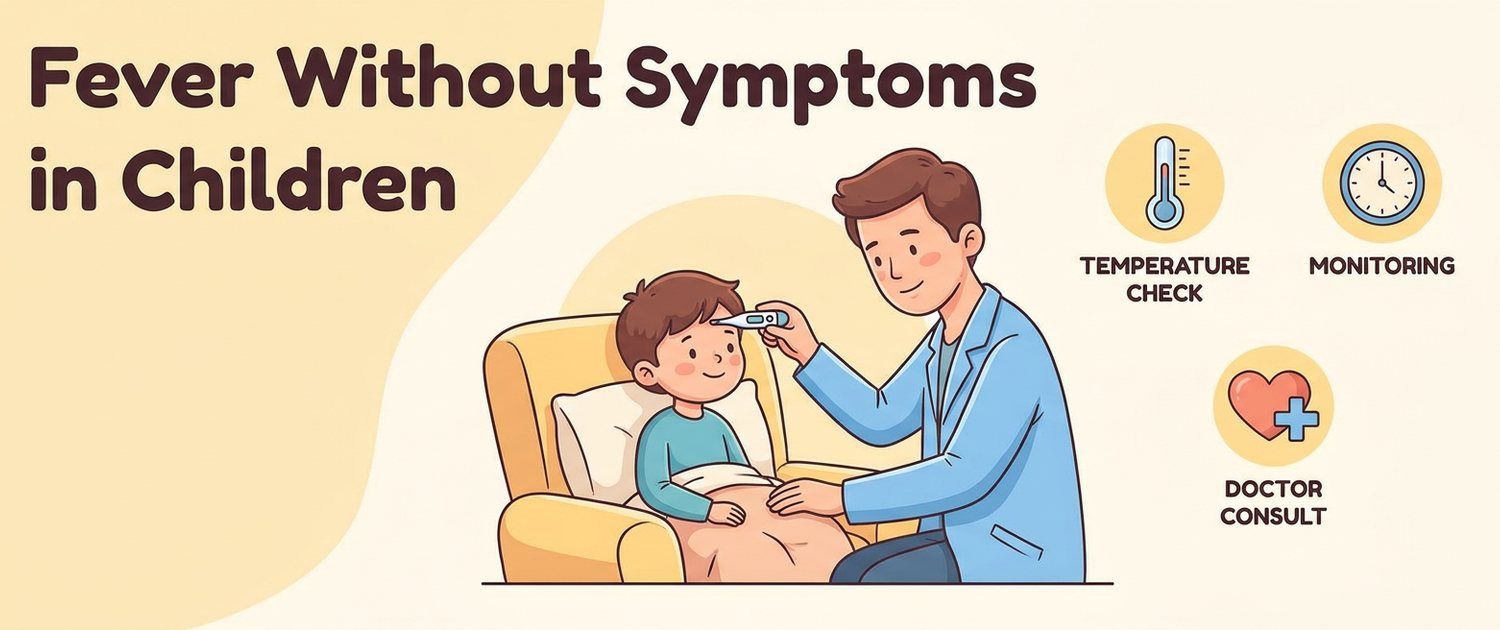
A situation that wears a parent down more than an ordinary cold: a temperature of 38.5–39.5 °C and nothing to find. The throat is clear, the nose dry, no cough, the belly soft, the child listless only at the peak. The doctor shrugs, the parent searches until three in the morning. In fact this scenario has a name — fever without a source — and it comes with a clear set of causes and clear timing for moving from watching to testing.
What fever without symptoms in children means
Medically this is fever without an established source: the temperature is there, but examination cannot find where it comes from. It is not a diagnosis but a point in a process. There are exactly three classes of causes:
- A viral infection whose symptoms lag. The commonest. Runny nose and cough appear on day two or three, rash on day four.
- A focus invisible from outside. Above all the urinary tract, less often the middle ear or pneumonia without cough in the very young.
- Non-infectious causes. Overheating, post-vaccination reaction, and rarely inflammatory or haematological conditions in prolonged fever.
General conduct during fever — antipyretics, fluids, red flags — is covered in the main article on fever in children; here only what is specific to the symptom-free case.
Roseola in children: three days of fever, then a rash
Roseola is the commonest benign ending of this scenario between 6 months and 2 years. The script is recognisable in detail:
| Day | What happens |
|---|---|
| 1–3 | Temperature 39–40 °C with no catarrhal symptom at all; the child is relatively active between peaks |
| 3–4 | The fever drops, often abruptly |
| 4–5 | A pale pink rash appears on the trunk and neck, without itch |
| 5–7 | The rash fades without a trace |
The key to recognition is that the rash appears once the fever is already over, not during it. How to distinguish it from other rashes, including dangerous ones, is covered in rash in children.
Urinary tract infection in children: the main hidden cause
This is the reason to read this article at all. In young children a urinary tract infection often runs without a single urinary complaint: no stinging, no frequency, no pain — only fever. The child cannot say it hurts, and outwardly the picture is indistinguishable from a viral illness.
That is why a urinalysis is part of the standard minimum for fever without a source under age two. What the findings mean — white cells in urine, nitrites, bacteria — is covered separately, and the test itself is described in the urine test card. One detail matters: the sample must be collected correctly, or a false result will be treated instead of the child.
Teething and fever: what is true and what is not
Systematic reviews give the same answer every time: teething may bring slight temperature elevation and irritability, but it does not cause a fever of 38.5–39 °C. If the temperature is high, teeth are not the reason — they merely coincide, because teething runs almost continuously from 6 months to 2.5 years, exactly the age of peak infection frequency.
What teething actually causes is set out in teething in children.
Occult bacterial infection and age
The younger the child, the less appearance can be trusted. In newborns a severe bacterial infection can run with no local signs at all, and sometimes without marked fever.
| Age | Approach to fever without a source |
|---|---|
| Under 1 month | Admission and full workup regardless of how well the child looks |
| 1–3 months | Immediate assessment; laboratory minimum mandatory |
| 3–36 months | Assess appearance; urinalysis for fever without a source, blood as indicated |
| Over 3 years | Observation, testing if fever is prolonged |
Worth knowing from current data: CRP and procalcitonin perform better in infants than the white cell count, but no single marker alone rules out serious bacterial infection — decisions are made on the whole picture.
Fever for three days without symptoms: when to test
The practical threshold is day three. If no local symptom has appeared by its end, watching is no longer enough. The usual minimum:
- a complete blood count with differential — paediatric ranges differ, see CBC in children and blood norms by age;
- C-reactive protein as a marker of bacterial inflammation;
- ESR, slow but useful in a protracted picture, see raised ESR;
- urinalysis — mandatory in young children.
A separate signal is fever lasting over 5–7 days. The search then widens: infectious mononucleosis, node enlargement (see lymph nodes in children), inflammatory disease. Unexplained prolonged fever always warrants a face-to-face workup rather than another dose of antipyretic.
What to do at home and when to see a doctor
While the first two or three days pass and the child drinks, passes urine and responds, management is ordinary: fluids, light clothing, antipyretics by comfort. See a doctor immediately if the child is under 3 months, if a non-blanching rash, lethargy, refusal to drink or breathlessness appears, or if fever has passed the third day with no symptom at all. If cough joins in, see cough in children.
This article is informational. Assessment and treatment belong to the paediatrician.
For informational purposes only
This article is for informational purposes only and does not constitute medical advice, diagnosis, or treatment. Please consult a healthcare professional for medical guidance.