How to Recover From Burnout: What Helps and What Does Not
Reviewed by the LabReadAI medical team
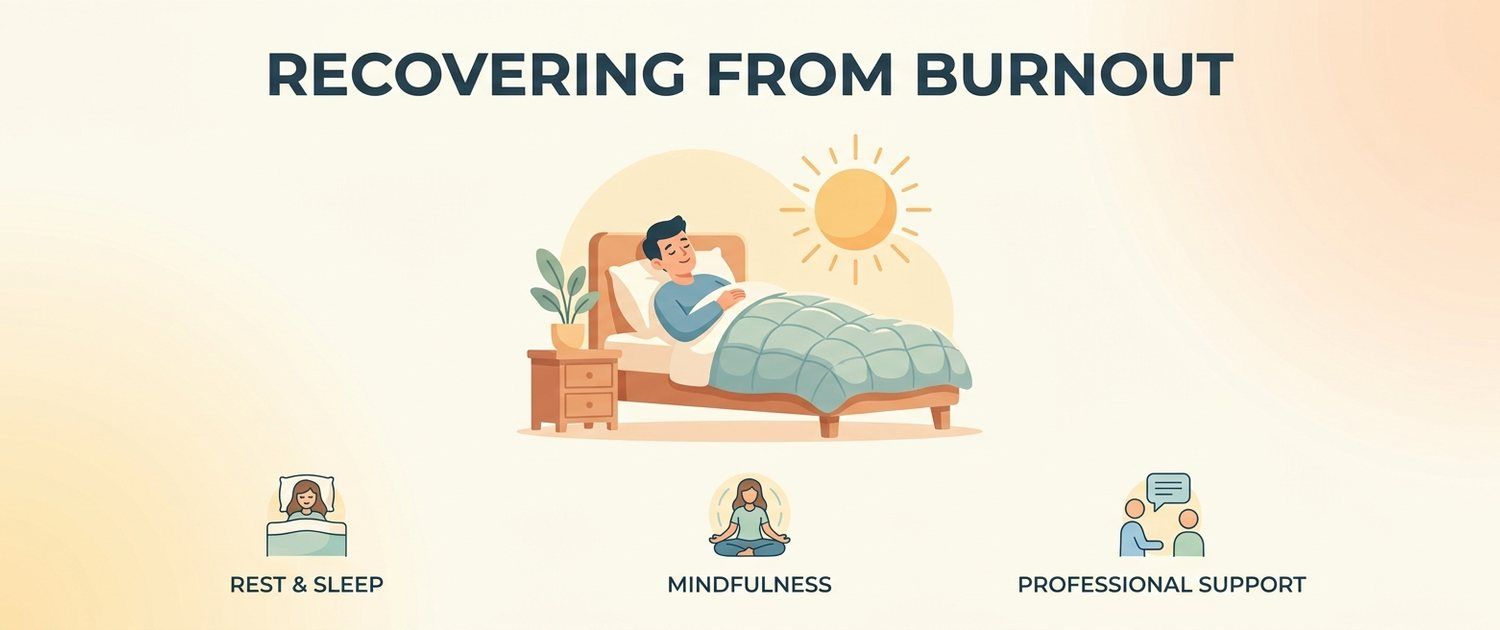
Advice about burnout usually opens with «look after yourself» and ends with a list of fifteen items. The trouble is that fifteen items are one more load. Below is an honest hierarchy: what comes first, what comes second, and where the part a person can carry alone actually ends.
Why «look after yourself» does not work
Burnout is not a shortage of self-care but the outcome of a long drain. While the source of the drain is still in place, a bath and morning pages return exactly as much as they can — and it is gone the next day. Willpower fails for the same reason: it is spent out of the very same pocket.
Hence an order in which first place belongs not to a technique but to a question. The general frame is in the article on what burnout is — including why it is not about weakness.
Step one: name what is spending the resource
A single tiredness score says how bad it is but not where the leak is. It is more useful to break the week into concrete sources of spending and, separately, sources of return.
- What spends. Not «work in general» but specifics: unannounced urgencies, three hours of meetings back to back, no influence over decisions, no visible result, one person whose messages ruin the day.
- What returns. Also specific: what in the past month genuinely gave you energy, even for an evening.
- What changed first. Usually it is not strength that goes first but interest and patience — the signals are unpacked in the article on the signs of burnout.
This is not an exercise for its own sake: every step below works exactly as well as the source of spending has been named.
Sleep: the lever that pulls everything else
If only one thing can be done from the whole list, make it sleep. It is not a healthy habit but the condition under which the rest works. In internet-CBT trials for exhaustion, much of the effect ran through improved sleep: insomnia turned out to be a mediator rather than a side detail.
In practice:
- One wake-up time, weekends included — it holds the rhythm more reliably than bedtime does.
- No work conversations and no screen in the last hour before bed.
- If trouble falling asleep or night waking lasts for weeks, it is a problem in its own right rather than a consequence: what can stand behind it is in the article on the causes of insomnia.
A separate fork is sleeping plenty and still having no energy. That is the subject of the text on constant tiredness.
Detachment: taking back the hours outside the work
The best studied recovery lever is psychological detachment: outside working hours the head is not occupied with work. A large meta-analysis of recovery experiences links it to less exhaustion, less negative affect and less work–family conflict.
What works is not «I will try not to think about it» but a boundary and a ritual: an hour after which work notifications go off; a walk, a shower or a change of clothes as the line between parts of the day; a written list of what is still open, so it stops circling at night.
Rest that actually restores
One belief has to go first: you will not recover from burnout on a holiday. The vacation meta-analysis shows well-being rises, but about a week after returning to work the measures no longer differ from the pre-holiday level, and a long break is no better than a short one. In detail in the article on why a holiday does not help.
What works instead of betting on two weeks a year:
| What to do | How it looks |
|---|---|
| Relaxation | Time with no task and no assessment: a walk, music, quiet |
| Something for yourself | Where you grow: a language, an instrument, sport — not for the sake of work |
| Control over a free hour | You decide how it is spent, rather than the leftovers of the day deciding |
| Short daily pauses | A few minutes with no screen — more often and more reliably than one big rest |
Changing the conditions: the hardest and the most effective
Everything above helps you carry the load. What changes the situation is different — changing the conditions themselves: volume, influence, reward, the people around. Breaking this into concrete areas, and working out what is and is not in your hands, is what the article on burnout at work is for.
It is worth saying separately that people burn out outside jobs too. Where the load has no end of shift — caring for a child, for instance — the «change the conditions» lever is built differently, and that is the subject of the text on parental burnout.
And if nothing can be changed? The honest answer: then what changes is not the conditions but their price — boundaries, expectations of yourself, how energy is spread through the day. It is less than one would like and still more than nothing. Decisions about leaving, paperwork and any employment questions are not for an article: those are conversations with people who know the field.
Honest about the size of the effect
This is the place where big promises are usual, so let us be plain. A meta-analysis of interventions among medical residents — thirty-three studies — found that individual programmes give a modest effect: exhaustion falls moderately, detachment even less. Organisational interventions showed no significant effect in that analysis.
Two conclusions follow. First, the expectation that management will fix it is not supported by evidence — the realistic bet is on what you do. Second, if even honestly made steps produce a moderate shift, the absence of an instant result is not your failure but the normal size of the effect.
How long does burnout last
The answer nobody likes: no one can give you a timeline. There are no diagnostic criteria, the literature holds more than a hundred and forty definitions, and no phase model has been confirmed by research — so there is no point to count «six weeks to normal» from. Why the popular twelve-step schemes predict nothing is unpacked in the article on the stages of burnout.
The practical bearing is different: watch not the calendar but whether rest is starting to pay off again. If several weeks with a changed routine move nothing, that is a signal to look for another explanation rather than to endure longer.
Is burnout treatable, and when to see a specialist
There is no treatment as such, because there is no illness: in the WHO classification burnout sits among factors influencing health status, not among diseases. The wording is unpacked in the article on burnout in ICD-11.
That does not mean a specialist is pointless. Reasons to go:
- the state has not moved for months, whatever you do;
- not only energy but interest and pleasure have gone — the fork is unpacked in the article burnout or depression, and a clinician settles it, not a text;
- persistent bodily symptoms have joined the exhaustion — that scenario is the text on nervous exhaustion;
- thoughts that you do not want to live have appeared — that is a reason to seek help straight away.
What is worth checking in the body: hypothyroidism (a shifted TSH), iron deficiency (low ferritin), a lack of vitamin B12 and vitamin D produce the same picture and, unlike burnout, are fixable. The order is in the article on blood tests for emotional burnout; results you already have the service will help you read in plain language.
Prevention: how to avoid burning out again
Burnout prevention is not a separate course but the same levers applied before the resource runs out. In practice: keep detachment permanent rather than emergency-only; notice rising load by counting hours rather than by how you feel; keep at least one pursuit unconnected to work; and every so often ask yourself that first question again — what is spending the resource now.
How to see your own picture
A quick bearing comes from the short burnout test: six questions, one level from 0 to 100. What to do next depends less on that score than on the combination of two things — your own state and what the environment around your work demands. The full burnout test scores them apart, and the point on the map shows where to apply effort: to recovery, to conditions, or to looking for a different cause.
This article is informational and does not diagnose. In the WHO classification burnout is not an illness, and what is happening to you is decided by a specialist, not by a text on the internet.
For informational purposes only
This article is for informational purposes only and does not constitute medical advice, diagnosis, or treatment. Please consult a healthcare professional for medical guidance.