Depression and Military Service: Articles 17 and 15 Explained
Reviewed by the LabReadAI medical team
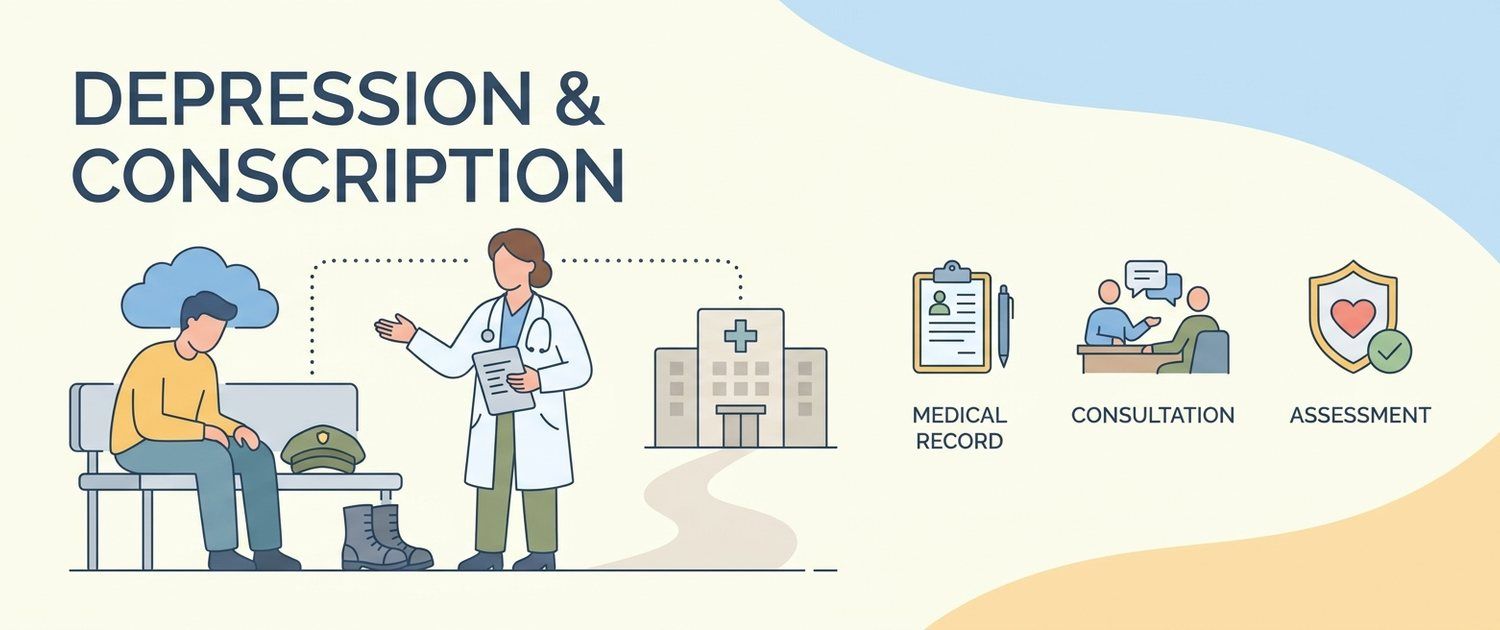
The short answer: depression usually does prevent conscription — but which article applies depends on the nature of the disorder. Psychogenic depression, a reaction to circumstances, falls under article 17 of the Schedule of Diseases, where even a mild depressive episode belongs to clause «b» with category V. Endogenous depression is assessed under article 15, where both clauses give a conscript category D.
Which fitness category depression yields
Article 17 is titled "Neurotic, stress-related and somatoform disorders" and covers reactive psychoses, neurotic, dissociative and somatoform disorders, psychogenic depressive states and reactions, and post-traumatic stress disorder.
| What the records show | Clause | Column I (conscription) | Column III (contract) |
|---|---|---|---|
| Pronounced persistent manifestations | «a» | D — unfit | V |
| Depressive episodes of moderate and mild severity; moderate prolonged or recurrent disorders | «b» | V — limited fitness | V |
| Moderate short-lived disorders ending in compensation | «v» | V — limited fitness | B |
| Mild short-lived adjustment disorders ending in recovery | «g» | B-4 — fit with restrictions | A |
The depressive episode in clause «b», verbatim
This is the key wording, introduced in the current edition:
Clause «b» covers the following mental disorders: psychotic disorders with a short and favourable course, including suicidal intentions and actions, and also depressive episodes of moderate and mild severity; moderately pronounced, prolonged or recurrent neurotic disorders.
Note that mild severity is named alongside moderate. The argument "mine was only a mild depression, it does not count" contradicts the regulation directly: with a confirmed diagnosis this is clause «b» and category V.
Psychogenic and endogenous depression: different articles
Article 17 covers psychogenic depressive states — those arising as a reaction to a traumatic situation. Endogenous affective disorders (recurrent depressive disorder, bipolar affective disorder) belong to article 15, "Endogenous psychoses", where the categories are stricter: both for pronounced persistent manifestations and for moderate short-lived ones, column I gives D.
The wording of the diagnosis in a discharge summary therefore has direct consequences. A psychiatrist determines whether a state is reactive or endogenous, and that must be recorded in writing. What bipolar disorder involves and how it differs from recurrent depression is covered separately in the piece on bipolar disorder.
What "pronounced persistent manifestations" means
Clause «a» is the most severe, and the regulation gives it a measurable criterion:
pronounced neurotic, dissociative and somatoform disorders, where the manifestations, despite treatment provided on an outpatient or inpatient basis (including day hospital), persist and exceed the average duration of continuous treatment by more than 2 times and (or) more than 4 months, and are expressed to a degree that impedes the performance of military service duties, and lead to maladjustment in the main spheres of life.
Three conditions at once: treatment was given, the symptoms outlived it, and the duration was twice the average or over four months. The average duration of a completed case, the regulation notes separately, is established on the basis of clinical guidelines and standards of medical care.
How severity is assessed
The regulation lists what the assessment rests on, and complaints are not on that list:
The severity of neurotic disorders is based on: analysis of their duration… and dynamics, the psychopathological structure and severity of the disorders, the effectiveness of therapy, the type, nature, persistence and severity of impairment of mental functions, the properties of the premorbid personality and the personality's reaction to the illness, insight into one's condition and situation, clinical and social compensation of the morbid state, and the level of social adaptation in the main spheres of life (occupational, family, everyday, social).
The practical consequence: the board is interested in the trajectory — how long it lasted, what treatment was given, whether it worked, and how it affected study, work and relationships. A single entry saying "depression" without that trajectory leaves nothing to assess.
Anxiety-depressive disorder: where it belongs
Mixed anxiety-depressive states are also neurotic disorders and are assessed under the same article 17 through severity and duration. The regulation contains no separate line for them: what matters is not the label but which clause the clinical picture leads to. The anxiety side is covered together with panic attacks and OCD on the neighbouring page of this hub.
What your records must contain
- A psychiatrist's conclusion with the diagnosis and the nature of the disorder — reactive or endogenous.
- A history of follow-up: dates of visits, duration of episodes, dynamics.
- The therapy regimen and its outcome — the regulation names treatment effectiveness as a criterion outright.
- Discharge summaries from inpatient or day-hospital treatment, where applicable.
- An assessment of social adaptation: how the condition affected study, work and daily life.
- The chart code is F32 for a depressive episode; with a protracted course F34.0 also appears.
What is usually missing
- The condition was endured without seeing a doctor — the chart is empty.
- There is one appointment and a prescription but no dynamics: how long it lasted, how it ended.
- The nature of the disorder is not stated, so article 17 cannot be distinguished from article 15.
- Medication was taken irregularly and the effect was never documented; why antidepressants may not work and what is checked then is a separate topic.
- Somatic causes of low mood were not excluded: deficiencies and inflammation genuinely affect mood, and the link between inflammation and depression is worth understanding before the board.
Questions for your doctor
- What is my diagnosis in its exact wording, and under which article is it assessed?
- Is the disorder reactive or endogenous — is that stated in writing?
- How long did the episode last, and how is it recorded by date in my chart?
- Which therapy was prescribed and what was the effect?
- Are there records of how the condition affected study, work and daily life?
Mental health at departmental boards
The above concerns assessment under Government Decree No. 565. The Interior Ministry, National Guard, Federal Security Service and Emergencies Ministry use their own schedules of diseases, and their mental-health requirements are generally stricter. A review under article 17 shows how complete your records are but is not their regulation.
The short version
A depressive episode of mild or moderate severity is named explicitly in clause «b» of article 17 and yields category V — perhaps the most underestimated provision in the whole Schedule. But everything rests on documents: a diagnosis stating the nature of the disorder, a dated history of follow-up, a therapy regimen and its result. Endogenous disorders are assessed more strictly, under article 15. Only the military medical board determines the fitness category.
For informational purposes only
This article is for informational purposes only and does not constitute medical advice, diagnosis, or treatment. Please consult a healthcare professional for medical guidance.