F34.0 — Cyclothymia in ICD-10: What This Diagnosis Code Means
Reviewed by the LabReadAI medical team
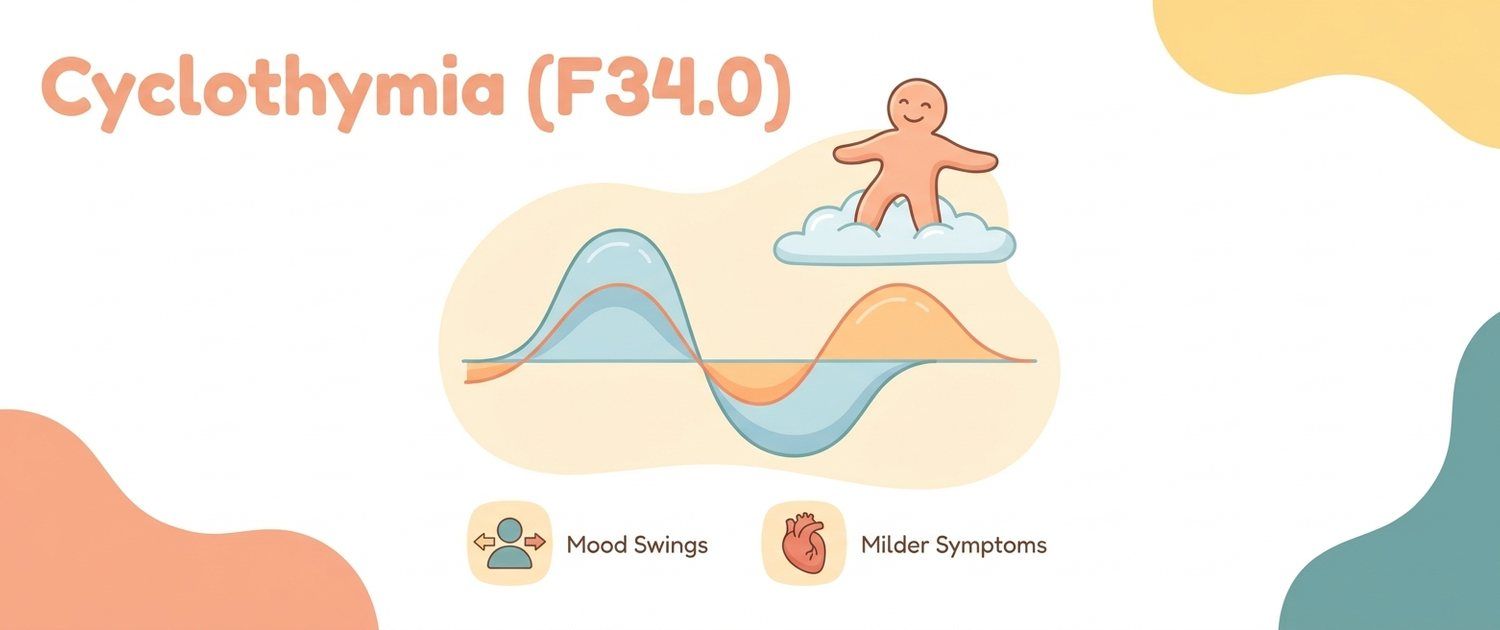
If the «Diagnosis» field of a report, referral or visit record contains only F34.0, the first reaction is almost always the same: the letter «F» is scarier than the diagnosis behind it. Let us take the code apart calmly — what it literally means, where it is used, how serious it is, how it differs from neighbouring codes and what is worth doing next.
What code F34.0 means in ICD-10, element by element
The official wording of F34.0 is «Cyclothymia». Read piece by piece:
- F — the letter of ICD-10 Chapter V: «Mental and behavioural disorders» (F00–F99). The chapter covers both mild and severe conditions, so the letter alone says nothing about severity.
- F30–F39 — the block «Mood [affective] disorders»: conditions whose core feature is an altered mood background rather than disordered thinking or perception.
- F34 — the category «Persistent mood [affective] disorders». The key word is persistent: these are chronic states lasting years that usually do not reach the severity of discrete episodes.
- .0 — the subcategory «Cyclothymia».
In plain language: chronic instability of mood. Periods of mild elevation — more energy, less sleep, plenty of ideas and plans — alternate with periods of decline, when everything is harder, interest is dulled and strength is below the usual level. Neither pole reaches the intensity or duration required for a full hypomanic or depressive episode. The swings typically begin in early adulthood, run in waves and often have no obvious external trigger — which is exactly why people around (and often the person themselves) explain them away as «character» for years.
Where you may have seen this code
| Document | Why F34.0 is there |
|---|---|
| Psychiatrist's or psychotherapist's report | The conclusion after an interview and follow-up — here the code carries real meaning |
| Outpatient visit record | The administrative record of the appointment; a code is mandatory |
| Referral to a specialist | One doctor passes a preliminary or established formulation to another |
| Certificate for a hospital, sanatorium or board | Used when the certificate is addressed to clinicians, not to employers |
| Insurance claim | The clinic reports the service delivered; the code justifies payment |
On confidentiality: your employer, university and colleagues have no access to your diagnosis. A certificate of incapacity for work states no diagnosis at all — neither in words nor as an ICD code, only a two-digit reason code. So F34.0 can only reach you through a medical document addressed to you or to a doctor.
Is cyclothymia (F34.0) dangerous or not
Plainly, without scaring and without softening.
What F34.0 does not mean. It is not a psychosis, not «mild schizophrenia», not a loss of legal capacity and not, in itself, grounds for restricting your work or family rights. Cyclothymia is not an emergency, and most people carrying this code work, study and build relationships as usual.
What it does mean. This is a recognised diagnosis, not a description of temperament. It appeared because a doctor saw a sustained, multi-year pattern rather than one bad week. There is an honest cost to it: unpredictable downswings damage work and relationships, during upswings people take on more than they can later carry, and the constant switching is exhausting. In some people cyclothymia later crystallises into bipolar disorder — which is why follow-up matters even when things feel manageable now.
When not to wait for a scheduled appointment. If the downswings are getting deeper and longer, if thoughts of not wanting to live or of self-harm appear, if sleep almost disappears for several days, or if behaviour becomes risky and unrecognisable — that is no longer «within the diagnosis». Seek help urgently.
Neighbouring codes: F34.0 versus F31, F33, F34.1 and F38
Codes in the F30–F39 block differ by how intense the mood swings are and in what rhythm they occur.
| Code | Meaning | How it differs from F34.0 |
|---|---|---|
| F31 | Bipolar affective disorder | The same two poles, but as distinct, full-strength episodes of mania/hypomania and depression |
| F32 | Depressive episode | One pole, one episode: a downswing with no elevated periods |
| F33 | Recurrent depressive disorder | Repeated depressive episodes without elevation — the unipolar pattern |
| F34.0 | Cyclothymia | Both poles, but mild, chronic and never reaching full episodes |
| F34.1 | Dysthymia | Also chronic and mild, but mood is persistently low, with no elevated periods |
| F38 | Other mood [affective] disorders | Presentations that do not fit the pictures above |
The pair most often confused is F34.0 and F31. The difference is not «better or worse», but amplitude and demarcation: cyclothymic swings are milder and near-constant, bipolar swings are stronger and split into episodes. The second common pair is F34.0 and F34.1 — both chronic, but dysthymia is unipolar. And if you were previously given code F32 and now see F34.0, that is not an error but a refinement made after watching the course over time.
Which tests are usually ordered with this code
Cyclothymia is diagnosed clinically — from the interview, the history of swings over years and observation of the course. There is no laboratory test for it. Yet tests are frequently ordered anyway, for a good reason: several physical conditions mimic the same picture and must be excluded before everything is attributed to mood.
What is usually checked:
- Thyroid function — TSH, and free T4 if TSH is abnormal. Both under- and overactive thyroid convincingly imitate swings of mood and energy; see code E03.9 — unspecified hypothyroidism.
- Full blood count and iron stores (ferritin) — anaemia produces persistent fatigue and low mood.
- Vitamin D and B12 — common deficiencies with blurred psychological symptoms.
- Glucose, and liver and kidney panels where indicated — the baseline physical picture, especially if medication support is being considered.
- A review of medicines and substances, alcohol included: mood swings are often their effect rather than a disorder in their own right.
A separate fork is burnout and chronic stress: clinically they resemble a mild downswing but call for a different approach — what is worth checking is covered in the guide on tests for emotional burnout. The same logic applies to code R53 — malaise and fatigue, used when the cause of exhaustion has not yet been established.
What to do next
- Do not read the code as a verdict. F34.0 describes a pattern of mood swings, not your personality or your prospects.
- Check who assigned the code and on what basis. F30–F39 diagnoses are made by a psychiatrist or psychotherapist; a code on a GP's visit record is most likely provisional.
- Start a mood diary. A simple «date — mood rating — sleep — events» table kept for 4–8 weeks tells a doctor more than any recollection and sharpens the distinction between F34.0, F31 and F34.1.
- Complete the ordered tests and rule out physical causes — thyroid first of all, plus deficiencies: see E03.9 and the burnout test guide.
- Go through your report before the appointment. Understanding the wording and the numbers lets you arrive with concrete questions instead of anxiety.
- Agree on the approach with your doctor. Some people need only observation, sleep regularity and psychotherapy; others need medication support. Any treatment decision belongs to the doctor, never to self-selection.
The short version
F34.0 is the ICD-10 code for cyclothymia: chronic, mild mood swings that run for years without reaching full episodes. It is neither a psychosis nor an emergency, but it is not a personality trait either — it deserves follow-up, because it interferes with life and sometimes crystallises into bipolar disorder. The diagnosis is clinical, tests exist to exclude physical causes, and the plan is set by a doctor together with you.
For informational purposes only
This article is for informational purposes only and does not constitute medical advice, diagnosis, or treatment. Please consult a healthcare professional for medical guidance.