M17 — Gonarthrosis (Knee Osteoarthritis): ICD-10 Code Explained
Reviewed by the LabReadAI medical team
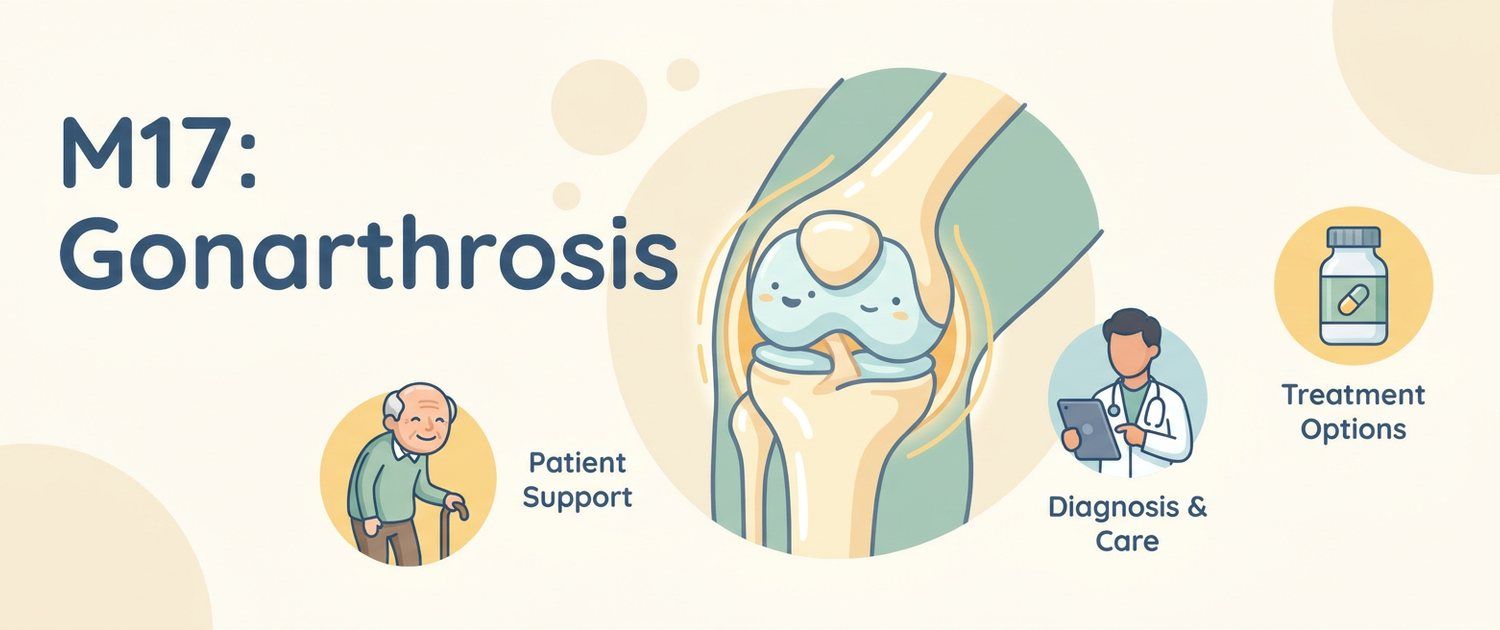
If the «Diagnosis» field of your chart, a radiology report or a referral contains M17, the translation is short and holds no mystery: it means osteoarthritis of the knee. The code states neither a stage, nor a prognosis, nor whether the joint will ever need surgery. It records which joint is involved and what kind of change is present. Below we take the code apart, compare it with its neighbours and set out what is worth doing next.
What code M17 means in ICD-10
The official wording of M17 is «Gonarthrosis [arthrosis of knee]». Element by element:
- M — the letter of ICD-10 Class XIII: «Diseases of the musculoskeletal system and connective tissue». The class covers joints, bones, muscles and ligaments — support and movement.
- M17 — the category «Gonarthrosis». The prefix comes from Greek gony, knee, while «arthrosis» denotes non-inflammatory degenerative joint disease. Together: osteoarthritis of the knee.
- the digit after the dot — origin and side:
| Subcategory | Wording | What it specifies |
|---|---|---|
| M17.0 | Primary gonarthrosis, bilateral | Arose on its own, both knees affected |
| M17.1 | Other primary gonarthrosis | Primary process, usually one knee |
| M17.2 | Post-traumatic gonarthrosis, bilateral | Linked to past injury, both joints |
| M17.3 | Other post-traumatic gonarthrosis | Consequence of injury to one knee |
| M17.4 | Other secondary gonarthrosis, bilateral | Developed on top of another joint disease, both knees |
| M17.5 | Other secondary gonarthrosis | Secondary process, one knee |
| M17.9 | Gonarthrosis, unspecified | No further detail recorded — the commonest entry in outpatient charts |
What happens inside the joint. The cartilage covering the ends of the femur and tibia gradually thins and loses its elasticity. The bone underneath becomes denser, bony outgrowths (osteophytes) form at the joint margins, and the joint space narrows on imaging. This is wear and remodelling, not infection — although swelling during a flare is common.
One practical detail: M17 is assigned from the combination of symptoms, examination and imaging. Phrases such as «grade 2 gonarthrosis» belong to a radiographic scale (usually Kellgren–Lawrence) and are not part of the ICD-10 code — the grade is written out in words beside it.
Where you may have seen this code
M17 appears in documents issued both before and after imaging:
| Document | Why M17 is there |
|---|---|
| Referral for knee X-ray, ultrasound or MRI | A referral needs a code; the doctor records a working diagnosis from symptoms and examination |
| Outpatient visit record | The administrative record of the visit: the reason is knee pain |
| Discharge note or orthopaedic report | The outcome of the appointment, written in words and as a code |
| Certificate for a spa stay, sport or restricted duties | The code marks a chronic musculoskeletal condition |
| Insurance claim | The clinic reports the service delivered; the code justifies payment |
A note on sick notes: certificates of incapacity for work carry no diagnosis at all — neither in words nor as an ICD-10 code — only a two-digit reason code. So if you see M17, you are holding a chart, a certificate, a referral or a discharge note.
Is knee osteoarthritis dangerous or not
Plainly, without alarm and without softening.
What M17 does not mean. It is not a tumour, not an infection and not a systemic autoimmune disease. Gonarthrosis does not threaten life and does not turn into cancer. The code by itself does not mean the joint is «finished» or that a replacement is inevitable: in many people the situation stays stable for years.
What M17 does mean. That structural change is present and chronic — cartilage does not grow back to its former state. Osteoarthritis of the knee is one of the leading causes of pain on walking and lost mobility after 50, and dismissing it as «just age» is wrong. Its real weight is measured not by the picture but by how far you walk without pain, whether stairs are manageable in both directions, and whether pain wakes you at night.
A mismatch between imaging and symptoms is normal. Marked changes on X-ray can come with moderate pain, and the reverse happens too. That is why neither a code nor a single line of a report tells you the severity — a doctor matches them against each other.
When to see a doctor promptly. Signs that do not belong to osteoarthritis itself but need quick assessment: the knee suddenly turns red, hot and swollen; fever appears; the joint locks and will not straighten; the knee gives way or feels unstable after an injury; pain starts abruptly and is unrelated to load.
Neighbouring codes and how they differ
Codes found near M17 differ either in location or in the nature of the process itself.
| Code | Meaning | How it differs from M17 |
|---|---|---|
| M16 | Coxarthrosis (osteoarthritis of the hip) | Same type of change, but in the hip; pain often radiates to the groin and thigh |
| M19 | Other arthrosis | Osteoarthritis of other joints — shoulder, ankle, hands and feet |
| M15 | Polyarthrosis | Several joint groups involved at once |
| M17 | Gonarthrosis [arthrosis of knee] | Degenerative change specifically in the knee joint |
| M13 | Other arthritis | A fundamentally different nature: joint inflammation rather than cartilage wear |
| M23 | Internal derangement of knee | Menisci, cruciate ligaments, loose bodies — structures inside the same knee |
| M42.1 | Adult osteochondrosis of spine | Degeneration too, but in the spine; sometimes explains pain radiating down the leg |
| M41 | Scoliosis | Spinal deformity that alters the load carried by the legs and knees |
The distinction between M17 and M13 is the key takeaway from this table. Arthrosis (M17) is cartilage wear; arthritis (M13) is inflammation with its own causes and its own workup. The words look alike, the substance does not, and confusing them is the commonest error when reading medical paperwork. When knee pain coexists with back pain, charts often carry M17 alongside M42.1 — two independent conditions, not one.
Which investigations are usually ordered for gonarthrosis
The diagnosis rests on symptoms and examination; investigations refine the picture and exclude other causes of knee pain:
- Knee X-ray — the baseline. Joint space width, osteophytes and bone density beneath the cartilage are assessed; films are often taken standing, under load. This is what the «grade» is based on.
- Ultrasound — shows effusion, the state of the synovial lining and a Baker's cyst.
- Knee MRI — when soft tissue matters: menisci, ligaments, cartilage, bone marrow oedema. Ordered when a meniscal tear is suspected or when symptoms and X-ray disagree.
- Blood tests — when an inflammatory cause is suspected: inflammatory markers and rheumatology panels. They are ordered to tell arthritis apart from arthrosis, not to confirm arthrosis itself.
- Bone densitometry — in older adults, to assess bone density in parallel; how that works is covered in the material on osteoporosis.
- Body weight assessment. Every extra kilogram multiplies the load passing through the knee with each step, so body mass index here is not a cosmetic figure but a direct measure of joint loading: it can be calculated with the BMI calculator, and how excess weight is classified is set out under code E66.
The hardest part after imaging is rarely the scan — it is the report: a line about «joint space narrowing», «subchondral sclerosis» and «marginal osteophytes» that leaves you unsure what any of it means for your knee. A description of an X-ray, ultrasound or MRI can be gone through point by point to see which findings explain your pain and which are an ordinary age-related picture.
What to do next
- Do not read severity out of the code. M17 states location and nature, not extent. Severity lives in your symptoms and in the wording of the report.
- Ask about the subcategory. If the document shows
M17with no digit after the dot, ask at your appointment whether the process is primary or post-traumatic and whether one knee is involved or both. It affects follow-up. - Record your symptoms as facts. How far you walk before pain starts, whether descending stairs hurts, how many minutes morning stiffness lasts, whether the knee swells by evening.
- Work through the imaging report. X-ray and MRI terminology translates into plain language, and once translated the document stops being frightening.
- Look at weight and load. Weight reduction is one of the few factors in gonarthrosis a person influences directly; the physiology behind it is covered in the guide to obesity.
- Agree a plan with your doctor. Activity levels, thigh muscle work, pain control, referral to an orthopaedic surgeon — all of that is decided at an appointment, not from a code on a certificate.
The short version
M17 records «gonarthrosis, arthrosis of knee»: chronic degenerative change of cartilage and bone in the knee joint. The code names the joint and the nature of the process, but neither the grade nor the prognosis. What counts is pain, range of motion, walking distance and the content of the report — take those to your doctor.
For informational purposes only
This article is for informational purposes only and does not constitute medical advice, diagnosis, or treatment. Please consult a healthcare professional for medical guidance.