M21.4 — Acquired Flat Foot (Pes Planus): ICD-10 Code Explained
Reviewed by the LabReadAI medical team
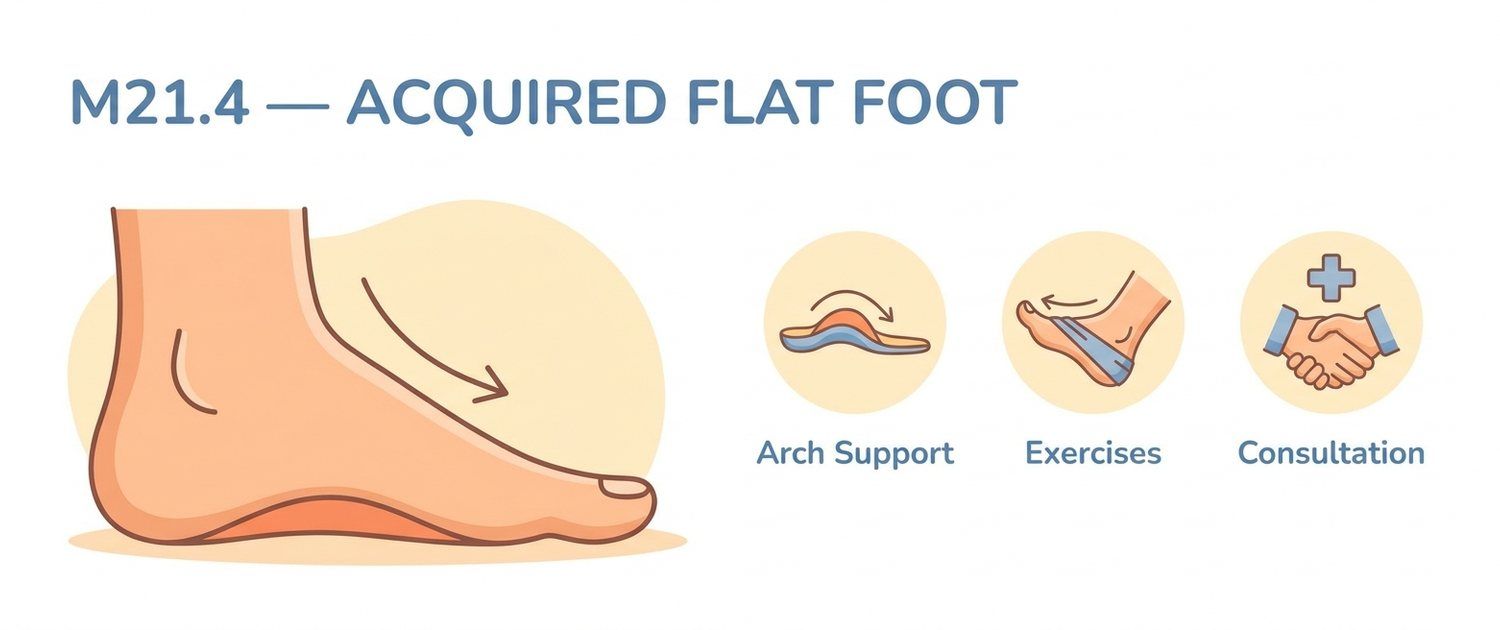
If the «Diagnosis» field of a chart, an orthopaedic referral or a certificate contains M21.4, the translation is short: it means flat foot — a flattened arch. The code states neither the grade, nor whether it will hurt, nor whether anything must be done about it. It records the type of deformity and where it came from. Below we take the code apart, look at where it appears, how it differs from neighbouring codes and what makes sense next.
What code M21.4 means in ICD-10
The official wording of M21.4 is «Flat foot [pes planus] (acquired)». Element by element:
- M — the letter of ICD-10 Class XIII: «Diseases of the musculoskeletal system and connective tissue». The class covers bones, joints, muscles and ligaments — support and movement.
- M21 — the category «Other acquired deformities of limbs». It groups changes in the shape of arms and legs that developed after birth: valgus and varus deviations, deformities of the hand and foot.
- .4 — the subcategory «flat foot (acquired)». The Latin pes planus in brackets is the international name for the same state and appears in the classification itself.
What lies behind the words. The foot does not rest on the ground with its whole surface: there is a longitudinal arch between the heel and the forefoot and a transverse arch across the metatarsals. Together they act as a spring, absorbing the impact of every step. When the ligaments and muscles that hold them stop coping, the arch drops — the contact area grows, shock absorption worsens and load is redistributed to the foot joints and further up to the knees, pelvis and spine.
The decisive word in the wording is «acquired». It means the arch had been built and then flattened: with age, with prolonged standing work, after an injury, with connective-tissue laxity, with weight gain. That is what separates M21.4 from congenital flat foot, which sits in an entirely different class.
Where you may have seen this code
M21.4 turns up in documents issued both at the appointment and after imaging:
| Document | Why M21.4 is there |
|---|---|
| Referral to an orthopaedist or for foot X-rays | A referral needs a code; the doctor records a working diagnosis from examination and complaints |
| Outpatient visit record | The administrative record of the visit: the reason is foot pain or fatigue on walking |
| Orthopaedic or trauma report | The outcome of the appointment, written both in words — usually with a grade — and as a code |
| A child's medical record, school or sports clearance form | A routine orthopaedic check; the code registers the finding about the feet |
| Medical board or conscription paperwork | The code marks a musculoskeletal state; fitness categories are decided by the board, not by the code |
| Insurance claim | The clinic reports the service delivered; the code justifies payment |
A separate note on sick notes: certificates of incapacity for work carry no diagnosis at all — neither in words nor as an ICD code — only a two-digit reason code. So if you see M21.4, you are holding a chart, a report, a referral or a certificate instead.
Is acquired flat foot dangerous or not
Plainly, without softening in either direction.
What M21.4 does not mean. It is not inflammation, not an infection and not a tumour. The code is not life-threatening, does not predict surgery and does not imply disability. A flattened arch is a very common trait: in many adults it persists for decades without pain or restriction.
What M21.4 may mean. That you have a genuine source of pain and early fatigue: aching feet by evening, heaviness in the calves, pain under the heel or the ball of the foot, soles worn down along the inner edge. Over time altered biomechanics increase load further up the chain. Dismissing that with «everyone has flat feet» is unhelpful — symptoms respond to consistent work, but the plan is the doctor's to set.
Childhood is a separate case. Up to roughly the age of 5–7 the arch is physiologically flat and filled with a fat pad — a normal stage of development, not a deformity. So «flat feet» in a three-year-old and in an adult are fundamentally different situations, and it is an orthopaedist at an examination who decides which is which, not the look of a footprint.
When to see a doctor promptly. Signs that do not belong to M21.4 itself but need assessment:
- the foot changed shape quickly, over weeks or months, especially on one side;
- pain and swelling along the inner ankle, or inability to rise on tiptoe on one leg;
- flattening that appeared after a fall, injury or fracture;
- numbness, burning or reduced sensation in the foot — particularly with diabetes;
- pain that does not settle at rest, with fever or redness.
None of these can be read out of a code — they are found on examination. That is exactly why an entry in a document does not replace an appointment.
Neighbouring codes and how they differ
Codes close to M21.4 often share the same paperwork. The difference lies in what is described: the origin of the deformity, its type or a different part of the skeleton.
| Code | Meaning | How it differs from M21.4 |
|---|---|---|
| Q66.5 | Congenital pes planus | Class XVII «Congenital malformations»: the arch never formed, the deformity is present from birth |
| M21.0 | Valgus deformity, not elsewhere classified | Describes outward deviation of the limb axis; often accompanies flat foot but is coded separately |
| M21.6 | Other acquired deformities of ankle and foot | The catch-all for foot deformities that do not fit a specific subcategory |
| M20.1 | Hallux valgus (acquired) | The «bunion» at the base of the big toe — a frequent companion of transverse flattening, but its own code |
| M21.5 | Acquired clawhand, clubhand, clawfoot and clubfoot | Other foot deformities, including the opposite one — an excessively high arch |
The principal contrast in this table is M21.4 versus Q66.5: acquired versus congenital flat foot. These are not two names for one thing but different ICD-10 classes describing different histories. If childhood paperwork carried Q66.5 and adult paperwork now shows M21.4, that is usually two clinicians coding the same case differently rather than a new condition — worth clarifying at an appointment.
Flat foot frequently shares a chart with codes for other parts of the musculoskeletal system: spinal deformity is coded as M41, and knee osteoarthritis as M17. Several codes mean the doctor recorded several conditions, not that one necessarily caused another.
Which investigations are usually ordered for flat foot
The diagnosis is made on examination; investigations exist to measure the degree and to rule out other causes of pain. The typical set:
- Weight-bearing foot X-rays — the mainstay: the image is taken standing, and from it the height and angle of the longitudinal arch are measured, or the angles between metatarsals for the transverse arch. Those numbers produce phrases such as «grade II flat foot», which the ICD-10 code itself does not contain.
- Plantography or pedobarography — a footprint and computerised pressure mapping; illustrative, but grading still requires X-rays.
- Assessment of gait and footwear — the wear pattern of a sole says as much about loading as an image does.
- Ultrasound of ankle tendons — when there is inner-side pain and suspected posterior tibial tendon disease.
- Growth and development review in children — when the code is given to a child, the feet are read alongside the wider picture: growth rate, milestones, bone health. Age references are gathered in the child development calculator, and impaired bone mineralisation as a separate cause of deformity is covered in the guide to rickets.
The hardest part is rarely the procedure itself — it is the report: a page of angles, degrees and terminology from which it is unclear what matters. A foot X-ray description can be gone through line by line to see which figures relate to your symptoms and which are ordinary anatomical variation.
What to do next
A practical sequence:
- Do not read severity out of the code. M21.4 records the type of deformity, not its extent or prognosis. Two people with the same code can walk very differently.
- Describe your symptoms in facts. After how many minutes of walking fatigue appears, exactly where it hurts, at what time of day, whether changing shoes helps. This tells an orthopaedist more than any footprint.
- Check the warning signs above. If even one is present, do not postpone the visit.
- Work through the X-ray report. Angles and indices in the description translate into plain language, and that is where the grade — absent from the code — is stated.
- Look at loading. Body weight is a direct measure of pressure through the arch at every step; in a child the weight-to-height relationship is easy to check with the children's BMI calculator, and in adults excess body weight itself is recorded in the chart under its own code, E66.
- Agree a plan with your doctor. Insoles, footwear, activity, work on the foot and calf muscles, the need for follow-up — all of that is decided at an appointment, not from a code on a certificate.
The short version
M21.4 records «flat foot, acquired» — flattening that developed after the arch had been built. The code carries no grade, describes no pain and is not a verdict: it states only the type of deformity and its origin. What counts is your symptoms, the examination and the figures in the X-ray report — take those to your doctor.
For informational purposes only
This article is for informational purposes only and does not constitute medical advice, diagnosis, or treatment. Please consult a healthcare professional for medical guidance.