Anti-dsDNA Antibodies: Normal Range, Results and Lupus
Reviewed by the LabReadAI medical team
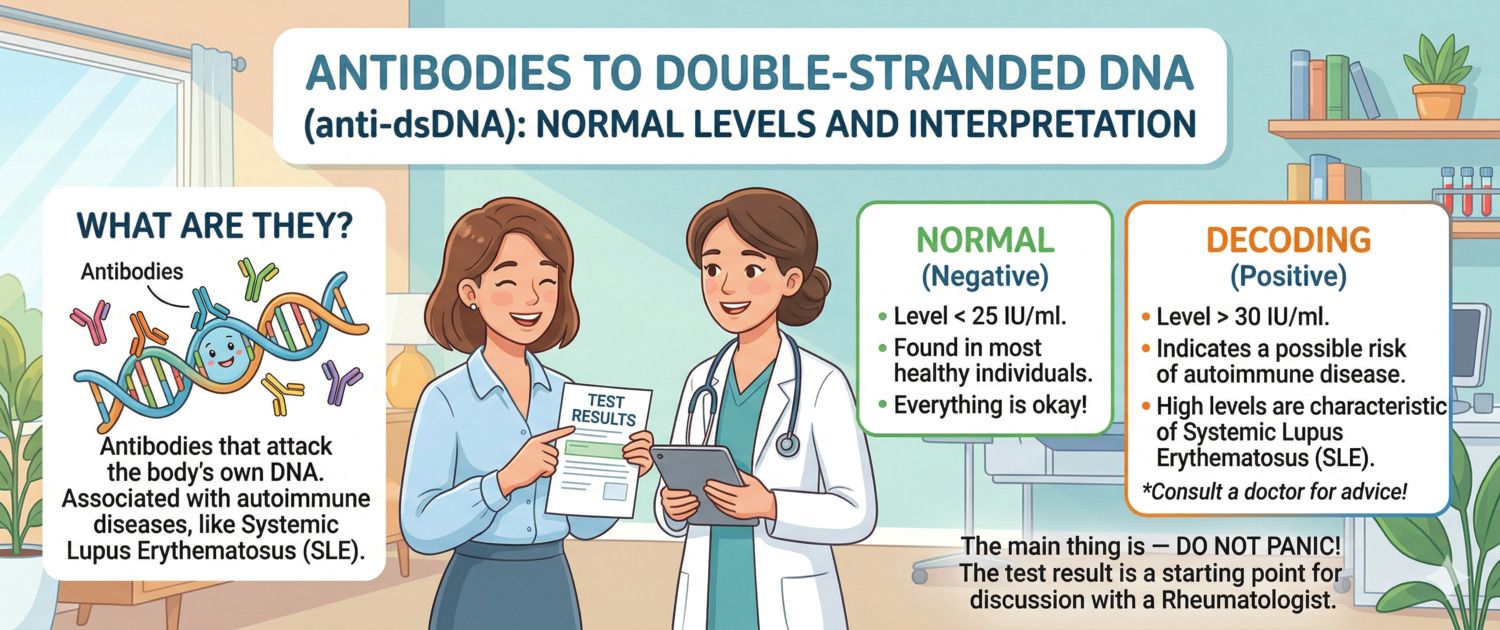
You have been ordered a test for "anti-double-stranded DNA antibodies" — and you are wondering why the immune system would attack its own DNA. That is exactly what happens in systemic lupus erythematosus (SLE): the immune system mistakenly produces antibodies against the double-stranded DNA of cell nuclei. Anti-dsDNA is one of the few serological markers in immunology that combines high specificity for a single disease with genuine prognostic value. This article explains what the test shows, what the reference ranges mean, and when a result requires urgent attention.
What Are Anti-dsDNA Antibodies and Why Are They Tested
Double-stranded DNA (dsDNA) is the core molecule of every living cell. Under normal circumstances the immune system does not react to the body's own DNA — tolerance mechanisms prevent autoantibody production. In systemic lupus erythematosus these mechanisms break down: apoptotic cells release nuclear material which, under the influence of UV radiation or viral infections, is recognised by the immune system as "foreign." Antibodies directed against nuclear components — including dsDNA — are produced in response.
Anti-dsDNA antibodies are pathogenically dangerous: they form immune complexes with DNA that deposit in renal glomeruli, vessel walls, and joint synovium — activating complement-mediated inflammation at each site. This is the direct mechanism of lupus nephritis development.
The clinical value of the test is defined by two properties. Specificity: anti-dsDNA is detected almost exclusively in SLE — specificity exceeds 95%, making it one of the most accurate tests in autoimmune diagnostics. Correlation with activity: unlike most autoantibodies, anti-dsDNA levels track disease activity — rising with flares and falling in remission. This makes the test useful not only for diagnosis but for longitudinal monitoring.
The test is ordered for: confirming the diagnosis when ANA is positive; suspected SLE based on clinical presentation; monitoring disease activity in established SLE; and assessing the risk of flares and lupus nephritis.
How to Prepare for an Anti-dsDNA Test
Blood is drawn from a vein, typically in the morning. The test is relatively robust against short-term external factors, but a few rules matter.
Fasting: the last meal should be at least 8 hours before the blood draw. Fatty food alters the optical properties of serum, which may affect immunofluorescence-based detection methods.
Immunosuppressive medications: glucocorticoids and cytotoxic agents lower anti-dsDNA titres — this reflects their therapeutic effect. For initial diagnostic testing, clarify with your doctor whether a temporary pause is appropriate. For monitoring — blood is drawn on current therapy.
Acute infections: they can transiently influence the immune background. For a planned test, postpone until 2–3 weeks after recovery from any acute illness.
Methods: immunofluorescence on Crithidia luciliae cells (the high-specificity gold standard), ELISA (more widely available, slightly less specific), and chemiluminescence immunoassay. Different methods produce different numerical ranges — direct comparison of results from different laboratories is not valid.
Anti-dsDNA Normal Range: Reference Values
Reference ranges differ between methods and laboratories. The values below are the most widely used benchmarks — always follow the range on your own report.
| Result | Value | Interpretation |
|---|---|---|
| Negative | < 10 IU/mL (ELISA) | Normal |
| Weakly positive | 10–25 IU/mL | Borderline — needs clarification |
| Moderately positive | 25–100 IU/mL | Suspicion for SLE; high clinical vigilance |
| Strongly positive | > 100 IU/mL | Highly specific for SLE; risk of active nephritis |
Several clinically important nuances. A negative anti-dsDNA does not exclude SLE: approximately 30–40% of patients with confirmed disease have a negative or weakly positive result. In these cases diagnosis is established on the composite of clinical and other serological data — anti-Sm antibodies, anti-Ro/SS-A, complement levels. A positive anti-dsDNA without SLE symptoms warrants monitoring: some such individuals develop overt disease within years, and early identification improves outcomes.
The anti-dsDNA titre is not the sole activity marker. A simultaneous fall in complement C3 and C4 together with rising anti-dsDNA is a far more convincing sign of an impending flare than either value alone.
Causes of Elevated Anti-dsDNA
Systemic lupus erythematosus is the primary and practically the only clinically significant cause of substantially elevated anti-dsDNA. With specificity above 95%, a strongly positive result identifies SLE in 9 of 10 cases.
Anti-dsDNA levels in SLE are dynamic. A doubling or greater rise from baseline is one of the earliest predictors of a flare, anticipating clinical symptoms by 4–8 weeks. The strongest correlation is with lupus nephritis activity: high anti-dsDNA in a patient with proteinuria and rising CRP is an indication for kidney biopsy.
Other autoimmune diseases. Weakly positive values (typically within 10–25 IU/mL) can occur in Sjögren's syndrome, mixed connective tissue disease, and chronic active autoimmune hepatitis. These findings are generally low-titre and unaccompanied by complement consumption.
Drug-induced lupus — a distinct condition triggered by certain medications (hydralazine, procainamide, isoniazid, some biologics). It often produces positive ANA, but anti-dsDNA — unlike idiopathic SLE — is usually negative or weakly positive.
Chronic infections — hepatitis B and C, HIV — may produce weakly positive results through non-specific polyclonal B-cell activation. These levels rarely reach the range characteristic of SLE.
Anti-dsDNA vs ANA: Differences and Combined Use
ANA (antinuclear antibodies) is a screening test that detects antibodies against any nuclear component. High sensitivity (95–99% in SLE) but low specificity: ANA is positive in 5–15% of healthy people and in dozens of autoimmune and infectious conditions.
Anti-dsDNA is a confirmatory test: evaluated after a positive ANA to verify an SLE diagnosis. Its high specificity (> 95%) compensates for lower sensitivity.
| Feature | ANA | Anti-dsDNA |
|---|---|---|
| Sensitivity in SLE | 95–99% | 60–70% |
| Specificity in SLE | 57–65% | > 95% |
| Correlation with activity | Weak | High |
| Role | Screening | Confirmation + monitoring |
The algorithm: negative ANA → SLE is unlikely (rare exceptions exist). Positive ANA → extended panel including anti-dsDNA. High anti-dsDNA → high probability of SLE; evaluate against EULAR/ACR 2019 criteria.
The complete blood count with differential is always examined in parallel — leucopenia, lymphopenia, and anaemia in SLE are independent diagnostic criteria.
Monitoring Anti-dsDNA During SLE Treatment
Anti-dsDNA is one of the principal tools for assessing treatment effectiveness and detecting flares early. With successful therapy, the titre gradually falls — a marker of remission. Persistently elevated levels on immunosuppression indicate inadequate disease control.
Monitoring frequency: every 1–3 months in active disease; every 6 months in stable remission. Complement C3 and C4, a complete blood count, and a urine test for proteinuria are always assessed in parallel.
Dynamic anti-dsDNA monitoring allows therapy to be intensified before a clinical flare develops — one of the principal strategies for reducing cumulative organ damage in SLE.
When to See a Doctor Urgently
Immediate rheumatology consultation is required when:
- Anti-dsDNA is markedly elevated (> 100 IU/mL) on initial testing — combined with clinical symptoms, this is a high probability of SLE requiring prompt treatment.
- In known SLE, anti-dsDNA rises sharply compared with the previous value — a likely approaching flare; pre-emptive therapy adjustment reduces organ damage risk.
- High anti-dsDNA is accompanied by proteinuria, rising creatinine, or oedema — signs of active lupus nephritis requiring kidney biopsy.
- Simultaneous falls in C3 and C4 alongside rising anti-dsDNA — the classic laboratory signature of an impending nephritis flare.
- Anti-dsDNA is weakly positive but rising on successive serial measurements — rheumatology follow-up is mandatory: some of these patients develop overt SLE within 1–3 years.
This article is for informational purposes only and does not replace medical consultation. Result interpretation and diagnosis are made by a qualified physician.
For informational purposes only
This article is for informational purposes only and does not constitute medical advice, diagnosis, or treatment. Please consult a healthcare professional for medical guidance.