Systemic Lupus Erythematosus: Symptoms, Diagnosis and Treatment
Reviewed by the LabReadAI medical team
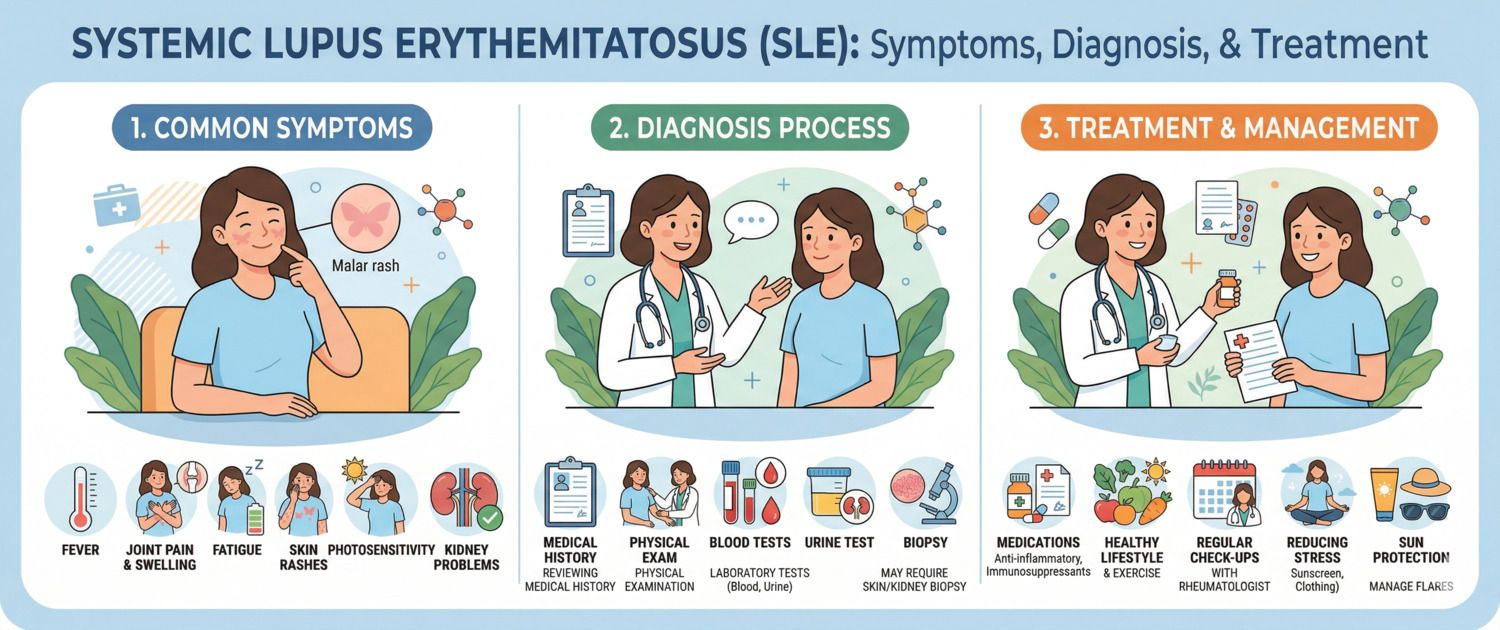
A butterfly-shaped rash across the cheeks, aching joints, persistent fatigue — and a blood panel with multiple abnormal markers. Systemic lupus erythematosus (SLE) is one of the most protean autoimmune diseases: it can affect virtually any organ, and its symptoms shift so unpredictably that years can pass between the first complaints and the correct diagnosis. This article covers how lupus presents, how it is diagnosed, and how it is treated today.
What Is Lupus (SLE) and Why Does It Develop
SLE is a chronic systemic autoimmune disease in which the immune system produces antibodies against the body's own cellular structures: DNA, nuclear proteins, and membrane antigens. The resulting immune complexes (antigen + antibody) deposit in vessel walls, renal glomeruli, joint tissues, and serosal membranes — triggering complement-mediated inflammation at each site.
The mechanism that initiates the disease is not fully understood. Three groups of factors play central roles. Genetic predisposition: carriage of certain HLA-DR2 and HLA-DR3 alleles doubles or triples SLE risk; deficiencies of complement components (C1q, C4) increase it dramatically. Hormonal factors: the disease is nine times more common in women than men, debuts predominantly in the reproductive years — oestrogens amplify autoimmune responses. Environmental triggers: ultraviolet radiation (the best-established precipitant of flares), viral infections (Epstein–Barr virus), and certain drugs (hydralazine, procainamide — causing drug-induced lupus).
SLE prevalence is approximately 50–100 cases per 100 000 population. Rates are substantially higher among women of reproductive age; in women of African and Asian descent, the disease tends to follow a more severe course.
Lupus Symptoms: How SLE Presents
SLE is the "great imitator" — it can masquerade as dozens of other conditions. Symptoms are characteristically relapsing and remitting.
Skin manifestations. The classic sign is the malar rash — a butterfly-shaped erythema across the cheeks and nasal bridge, appearing or worsening after sun exposure. Present in 50–60% of patients; its absence does not exclude the diagnosis. Discoid lupus produces firm erythematous plaques with central atrophy and depigmentation, primarily on the face and scalp. Photosensitivity — exacerbation of skin and systemic manifestations after even brief sun exposure — is one of the formal diagnostic criteria.
Joint involvement occurs in 90% of patients and is frequently the presenting symptom. Unlike rheumatoid arthritis, lupus arthritis is typically non-erosive — joints are painful and swollen but structural destruction does not occur. The symmetrical involvement of small hand, wrist, and knee joints is characteristic.
Lupus nephritis — renal involvement — is the most serious organ manifestation and the primary determinant of long-term prognosis. It develops in 40–60% of patients and presents with proteinuria, haematuria, and rising creatinine. Without treatment it progresses to chronic kidney failure.
Serositis. Pleuritis (pleuritic chest pain worsening on breathing) and pericarditis (retrosternal pain with a pericardial friction rub) are common manifestations of active SLE.
Haematological abnormalities. Autoimmune haemolytic anaemia, leucopenia (particularly lymphopenia — a characteristic activity marker), and thrombocytopenia. All three cell lines may be simultaneously suppressed.
Neuropsychiatric SLE — headaches, seizures, cognitive impairment, psychosis, stroke. This is one of the most diagnostically challenging aspects of the disease.
Constitutional symptoms — chronic fatigue, low-grade fever, weight loss — frequently precede organ manifestations by months.
Lupus Diagnosis: SLE Diagnostic Criteria and Blood Tests
Diagnosis is made against the EULAR/ACR 2019 classification criteria. The system awards points for clinical and immunological features: a score of ≥10 points plus positive antinuclear antibodies (ANA) confirms the diagnosis.
Antinuclear antibodies (ANA) — the obligatory entry-level test. Detected in 95–99% of SLE patients by indirect immunofluorescence. Critically: a positive ANA is non-specific — it occurs in 5–15% of healthy individuals and in many other conditions. A negative ANA at high clinical probability is grounds to repeat the test or perform an extended antibody panel.
Anti-double-stranded DNA antibodies (anti-dsDNA) — the most specific marker of SLE (specificity > 95%). Their titre correlates with disease activity, particularly with lupus nephritis. Rising anti-dsDNA often precedes a clinical flare by 4–8 weeks — making the marker valuable for monitoring.
Rheumatoid factor — moderately elevated in approximately 25–30% of SLE patients. Its presence in lupus does not imply coexisting rheumatoid arthritis, although overlap syndromes exist.
Inflammatory markers and blood cell counts. C-reactive protein behaves atypically in SLE: even with high disease activity it is often normal or mildly elevated. A substantial CRP rise in an SLE patient is more likely to indicate a concomitant infection than a lupus flare. ESR, conversely, is reliably elevated in active SLE. The complete blood count — leucopenia, lymphopenia, anaemia, thrombocytopenia — reflects the degree of immune-mediated cell destruction.
Complement system. Falls in C3 and C4 are markers of active complement consumption by immune complexes. Simultaneous low C3, low C4, and rising anti-dsDNA is the classic laboratory signature of a lupus nephritis flare.
Antiphospholipid antibodies (anticardiolipin, lupus anticoagulant, anti-β2-glycoprotein I) — detected in 30–40% of SLE patients and indicate the risk of antiphospholipid syndrome: thrombosis and obstetric complications.
Lupus Antibodies: Reference Values for Key SLE Markers
| Marker | Normal | Significance in SLE |
|---|---|---|
| ANA (IF) | < 1:80 | ≥ 1:80 positive; > 1:320 high titre |
| Anti-dsDNA | < 10 IU/mL | > 10 positive; correlates with activity |
| C3 complement | 0.9–1.8 g/L | Fall indicates active consumption |
| C4 complement | 0.1–0.4 g/L | Fall characteristic of nephritis flare |
| ESR | < 20 mm/h | In active SLE: 40–100 mm/h or higher |
| CRP | < 5 mg/L | Typically normal or mildly elevated in SLE |
The key interpretive rule: in SLE, diagnosis and activity assessment are based on the composite of all markers, not a single value. Clinicians use the SLEDAI (SLE Disease Activity Index) — an integrated score combining clinical and laboratory data into a single numeric scale.
Systemic Lupus Erythematosus Treatment
There is no cure for SLE, but modern therapy allows most patients to achieve remission and live a normal life.
Hydroxychloroquine (Plaquenil) — the cornerstone of background therapy for all SLE patients without contraindications. It reduces flare frequency, protects the kidneys and heart, and lowers mortality. Prescribed lifelong. Annual ophthalmological monitoring is required because of the risk of retinopathy with prolonged use.
Glucocorticoids (prednisolone, methylprednisolone) — the primary tool for managing flares. In severe organ involvement (nephritis, neuropsychiatric SLE) — intravenous methylprednisolone pulse therapy. Long-term high-dose use is limited by cumulative toxicity: osteoporosis, infections, cataracts, arterial hypertension.
Immunosuppressants. Mycophenolate mofetil and azathioprine are the backbone of maintenance therapy in nephritis. Cyclophosphamide is used in severe class III–IV nephritis and neuropsychiatric SLE. Methotrexate is an option for joint and skin manifestations.
Biologics. Belimumab (BLyS/BAFF inhibitor) — the first biologic approved specifically for SLE: it reduces disease activity and allows glucocorticoid dose reduction. Anifrolumab (type I interferon receptor inhibitor) — a newer agent for moderate-to-severe disease.
Sun protection — not a recommendation but a medical necessity: UV radiation is the primary trigger for flares. Daily SPF 50+, UV-protective clothing, and avoiding peak sun hours are part of treatment.
Lupus Complications and Comorbidities
SLE substantially raises cardiovascular risk: the risk of myocardial infarction in young women with SLE is up to 50 times higher than in age-matched women without the disease. Drivers include chronic inflammation, accelerated atherosclerosis, hypertension from renal involvement, and glucocorticoid side effects.
Antiphospholipid syndrome in SLE — venous and arterial thrombosis risk, recurrent pregnancy loss. Requires anticoagulant therapy.
In chronic kidney disease from lupus nephritis — renoprotective strategy: ACE inhibitors, blood pressure below 130/80 mmHg, protein restriction.
Hypothyroidism occurs in SLE patients more frequently than in the general population: autoimmune thyroiditis is a common comorbidity. Routine TSH monitoring is standard in all SLE patients.
When to See a Doctor Urgently
Immediate rheumatology consultation or hospitalisation is required when:
- Worsening proteinuria or rising creatinine in a patient with SLE — possible lupus nephritis flare requiring kidney biopsy and aggressive immunosuppression.
- Acute pleuritic pain with breathlessness — serositis or thromboembolism; in patients with antiphospholipid antibodies, PE is especially likely.
- Seizures, psychosis, or acute stroke in a young woman with SLE — neuropsychiatric SLE or antiphospholipid syndrome.
- High fever (> 38.5°C) on immunosuppressive therapy — differentiating a lupus flare from infection is critical; CRP helps: a marked rise points toward infection.
- Anti-dsDNA titre rises sharply on routine monitoring — a clinical flare may follow in 4–8 weeks; adjusting therapy before manifestation improves prognosis.
- First presentation: the combination of joint involvement, skin changes, haematological abnormalities, and fatigue in a young woman — SLE until excluded.
This article is for informational purposes only and does not replace medical consultation. Result interpretation and diagnosis are made by a qualified physician.
For informational purposes only
This article is for informational purposes only and does not constitute medical advice, diagnosis, or treatment. Please consult a healthcare professional for medical guidance.