Fight, Flight, Freeze: Threat Responses and Why There Are Four
Reviewed by the LabReadAI medical team
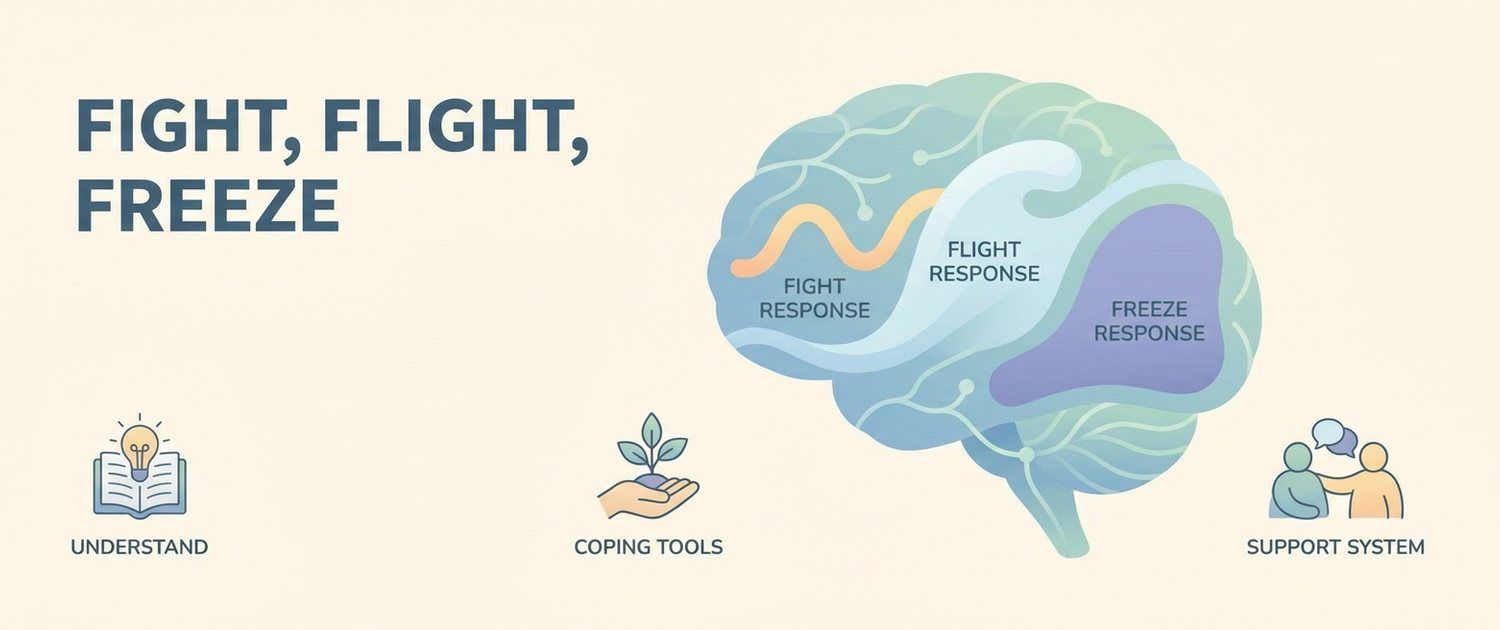
Fight or flight is the best-known formula about responding to danger and the least complete one. People who have been through an assault, a crash or domestic abuse most often ask not about fight and not about flight, but about the third thing: why did I do nothing, why did I stand there, why did I not shout.
The answer lies in physiology rather than character. There are more than two responses, they engage in a particular order, and some of them are built so that decisions do not reach them.
The defence cascade: what follows what
The current description is the defence cascade (Kozlowska et al., 2015): a continuum of innate, automatically activated responses, each with its own neural pattern.
Arousal
The first step is not action but arousal and orienting: attention narrows onto the source, the body prepares. When the system gets stuck here for a long time, that is hypervigilance.
Fight and flight
Active defence. The sympathetic system accelerates the heart, redistributes blood flow to the muscles and raises blood pressure. This is what everyone knows as adrenaline.
Freezing
Neither passivity nor surrender. Roelofs (2017) describes freezing as a parasympathetic brake on the motor system, accompanied by heart rate deceleration: the body is stopped while preparation for action continues. Hence her own phrase, freeze for action: freezing serves perception and the preparation of movement, and flexibly shifting between freezing and active defence depends on connections between the frontal cortex and the amygdala.
Tonic immobility and collapse
The last-resort responses. They engage when active defence is no longer possible — for instance when resistance is physically useless or blocked. A review of stabilometry studies (Volchan et al., 2017) distinguishes attentive immobility, immobility under attack and tonic immobility; the first two involve reduced body sway and slowed pulse, while tonic immobility is marked by robust tachycardia. The authors note separately that tonic immobility in particular is strongly associated with the severity of subsequent PTSD.
Why freezing is neither weakness nor a choice
Three facts worth knowing.
First: it is a common response, not a rare one. In a study of 298 women who attended an emergency clinic for raped women within a month of the assault (Möller et al., 2017), 70% reported significant tonic immobility during the event and 48% reported extreme tonic immobility.
Second: it affects the outcome. In the same study, tonic immobility was associated with higher odds of PTSD (OR 2.75) and severe depression (OR 3.42) at six months. The authors state directly that knowledge of this reaction matters in legal contexts too: absence of resistance does not mean consent.
Third: it does not pass through a decision. The last-resort responses are served by ancient structures (the amygdala, the periaqueductal grey, autonomic nuclei) and start faster than an appraisal of the situation can form. The reproach I should have acted is addressed to a system that was not connected to decision-making at that moment.
The practical point of this is not consolation but the removal of a false ground for shame — the shame that afterwards holds self-concept hostage for years and feeds avoidance.
What happens afterwards
The cascade has a tail. When the threat recedes, the mobilisation that built up has to go somewhere — hence trembling, tears for no reason, nausea, yawning, abrupt sleepiness or, conversely, an inability to stop and sit down. This is not a nervous breakdown and not a sign of getting worse: it is discharge, and it usually takes from a few minutes to a few hours.
Nothing speeds it up except quiet: a warm drink, no urgent tasks, familiar surroundings, someone nearby if possible. What goes badly is the other option — pulling yourself together and working immediately. Then the mobilisation does not discharge but stays as a background and adds to the next episode; that is how the level accumulates at which any small thing starts the cascade from scratch. What actually changes in physiology along the way — and where retellings run past the data — is unpacked in the article on the body keeping the score.
The fourth response: fawning
Popular texts often add a fourth response to the three — fawning: under threat a person neither fights nor runs but becomes maximally convenient, agrees, manages the other person's mood, absorbs the conflict.
Honesty is needed here. The term comes from practitioner literature on complex trauma, not from the research model of the defence cascade. As a description of behaviour it is accurate and recognisable: in a prolonged dangerous environment — a family, an abusive relationship — reading and anticipating someone else's state really does become the main means of survival. As a fourth physiology alongside sympathetic acceleration and parasympathetic braking it is not accurate: the cascade model describes no separate neural pattern for fawning.
A reasonable formulation: this is not a physiological response to acute threat but a learned strategy under chronic threat. Which makes it more interesting, not less, because the strategy stays when the environment changes.
How this looks years later in ordinary life
The modes do not go anywhere; they simply get applied to ordinary situations.
- Fight — a flare of irritation over something trivial, sharpness in messages, the sense that the body is faster than words. On the swings themselves, see emotional dysregulation.
- Flight — an abrupt exit from a relationship, a job, a conversation; the pull to close the tab, leave the chat, drive away. It often looks like decisiveness and feels from inside like necessity.
- Freeze — blankness in a meeting, an inability to answer an unfair accusation, a simple task postponed for days. It is recognisable by the way the right words arrive an hour after the conversation.
- Fawn — an automatic yes, apologising for someone else's mistake, an inability to name a boundary without guilt.
Mixed forms are more common than pure ones: first an automatic yes, then a delayed flare at a safe person — a partner, a child, a colleague who did nothing to earn it — and then shame, which returns you to fawning again. This is not a character trait but a loop, and it is broken not by willpower but by lowering the general background and by having words ready in advance.
If an episode involves losing contact with the body or the surroundings — watching yourself from outside, the world behind glass, time dropping out — that is closer to dissociation; if the scene of the event itself returns, that is flashbacks. Neighbouring mechanisms, different anchors.
What to do with this
The task is not to switch the responses off — they are useful and they are not going anywhere. The task is to widen the window in which choice is available.
- Recognise the mode by the body, not by thoughts. Acceleration (heart, heat, urge to act) and braking (cold, heaviness, blankness) need different things: the first needs discharge and a lengthened out-breath, the second needs movement, warmth, speaking aloud, contact with a support.
- Bring back the present. Place, date, age, feet on the floor. Simple and effective.
- Decide nothing important while in the mode. Neither in acceleration nor in numbness is the appraisal of a situation accurate.
- Prepare phrases in advance. I need to think about it until tomorrow is a legitimate answer that removes the need to respond instantly.
- Lower the general background. Sleep, regularity, less incoming threat. The lower the background, the less often the cascade fires.
If the responses have become frequent and are costing you your life, it is worth looking at the whole picture. The free PCL-5 scale gives a score against DSM-5 criteria in five minutes — a convenient reference point for a conversation with a doctor. If the question is not the score but which part predominates — the traumatic core, or what a prolonged situation has left in self-concept and relationships — the complex PTSD test works that through across the six ICD-11 clusters. Neither one makes a diagnosis.
If the danger is ongoing right now, or thoughts of death have appeared, call or text 988 in the United States, Samaritans on 116 123 in the United Kingdom, or your local emergency number. Safety comes before any analysis of your state.
When it is not trauma
Numbness, flares and sudden weakness happen for other reasons too, bodily ones included, and those are worth checking rather than guessing at.
- Anxiety disorders and panic attacks. They produce acceleration with palpitations and an urge to leave, but usually without a tie to reminders of a specific event.
- Depression and long-running exhaustion. They give the same freeze picture: blankness, postponed tasks, an inability to start. The leading sensation here is powerlessness and indifference rather than danger.
- ADHD. Stalling in front of a task and flares of irritation are a typical picture, but they reach back into childhood and are not tied to reminder cues.
- Autism. Shutdown and loss of speech under overload are built differently: they follow sensory and social load rather than threat.
- A borderline pattern. The flares are addressed to the risk of abandonment and belong to relationships rather than to the environment.
- The body. Fainting and near-fainting, abrupt weakness and palpitations deserve a separate check: iron deficiency with low ferritin, a shifted TSH, low blood pressure, rhythm disturbances, low blood sugar. Muscle weakness and numb limbs also occur with a lack of vitamin B12. Results you already have, the service will help you read.
The distinguishing marker is the same as across the whole topic: does the mode engage in response to reminders, and do intrusions and avoidance stand alongside? The body explains the strength of a reaction, not what it is addressed to.
This article is informational and does not diagnose. It does not claim that you have PTSD, nor that you do not: a doctor determines that in person.
For informational purposes only
This article is for informational purposes only and does not constitute medical advice, diagnosis, or treatment. Please consult a healthcare professional for medical guidance.