Hypervigilance: When Watchfulness Does Not Switch Off
Reviewed by the LabReadAI medical team
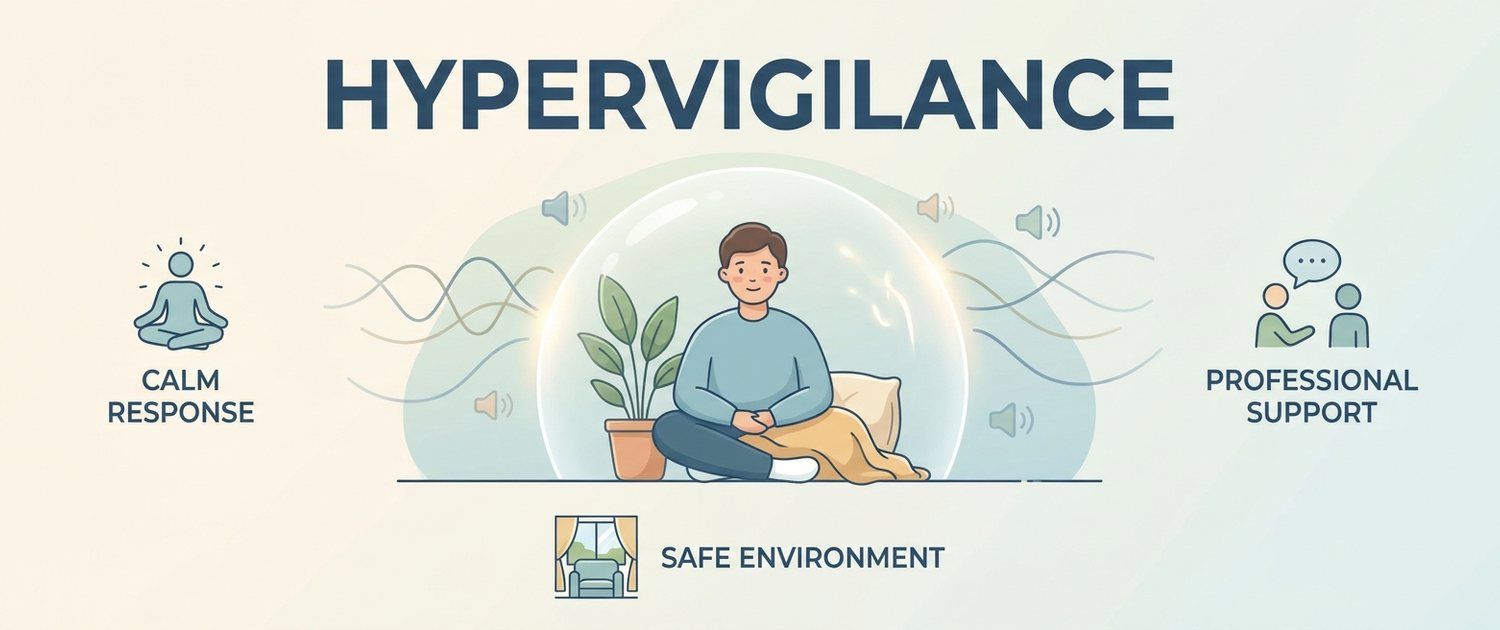
Hypervigilance is a state in which attention is permanently occupied with checking the environment for danger. Not panic, not an attack, but a steady background: the person knows who has entered the cafe, where the nearest exit is, how many people are behind them, and hears footsteps in the stairwell before anyone else.
From the inside it is rarely called a symptom. More often it is I am careful, I am observant, I just have good hearing. What makes it visible is the cost: by evening there is nothing left although nothing in particular happened; a holiday takes four days before anything unclenches; in a noisy place a conversation turns into work.
What hypervigilance is
Formally it belongs to the third ICD-11 PTSD cluster — a sense of current threat, which also covers an exaggerated startle response, constant watchfulness, difficulty relaxing, broken sleep and irritability. All three clusters are covered in the article on PTSD.
What matters is that this is neither paranoia nor a character trait. Scanning mode is a normal function that switches on in dangerous surroundings, where it is entirely appropriate. The problem arises when the surroundings change and the mode stays on: the system keeps running by the rules of an environment that no longer exists.
The objective side is measurable. The meta-analysis of psychophysiological studies (Pole, 2007) shows a higher heart rate in people with PTSD at rest and especially in response to event-related cues, along with slower habituation of the startle response — the system takes longer to accept a signal as safe. The author is explicit about a limitation: published samples skew towards male veterans.
How it looks in ordinary life
The recognisable forms are almost always domestic:
- the seat in a cafe is chosen with the back to the wall and facing the door — and by coincidence it happens every time;
- faces are read for mood and a voice for intonation: has it shifted, is something starting;
- on the road the gaze holds the mirrors and the verges, in the stairwell the footsteps and the doors;
- a sharp sound produces not a flinch but a full launch: heart, breath, readiness to act;
- falling asleep requires conditions, and any noise at night brings you fully up;
- the phone gets checked first thing for what has happened;
- in a conflict the person reads danger several moves ahead — and is often right, which is what makes the mode so hard to switch off.
That last point is worth underlining: hypervigilance often does give a real advantage in reading people and situations. The argument is not with its accuracy but with its price, which is paid in attention, sleep and relationships.
Why watchfulness sustains itself
The nastiest property of the mode is that it is self-sustaining. The experiment by Kimble and colleagues (2014) with 71 participants tested this directly: people were instructed to stay watchful while looking at neutral pictures. In the hypervigilant condition participants made significantly more fixations, spread them across a greater area of the scene and had larger pupils — while self-reported anxiety did not change. Increased scanning itself raises arousal, even when there is nothing to look at and the person does not consider themselves anxious.
Hence a practical conclusion: persuading yourself that everything is safe is of little use, because the loop rests on the behaviour of attention rather than on belief. What works is what changes behaviour and environment, not an argument with yourself.
The second amplifier is avoidance. The more places and situations get steered around, the less experience there is to lower the forecast of danger. How this ties into cues is in the article on retraumatisation. The third amplifier is emotional swings: on a high background any small thing produces a large response, and vice versa — covered separately in the article on emotional dysregulation.
How this differs from an anxiety disorder
The difference is the address of the worry.
Generalised anxiety is about the future in general: health, money, children, work. It is spread out in time and lives in the head as a stream of what-ifs.
Hypervigilance is about the present and about space: who is nearby, what is behind you, whether an intonation has changed. It is spread out in the environment and lives in the body and in attention before it reaches thought.
A further difference is the tie to cues. In PTSD the background rises in recognisable circumstances: similar surroundings, a similar person, an anniversary. In generalised anxiety there is usually no such link. And a third: in PTSD intrusions and avoidance stand alongside — which pure anxiety does not have. Intrusions are covered in the article on flashbacks.
Watchfulness is also worth distinguishing from freezing: cannot move and cannot decide is a different mechanism, covered in fight, flight, freeze.
Sleep is part of the mechanism, not a consequence
Sleep almost always breaks up under hypervigilance: control is hard to release, hearing stays sharp, the plots of dreams involve threat. The temptation to treat this as a side effect that will catch up by itself is strong — and mistaken.
Germain's review (2013) notes that sleep disruption and nightmares may reduce the efficacy of first-line PTSD treatment, and that sleep itself is considered a modifiable risk factor for poor outcome. A prospective study of 453 service members (van Liempt et al., 2013) found that nightmares before deployment predicted PTSD symptoms six months after it (OR 2.99), while insomnia complaints did not. The practical reading: sleep deserves to be a task of its own and a topic with a doctor, not something postponed until the main thing is sorted.
What lowers the background
None of the items below treats PTSD — this is stabilisation, meaning what brings the background down and makes further work possible.
- Regularity. The same waking time, food, daylight, movement. A predictable day is the most underrated tool in this field.
- Sleep as a project. A dark and quiet room, no screen before bed, no alcohol as a sedative (it shreds the second half of the night). Recurring nightmares are a reason for an appointment, not for endurance.
- A managed environment. Headphones on transport, familiar routes on hard days, seats where your back is covered. Using supports is not a defeat; the defeat is paying for their absence in attention.
- Less incoming threat. A news feed and crime stories feed the danger forecast directly. This is not about staying ignorant but about the dose and the time of day.
- The body before the head. A long out-breath, walking, exertion. Arousal comes down through the body faster than through arguments.
- One person who knows. Not for going through details, but so that it is not carried alone.
None of these promises a quick result, and none works as a one-off. The background comes down the way it went up — by accumulation: a week of a predictable routine shows more than one perfectly spent evening. It is more useful to track something measurable than the feeling of having calmed down: how many times you flinched this week, how many nights passed without waking, how many places you stopped avoiding.
If the background holds for months, it is worth measuring rather than eyeballing. The free PCL-5 scale gives a score against DSM-5 criteria in five minutes — convenient to bring to a doctor. If the question is not the score but which part predominates — the sense of threat itself, or what a prolonged situation has left in self-concept and relationships — that logic is what the complex PTSD test works through: it separates the six ICD-11 clusters and shows the cost in life separately. Neither one makes a diagnosis: a doctor does that in person. Decisions about medication are also made by a doctor.
If thoughts of death or an urge to hurt yourself appear, call or text 988 in the United States, Samaritans on 116 123 in the United Kingdom, or your local emergency number.
When it is not trauma
Constant watchfulness and background anxiety are a non-specific sign. Before explaining them by what was lived through, it is worth walking the ordinary list.
- An anxiety disorder. The worry is addressed to the future and not tied to recognisable cues; intrusions and avoidance of reminders are absent.
- Depression. It brings irritability, broken sleep and morning anxiety, but the lead is a drop in interest and energy rather than scanning of the environment.
- Long-running exhaustion. At the bottom of the tank thresholds fall: everything seems louder. It is distinguished by recovering with rest.
- ADHD and autism. Here high reactivity to the environment reaches back into childhood: in autism the sensory load comes first, in ADHD the difficulty of filtering background. There is no before and after.
- A borderline pattern. The scanning is addressed to relationships and the risk of abandonment rather than to the environment.
- Substances. Large doses of caffeine, nicotine swings, energy drinks and especially alcohol withdrawal produce exactly this picture — tremor, startle, insomnia.
- The body. An overactive thyroid with a shifted TSH is the classic imitator: palpitations, sweating, anxiety, insomnia. Iron deficiency with low ferritin gives palpitations and depletion; a lack of vitamin B12 gives paraesthesia and brain fog. Sleep apnoea and low blood sugar also produce night waking with a pounding heart. Results you already have, the service will help you read.
In the end the distinction rests on one marker: whether the background rises in response to reminders — places, people, dates, sounds — and whether intrusions and avoidance stand alongside. The body explains the level of arousal, but not what it is addressed to.
This article is informational and does not diagnose. It does not claim that you have PTSD, nor that you do not: a doctor determines that in person.
For informational purposes only
This article is for informational purposes only and does not constitute medical advice, diagnosis, or treatment. Please consult a healthcare professional for medical guidance.