Retraumatisation and Triggers: Why It Gets Worse and How to Avoid That
Reviewed by the LabReadAI medical team
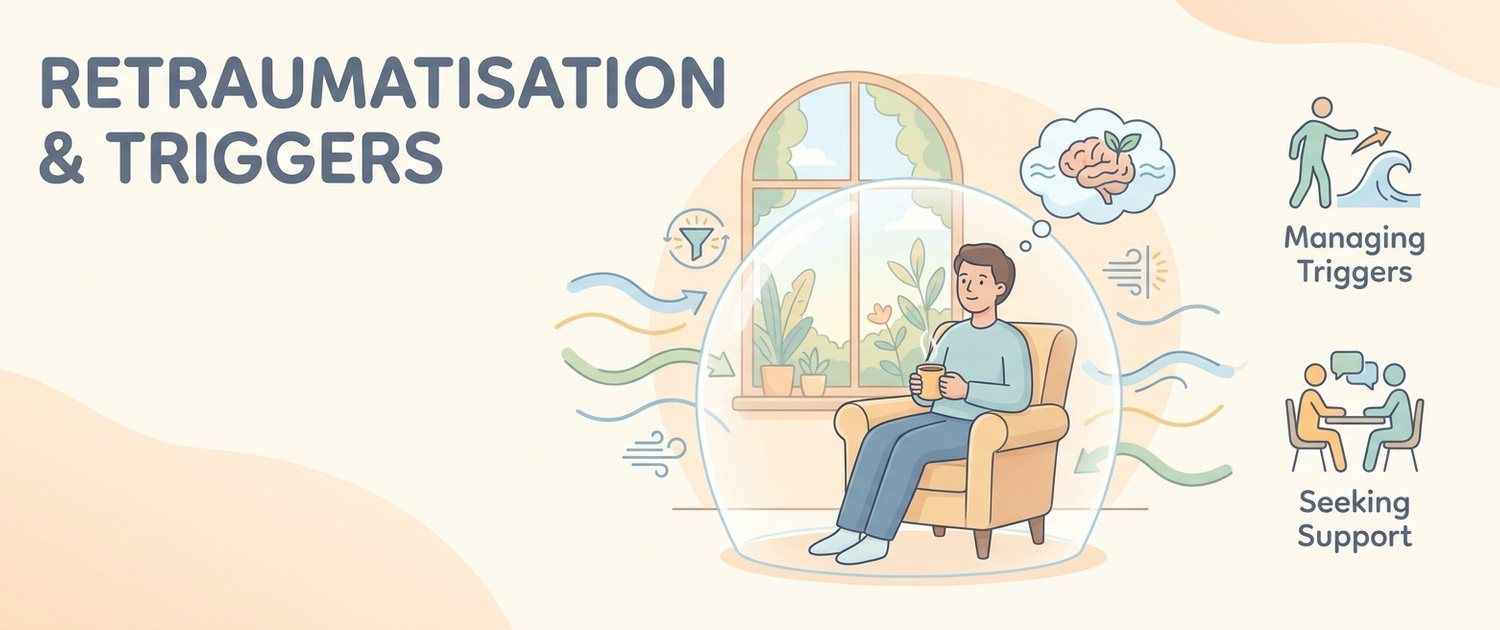
The word "trigger" has spread so widely that it has nearly lost its meaning: it now covers anything unpleasant. "Retraumatisation" followed, used to explain any dip in mood. Both, however, denote something quite specific, and the difference between them and ordinary distress matters in practice: it decides what helps and what makes things worse.
What a trigger is, and how it differs from "unpleasant"
A trigger is a match signal. Not the meaning of an event but its sensory and contextual shell: a smell, a tone of voice, a door creak, a time of day, a body position, a certain quality of light, a sentence with the same shape. The response fires on a feature match, not on logic.
Four features separate a trigger from ordinary discomfort.
- Speed. The body reacts before a thought arrives. Heart rate and tension come before the person has registered what set them off.
- Disproportion. The strength of the response does not match the scale of what is happening, and the person can see that themselves.
- Embodiment. The reaction sits in muscles, breath, vision and temperature rather than in reasoning.
- Lost time. For seconds or minutes, the sense of "that was then" disappears; flashbacks run on the same mechanism.
One more marker is the background. When alertness will not switch off by itself, every signal lands faster and harder; that has its own article — hypervigilance.
What retraumatisation is
Retraumatisation is not "getting a new trauma" and not "being upset". It is the old response switching on again in a situation that objectively is not the original one — with the state worsening afterwards. What separates it from an ordinary hard conversation is time: after a conversation that did good, by evening or the next day things feel lighter. After retraumatisation they feel worse, and that holds.
One wrong conclusion is worth removing straight away. None of this means the subject cannot be touched. It means that touching it without a plan, without the right to stop and without closure is not the same as working with it in a structured format.
Why unsupported retelling of details harms
Two things get constantly conflated here, and they are worth separating.
First: structured trauma-focused therapy. This was tested on purpose. A 2024 systematic review and meta-analysis (Journal of Anxiety Disorders) across 23 studies found no evidence of worsening PTSD or depression symptoms mid-treatment in trauma-focused interventions. An earlier study by Foa and colleagues (2002) asked directly whether imaginal exposure exacerbates symptoms: reliable worsening appeared in a minority of participants, and those participants benefited from treatment comparably. So the reputation of "dangerous" does not hold for a method with preparation, a plan and closure.
Second: unprepared detailed retelling. The cleanest example is the one-off "talk it through immediately after the event". The Cochrane review of psychological debriefing found neither reduced distress nor prevention of PTSD (pooled odds ratio 1.0), and in one trial the risk of PTSD at one year was higher among those debriefed (OR 2.9); the authors recommended that compulsory debriefing of trauma victims cease. A meta-analysis of single sessions in The Lancet (2002) reached the same conclusion.
The difference between the two cases is not candour or depth of detail. It is construction: whether there is preparation, whether there is a right to stop, who tracks the state, and how the meeting ends.
Retraumatisation in the consulting room
A clinician can make things worse too — usually not through ill will but through how the work is built. Typical mechanisms: demanding a full detailed account at the first meeting; probing for details of the event "for completeness"; a session that ends exactly at a peak; no agreement about what to do between meetings.
That is why trauma-informed practice guidance (SAMHSA, TIP 57) contains a dedicated section on policies and procedures to prevent retraumatisation: it is a requirement of service design, not a matter of delicacy.
An indirect but telling indicator is dropout. A 2020 systematic review put dropout from PTSD psychotherapy trials at 16%, higher in trauma-focused approaches. The conclusion is not "the method is bad" but "pace and preparation decide".
A detail specific to Russia: the complex form is absent from the classification in force there, so a different label will be used in the consulting room — usually F43.1, more rarely F62.0. That is a feature of the document, not a judgement about the person, and knowing it in advance helps: otherwise it is easy to decide you were not understood and leave.
Retraumatisation online and with people close to you
The second most common context is the internet, with two mechanisms.
First: detailed descriptions in feeds and topic communities. Somebody else's detailed account works as somebody else's trigger, delivered without preparation and at the wrong moment — on public transport, at night, between tasks.
Second: your own detailed account in an open space. It often feels like relief, but the construction is exactly the one tested in debriefing research: no preparation, no closure, and nobody accompanying whatever comes after. Add irreversibility: what is written stays, and the reactions of commenters cannot be predicted.
With people close to you a third storyline operates — invalidation. When the regular answer is that you are exaggerating, imagining it or brought it on yourself, that is a separate mechanism, covered in the article on gaslighting.
Secondary traumatisation: when it lands through someone else's experience
A separate storyline belongs to people in regular contact with other people's hard material: helping professionals, dispatchers, volunteers, and sometimes a relative who has become the only listener. Lasting shifts in wellbeing and in one's picture of the world from constant exposure to someone else's material are described as secondary traumatisation; the SAMHSA guidance devotes a section to it and treats it as an occupational risk rather than a personal weakness.
The practical part is the same as everywhere else in this article: dosing, limits on volume, recovery between episodes, and somewhere to talk about the load with someone who is not its source. For a close relative that means the right not to be an around-the-clock channel — which is not betrayal but the condition on which they stay present at all.
How safe work is built
Safety is recognised by construction rather than by a soft tone. Five markers:
- A plan. It is known where this is going and how we will tell that it works.
- The right to stop. Stated in words, not assumed.
- Dosing. Material is taken in parts, not "all of it while we are at it".
- Closure. The session does not end at a peak: time is left to return to a settled state.
- An agreement for the gap. It is known in advance what to do if things hit hard between meetings.
In EMDR that principle is built into the protocol: a separate preparation phase and a separate closure phase — and narrating content aloud is not required, reporting what shifted is enough. How those five markers sit alongside the other options is set out in the general account of treating PTSD and complex PTSD.
What to do with triggers in daily life
Total avoidance is a poor strategy: it relieves immediately and narrows life afterwards, because the list of forbidden places keeps growing. The working logic is different.
- Name the feature. Not "supermarkets are bad" but "the light and the hum", or "when someone comes up from behind". Precision restores control.
- Restore time. A plain "it is this year, I am here, this is memory" sounds primitive and works: it restores the context that disappears first.
- Lean on the senses. What I see, what I hear, what I feel under my feet — not in order to calm down but in order to return to the present.
- Dose rather than avoid. Go back gradually and in conditions you control.
- Watch the background. Sleep debt, hunger, alcohol and overload lower the threshold; half of all "sudden" reactions are explained by the background.
To see what is actually in focus, two different instruments exist. The free PCL-5 scale is a short single-axis screen: how pronounced PTSD symptoms have been over the past month. The complex PTSD test splits the picture into the six ICD-11 clusters and shows the traumatic core apart from disturbances in self-organisation. Neither is a diagnosis. And neither asks what exactly happened: only about the state and its cost.
When it is not trauma
Sharp reactions and a sense of things getting worse also arise for other reasons. A useful reference for comparison is the account of what PTSD is: intrusions, avoidance of reminders and a sense of current threat.
- Depression. The worsening here is even and background-level, not tied to specific cues, and without intrusions.
- Long-running exhaustion. Thresholds drop in everyone: at the bottom of the tank, things that normally pass unnoticed become intolerable.
- Anxiety disorder. The reaction points to the future — "what if it happens" — rather than to a reminder of what has passed.
- A borderline pattern. Abrupt switches are tied to fear of abandonment and a swinging self-image; the comparison is in the article on complex PTSD or BPD.
- ADHD and autism. Sensory overload and impulsivity run from childhood at an even level, with no "before" and "after".
- Bodily causes. A shifted TSH, iron deficiency with low ferritin, lack of vitamin B12, apnoea and sleep debt produce startle, irritability and palpitations. Results you already have, the service will help you read. The boundary is simple: the body explains the threshold but not the tie between a reaction and a specific reminder.
If there are thoughts of death right now, an urge to self-harm, or danger that is ongoing, this is not a subject for solo reading. In the US call or text 988; in the UK, Samaritans on 116 123; anywhere else, your local emergency number.
This article is informational and does not diagnose. It claims neither that you have PTSD nor that you do not: a doctor determines that in person.
For informational purposes only
This article is for informational purposes only and does not constitute medical advice, diagnosis, or treatment. Please consult a healthcare professional for medical guidance.