Complex PTSD (CPTSD): What It Is and How It Differs from PTSD
Reviewed by the LabReadAI medical team
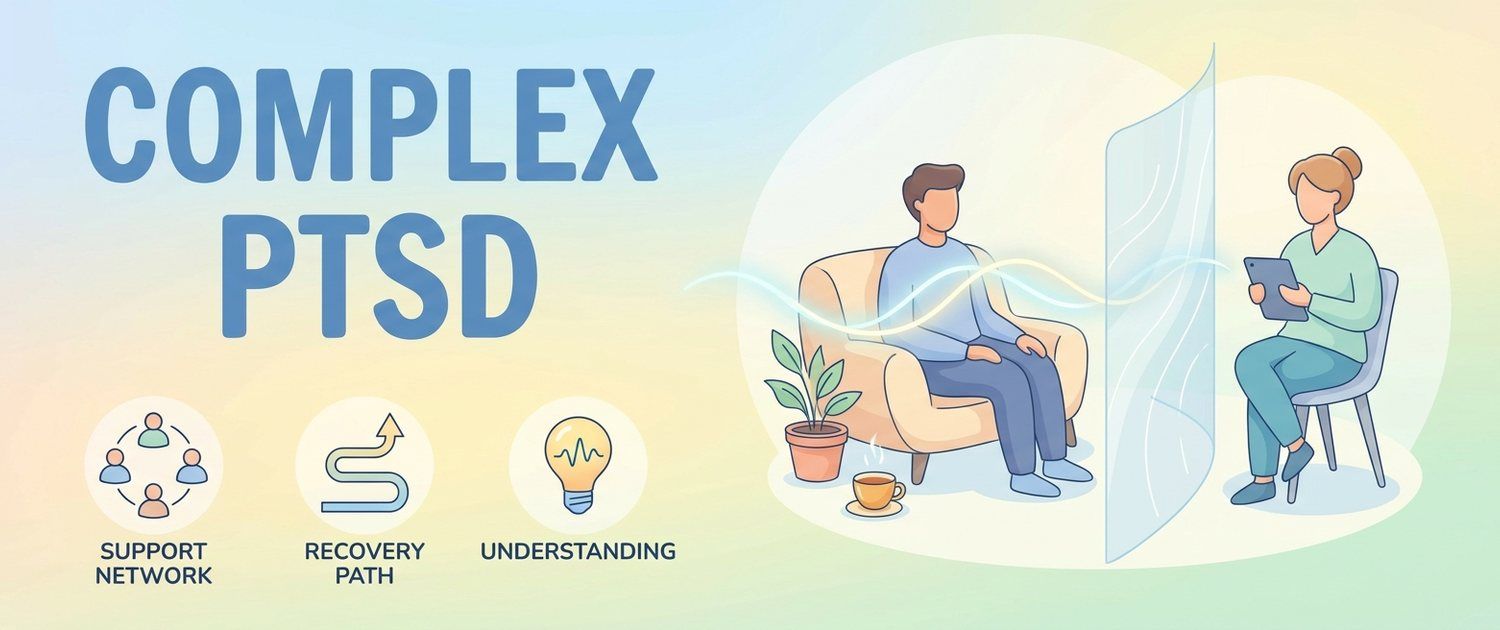
Complex post-traumatic stress disorder (CPTSD) is a diagnosis introduced in ICD-11 under code 6B41. It describes a picture familiar to many people with a long history: the events are far behind, and what changed is not only the attitude to those events but the attitude to oneself and the ability to be with other people.
The key difference from ordinary PTSD is not intensity. CPTSD is not a heavier PTSD but a different configuration. Three further clusters join the three familiar ones, and it is those three that shape what life looks like years later.
The six ICD-11 clusters
A CPTSD diagnosis requires both halves at once.
First half: the traumatic core
The same three clusters as in PTSD:
- re-experiencing — flashbacks, images, dreams and bodily reactions that return the event to the present tense;
- avoidance — steering around places, people and conversations, and around one's own thoughts and feelings;
- a sense of current threat — watchfulness, startle, an inability to let the background go.
Second half: disturbances in self-organisation (DSO)
These are what make PTSD complex:
- Affective dysregulation. Both sides at once: flooding over trivia, then numbness with feelings switched off entirely. More in emotional dysregulation.
- A persistently negative self-concept. Not low mood but a background position: something is wrong with me, I am damaged, I am guilty by the fact of existing. This is the core of toxic shame.
- Difficulties in relationships. Closeness is hard to tolerate, trust comes slowly, relationships are either avoided or experienced as an ongoing hazard.
Plus a mandatory requirement: a significant cost in work, relationships and daily life. A symptom that costs nothing does not make a diagnosis.
Exactly this structure is what the International Trauma Questionnaire (ITQ, Cloitre et al., 2018) measures — a short scale of 12 core items developed on UK samples (n = 1,051 community and n = 247 clinical) and published openly. Its logic is not a sum of points but a set of gates: at least one item has to light up in each cluster.
CPTSD and PTSD: the difference that changes help
It comes down to three things.
The cause. PTSD more often follows an event — a crash, an assault, a disaster. CPTSD describes the outcome of a prolonged or repeated situation that was hard or impossible to escape: a dysfunctional family and childhood trauma, psychological abuse in a relationship, captivity. In the UK study (Karatzias et al., 2019) CPTSD was independently associated with interpersonal trauma in childhood and in adulthood, whereas PTSD was associated with how recent the exposure was.
What hurts today. In PTSD the leading sensation is danger. In CPTSD it is joined by something is wrong with me and I do not know how to be with people — and often it is that, not the flashbacks, that sets the quality of life.
Where help goes. When the traumatic core predominates, the work is usually shorter and focused on the memory of the event. When the second half predominates, help is more often longer and starts with regulation skills and safety — more in the article on treatment for PTSD.
There is one more difference that rarely gets said out loud. In PTSD a person usually feels that something happened to them. In CPTSD, that they are like this. A prolonged situation, an early one especially, is not experienced as an event: it has no beginning and no end to check against, so its consequences feel like character traits — I am withdrawn, I am too sensitive, I am no good with people. That is one reason help is sought late: what looks like the architecture of a personality rarely seems like grounds to see a doctor.
How common it is
Estimates diverge, and that is worth knowing in advance. The Lancet review (Maercker et al., 2022) gives a population prevalence of 1–8% and up to 50% in mental health facilities. A meta-analysis of 16 community studies (2026) produced a pooled estimate of 8.59% (95% CI 5.84–11.34%) with very high heterogeneity between studies — meaning the figure depends heavily on country, sample and instrument. In the UK sample of trauma-exposed adults, 5.3% met criteria for PTSD and 12.9% for CPTSD.
Co-occurring conditions are the rule rather than the exception. In the same UK study, people with CPTSD had sharply raised odds of depression (OR 21.85) and generalised anxiety disorder (OR 24.63), suicidality was more than three times higher, and nearly half of participants reported a chronic physical illness. The practical conclusion is one: what needs sorting out is the whole picture, not one complaint.
Why ICD-10 has no such diagnosis
Russian healthcare works by ICD-10, and CPTSD only appeared in ICD-11. The nearest ICD-10 codes are F43.1 (post-traumatic stress disorder) and F62.0 (enduring personality change after catastrophic experience); the second was conceived for roughly what ICD-11 later called CPTSD, but it is rarely used.
From which follows something purely practical: a person who recognises themselves in a description of CPTSD will hear a different label in the consulting room, and may conclude they were not understood. Not necessarily — more often it is a limitation of the classification the clinician is obliged to work by. The conversation is better held about what is happening and what is done about it than about the name.
DSM-5, the American classification, has no CPTSD either: instead of a separate diagnosis it broadened the PTSD criteria and added a dissociative subtype. That is why most English-language screeners measure only the traumatic core and are blind to the second half of the picture.
Complex trauma and developmental trauma: about the terms
Popular texts use complex trauma, developmental trauma, attachment trauma. These are descriptive concepts rather than diagnoses: they say something about the nature of what was lived through (prolonged, repeated, early, inside significant relationships) but not about the present state. A diagnosis is made from the current picture, not from the biography — which matters, because a similar biography does not guarantee a similar outcome, and a severe state is entirely possible where the events sound not frightening enough.
What to do with this
First, separate out what is actually burning. The free PCL-5 scale gives a score against DSM-5 criteria and shows the traumatic core well, but by construction it cannot see disturbances of self-organisation. If the question sounds like why the events are long gone and I am still like this, a different optic is needed: the complex PTSD test works through the six ICD-11 clusters separately and shows the cost in life separately — instead of a single number. No questionnaire makes a diagnosis; it prepares the conversation with a specialist.
Second, what to ask for. Trauma-focused therapy (EMDR, TF-CBT, CPT) — and, where dysregulation is marked, a preceding skills phase. Decisions about medication are made by a doctor; the articles in this section carry no drug names on purpose.
Third, what not to do. Do not recount the details of the event to just anyone, and do not work them through alone using videos from the internet — that is work done in contact with a specialist, and not from day one. Why, exactly, is in the article on retraumatisation.
If there are thoughts of death right now, an urge to hurt yourself, or the danger is still ongoing, call or text 988 in the United States, Samaritans on 116 123 in the United Kingdom, or your local emergency number.
When it is not trauma
The second half of the picture — swings of emotion, a heavy self-concept, difficulty in relationships — is not unique to CPTSD at all. The distinctions run through the traumatic core and through how the symptom is built.
- Depression. It also delivers worthlessness, detachment and depletion, but usually in episodes and without intrusions or avoidance of reminders. In CPTSD the sense of being damaged is a background, not a mood episode.
- Borderline personality disorder. The closest neighbour. A latent class analysis of 280 women with histories of childhood abuse (Cloitre et al., 2014) identified separate CPTSD and BPD classes and named the features that raise the odds of BPD specifically: frantic efforts to avoid abandonment, an unstable sense of self, unstable and intense relationships, impulsiveness. In CPTSD the self-concept is negative but stable. More in CPTSD or BPD.
- An anxiety disorder. Worry about the future in general, not tied to what was lived through.
- ADHD and autism. Difficulties reaching back into childhood, with no before and after; in autism sensory processing and the architecture of communication come first, not the aftermath of an environment.
- Bipolar disorder. Distinguished by episodicity: weeks and months of a state, rather than a constant background reacting to triggers.
- Long-running exhaustion and bodily causes. A shifted TSH produces both an anxious background and apathy; iron deficiency with low ferritin gives depletion and irritability; a lack of vitamin B12 gives brain fog and numbness; chronic sleep loss imitates dysregulation entirely. Results you already have, the service will help you read.
The boundary is the same as across the whole topic: the body explains the background and the fatigue, but not why closeness is experienced as danger and why shame does not yield to anyone's arguments. And the reverse holds too — attributing to trauma what sleep and a thyroid panel would fix is equally wrong. A separate storyline is learned helplessness and the aftermath of gaslighting: they explain part of the picture but do not replace a diagnosis.
This article is informational and does not diagnose. It does not claim that you have CPTSD, nor that you do not: a doctor determines that in person.
For informational purposes only
This article is for informational purposes only and does not constitute medical advice, diagnosis, or treatment. Please consult a healthcare professional for medical guidance.