Emotional Dysregulation and the Window of Tolerance Explained
Reviewed by the LabReadAI medical team
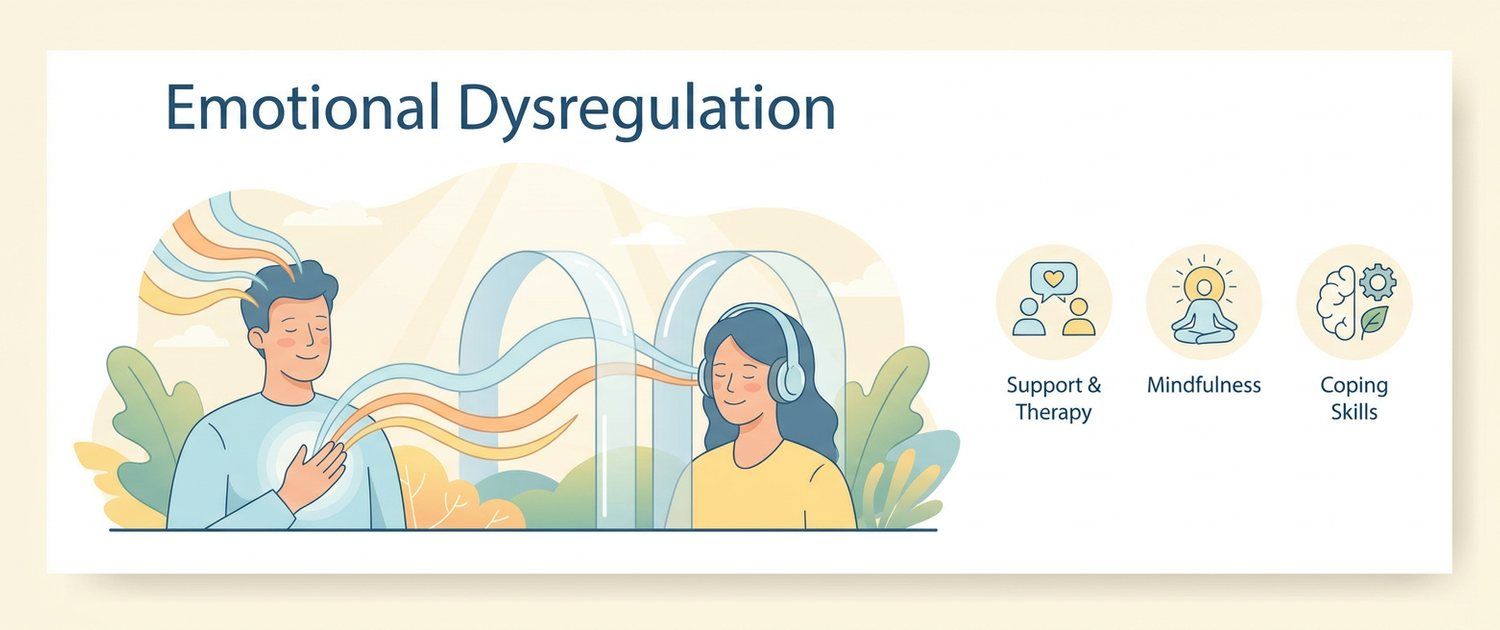
Emotional dysregulation is a failure not in the strength of feelings but in their management: the reaction starts faster than it should, comes out larger than the trigger and lasts longer than the situation. The term is often read as "this person will not restrain themselves", and that is the first thing to correct: restraint is not the variable. What has narrowed is the range within which feelings stay workable.
What emotional dysregulation is
In ICD-11, affective dysregulation is one of the three clusters of "disturbances in self-organisation" which, together with PTSD symptoms, make up complex PTSD. The wording there is deliberately two-sided: either heightened emotional reactivity or, conversely, numbing and an absence of feeling — often in the same person at different periods.
In practice it looks like this:
- the reaction to something small is disproportionate, and the person can see it — usually afterwards;
- the return to a calm state takes not minutes but hours or a day;
- between waves there is not calm but emptiness: "I feel nothing", "as if the sound was turned off";
- decisions made at the peak look like somebody else's later;
- shame arrives after the wave, and shame starts the next round.
The instrument used to measure this in CPTSD research is the International Trauma Questionnaire (Cloitre et al., 2018): two items for each of the six clusters plus separate items on what it costs in work, relationships and daily life. A key point of its design is that cost is measured separately from symptoms, because cost is what determines severity.
Two directions: flooded and numb
Half the people this concerns do not recognise themselves in it, because they are looking for outbursts. The other direction looks like the opposite: an even voice, "I am fine", no tears at a funeral, no ability to feel pleased by good news. From inside that is not calm — it is loss of access.
Both directions are one mechanism. When load exceeds what can be carried, the system either revs up or damps the signal down. The same thing in the language of defensive responses is in the article on fight, flight and freeze, and the bodily half of it is in The body keeps the score.
The window of tolerance as a working model
The window of tolerance is the most useful picture in this subject. Inside the window a person feels a great deal yet stays in contact: able to think, to hear the other person, to choose. Above the boundary lies hyperarousal; below it, hypoarousal. The model is used in clinical work as a way of describing the long-term effects of severe emotional trauma; it is set out, among others, by Corrigan, Fisher and Nutt (2011), where self-harming behaviour and substance use are viewed as attempts to regulate an autonomic system that is too easily driven into extreme states.
A caveat straight away, so the metaphor is not passed off as a measurement: the window of tolerance is a model, not a scale. It cannot be scored, it has no norm, and no test outputs a "window width". Its value is different — it gives a language in which what is happening, and which way to move, becomes clear.
Hyperarousal and hypoarousal
Above the window. Palpitations, a sense of danger, an inability to sit still, rage, panic, thoughts running fast in circles. Sleep breaks, sound irritates, by evening there is no stopping. The persistent version of that background is hypervigilance.
Below the window. Heaviness, slowing, emotional emptiness, a sense of glass between yourself and the world, an inability to start a simple task. From outside it looks like laziness or indifference; from inside, like a cut power supply.
The practical point of telling them apart is that the help differs. In hyperarousal everything that lowers works: a long exhale, cold, rhythmic movement, quiet. In hypoarousal the opposite — everything that gently raises: stand up, turn on the light, a short burst of exertion, contact with a person, something with pronounced taste or texture. Meditating while already empty is a very common mistake.
How this differs from a lack of self-restraint
In three ways.
First, the threshold. In dysregulation the reaction fires on what is not an event at all for someone else: an intonation, a look, cancelled plans. That is not a decision to react.
Second, the return time. Someone who is simply short-tempered flares up and is ordinary ten minutes later. Here the peak passes but the background holds for hours, and on that background every next event lands harder.
Third, the link to cues. The wave is often tied not to the current situation but to its resemblance to the past. That is why "just do not react" is meaningless advice: the reaction starts before the reasoning.
The data here are fairly unambiguous. The meta-analysis by Seligowski et al. (2015) — 57 studies, 74 effect sizes — found the strongest association of post-traumatic symptoms precisely with general emotion dysregulation (r = 0.53), then rumination (0.51), thought suppression (0.47) and experiential avoidance (0.40); acceptance and reappraisal showed no significant effect. The studies are cross-sectional, so this is association, not demonstrated causality.
When it is not trauma
Dysregulation on its own points to no particular cause — it occurs across very different states, and they are told apart by structure rather than by intensity.
- Depression. Produces both irritability and numbing, but is usually episodic and lacks a traumatic core — intrusions, avoidance of reminders, a sense of current threat.
- Long-running exhaustion. Years of overload narrow the window in people with no traumatic history and respond to unloading rather than to work on the past.
- Anxiety disorder. Persistent worry holds a person above the window in its own right, with no tie to reminders.
- A borderline pattern. The closest neighbour, and the distinction is not "who had a worse childhood". In a community sample of women (Cyr et al., 2022) the symptoms of PTSD, CPTSD and borderline personality disorder could be separated: in CPTSD the self-image is stably negative, in the borderline pattern it swings, with fear of abandonment and self-harm as regulation on top. More in the article CPTSD or BPD.
- ADHD and autism. Here dysregulation runs evenly from childhood without a "before and after"; in autism the sensory load comes first, in ADHD the architecture of attention and impulsivity.
- Bipolar disorder. Distinguished by episodes lasting weeks with changes in sleep and activity, rather than waves in response to events.
- Bodily causes. A shifted TSH produces both irritability and slowing; low ferritin produces flatness and restlessness; lack of vitamin B12 produces fog and dullness. Add chronic sleep debt, apnoea, alcohol and the premenstrual phase. Results you already have, the service will help you read.
One honest number for perspective: in a UK sample of trauma-exposed adults, people matching the CPTSD picture endorsed depressive symptoms far more often (odds ratio 21.9) and anxiety symptoms likewise (24.6), and the likelihood of suicidality was more than three times higher (Karatzias et al., 2019). The point being that sorting out one label is usually not enough — there are almost always several states at once.
What widens the window
Nothing on this list is heroic, and that is its main virtue.
- Sleep. The strongest lever. On short sleep the window narrows in everyone without exception, and every other piece of work goes worse.
- Predictable load. Regular movement lowers background arousal more reliably than talking about it.
- Food and water. Dull, but hunger is a classic accelerant of a wave.
- Environment. Less contact with what reliably knocks you over; an exit from the situation agreed in advance; warning the people close to you beforehand rather than explaining afterwards.
- Grounding in the present. Footing, five objects named aloud, cold water, a change of posture. The aim is not to "process" anything but to mark that now is not then.
- A map of your own early signs. What happens ten minutes before a wave — a clenched jaw, faster speech, an urge to leave. Catching it there is far cheaper than at the peak.
- A skills phase in therapy. With pronounced dysregulation, help usually begins with regulation skills and only then moves to memory work; what is known about that is in the article on treatment for PTSD. Decisions about medication are made by a doctor — this article does not discuss them.
What to ask a specialist at the first meeting: how the plan is built, whether there will be a skills phase, what to do between sessions, and what happens if things get worse after a session. A clear answer to the fourth question is a good sign.
If you want to orient yourself beforehand, there are two different instruments. The free PCL-5 scale is a screener for PTSD symptoms: one axis, one score, with no dysregulation in it at all. The paid complex PTSD test separates the traumatic core from disturbances in self-organisation across six clusters and looks separately at the cost in work, relationships and daily life. Neither is a diagnosis.
If things are hard right now — thoughts of not living, a pull to hurt yourself, or ongoing danger — in the US call or text 988 (Suicide and Crisis Lifeline); in the UK, Samaritans on 116 123; elsewhere, your local emergency number.
This article is informational and does not diagnose. It does not claim that you have complex PTSD, nor that you do not: that is determined by a clinician in person.
For informational purposes only
This article is for informational purposes only and does not constitute medical advice, diagnosis, or treatment. Please consult a healthcare professional for medical guidance.