Treating PTSD and Complex PTSD: What Actually Works
Reviewed by the LabReadAI medical team
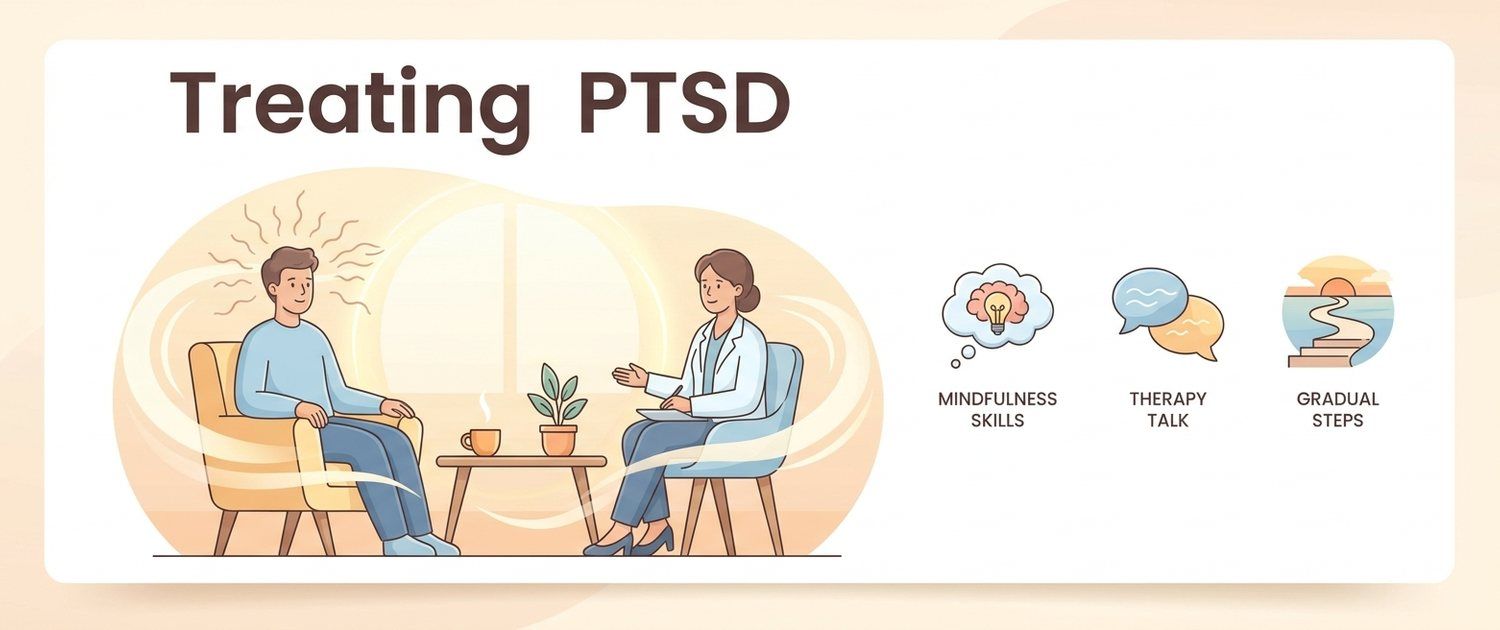
"Treating PTSD" covers very different things: a conversation with a doctor, a course of psychotherapy, body-oriented work, the rebuilding of sleep and routine. Below: what clinical guidelines and reviews actually establish, where the line runs between demonstrated and promised, and what a person can do before reaching a specialist.
What "treatment" means here
The goal is not to erase memory. The goal is for the past to stop being the present: for a reminder to stop launching full readiness for threat, for a life narrowed in the name of safety to widen again, for sleep and attention to return to working order. What happens in PTSD, and how it differs from a normal reaction in the first weeks, is covered in the article on PTSD.
Treating this well starts not with a method but with an assessment: what is happening, for how long, and what has already been tried. One consequence follows immediately: success is measured not by "did it get forgotten" but by how much room came back into life. That is also why a promised timeline is a bad sign. No guideline names a date.
What works: trauma-focused therapy
The backbone of demonstrated help for PTSD is psychotherapy that engages the experience itself rather than only its consequences. The Cochrane review of psychological therapies for chronic PTSD (2013) lists trauma-focused CBT and EMDR among interventions with a confirmed effect. A 2020 systematic review and meta-analysis (European Journal of Psychotraumatology) confirms the effect of trauma-focused approaches in adults, with small differences between individual methods.
In practice that means three working families:
- TF-CBT — gradual approach to what is avoided, plus work on thoughts and beliefs;
- EMDR — work with the memory under rhythmic bilateral stimulation, covered separately in the article on EMDR therapy;
- CPT, cognitive processing therapy — focused on stuck beliefs: blame, trust, safety, control.
Group formats exist too. A 2019 systematic review and meta-analysis (Journal of Affective Disorders) across 36 randomised trials of group therapy for the aftermath of prolonged interpersonal trauma found large effects for groups involving trauma memory processing compared with usual care; against psychoeducational groups the difference was small and not significant. The authors' conclusion is balanced: processing helps along the traumatic line, psychoeducation along general distress, and both formats have their place.
Why complex PTSD usually takes longer
In the complex form a second axis joins the traumatic core: disturbances in self-organisation — emotional dysregulation, a steadily negative view of oneself, and difficulties in relationships. What that construction is, is set out in the article on complex PTSD.
The practical consequence is simple. Flashbacks and avoidance may retreat while "something is wrong with me" and the impossibility of closeness stay, because they were built over years and are not tied to one episode. So in complex PTSD, memory processing is usually joined by work on regulation skills and relationships, and that takes longer than after a single event.
A separate research strand addresses the aftermath of prolonged trauma as such. A 2020 component network meta-analysis in PLOS Medicine assembled psychological and pharmacological interventions for PTSD and comorbid problems following complex traumatic events and took them apart by component — one of the fullest syntheses on the topic to date.
Phase model versus immediate processing: two approaches
The classic logic: phase 1 — safety and skills, phase 2 — memory processing, phase 3 — returning to life. It is popular and sensible, but presenting it as the only valid route would be untrue.
In a 2021 randomised trial (BJPsych Open), adults with PTSD following childhood abuse were assigned to either eight sessions of the STAIR skills phase plus sixteen sessions of EMDR, or straight to sixteen sessions of EMDR. No significant differences appeared at the end of treatment or at follow-up; after treatment 68.8% of participants no longer met PTSD criteria. The authors state directly that a stabilisation phase is not a necessary condition.
So there are two approaches and both are defensible. A skills phase is discussed more often when the state swings too hard, when dissociation is marked, or when danger is ongoing. Immediate processing is discussed when postponement has itself become avoidance and year after year nothing shifts. That is a conversation with a clinician, not a ready-made answer.
Stabilisation: what can be done before therapy
Before a first appointment and between sessions, the useful work is not memory processing — that is the therapist's job — but support.
- Sleep. Not as a wholesome habit but as load-bearing structure: emotion regulation and attention both collapse on a sleep deficit.
- A daily rhythm. A predictable schedule lowers background load more than it seems.
- Movement. Regular moderate exercise is the most accessible way to bring general arousal down.
- One person you can reach. Isolation makes almost everything worse; even a single contact changes the course.
- Fewer detailed retellings. An extended account of the event without support does not discharge it but entrenches it — see the separate article on retraumatisation and triggers.
- Care with alcohol. It lowers the background for an hour and worsens sleep and regulation for a day.
None of this is therapy or a substitute for it. It is what makes therapy tolerable — and treating it as preparation rather than as help instead of therapy is what actually keeps it useful.
Medication: what can honestly be said
Decisions about medication are made by a doctor. No names, classes or schedules appear in this article — not out of squeamishness about the subject, but because any sensible choice depends on the full picture: co-occurring conditions, sleep, physical health, what has already been tried. None of that is knowable from an article.
What is worth knowing in advance: clinical guidelines treat psychotherapy as the backbone of PTSD care, with pharmacological support discussed additionally and individually. That conversation happens with a psychiatrist, and asking about the purpose, the expected effect and when it will be reviewed is a normal part of it.
Dropout — and what to do about it
This is rarely written about and useful to know. A 2020 systematic review and meta-analysis (European Journal of Psychotraumatology) put dropout from randomised trials of PTSD psychotherapy at 16% (CI 14–18%), with a higher share in trauma-focused approaches.
The right conclusion is not "these methods are too hard" but "preparation and pace matter": a method actually works only as far as a person can stay inside it. Direct implications: agree the plan in advance; agree what to do if things get worse between sessions; keep the right to say "too fast". Leaving therapy without that conversation is the most common way a result gets lost.
How this is arranged in Russia
The complex form is absent from the classification currently in force there: ICD-10 does not contain it. In a consulting room a person will hear a different label — usually F43.1, more rarely F62.0. That is a feature of the document, not a statement about the person: what ICD-11 describes does not disappear because the form is built to an older standard.
What to ask for: trauma-focused therapy (EMDR, TF-CBT, CPT); where dysregulation is strong, a skills phase before or alongside; where dissociation is marked, a clinician who works with it. It helps to arrive with a concrete goal rather than "cure me": sleep, get work back, stop avoiding travel.
Two different instruments help clarify what is in focus. The free PCL-5 scale is a short single-axis screen: how pronounced PTSD symptoms have been over the past month. The complex PTSD test is built differently — it separates the picture into the six ICD-11 clusters and shows the traumatic core apart from disturbances in self-organisation, and it is that split which decides what kind of help to discuss. Neither is a diagnosis: a doctor makes that in person.
What recovery should not be required to deliver is covered separately in the article on post-traumatic growth.
When it is not trauma
A similar picture assembles for other reasons, and then trauma-focused therapy is aimed at the wrong target.
- Depression. Heaviness, loss of interest, early waking — but without a traumatic core: no intrusions, no avoidance of reminders, no constant sense of threat.
- Long-running exhaustion. Months at the limit produce blunting and irritability; the link to load and the retreat after real rest distinguish it.
- Anxiety disorder. Anxiety about the future and "what if", not about a reminder of what has passed; the background is not tied to specific cues.
- A borderline pattern. Fear of abandonment and a swinging self-image sit at the centre — the comparison is in the article on complex PTSD or BPD.
- ADHD and autism. Difficulties run from childhood at an even level, with no "before" and "after"; the sensory and communicative side comes first.
- Bodily causes. A shifted TSH, iron deficiency with low ferritin, lack of vitamin B12, apnoea and chronic sleep debt all produce irritability and attention lapses. Results you already have, the service will help you read. The boundary is simple: the body explains the background but not intrusions and avoidance tied to reminders.
If there are thoughts of death right now, an urge to self-harm, or danger that is ongoing, an article is not the place to start. In the US call or text 988; in the UK, Samaritans on 116 123; anywhere else, your local emergency number.
This article is informational and does not diagnose. It claims neither that you have PTSD nor that you do not: a doctor determines that in person. Decisions about medication are made by a doctor.
For informational purposes only
This article is for informational purposes only and does not constitute medical advice, diagnosis, or treatment. Please consult a healthcare professional for medical guidance.