EMDR Therapy: How Trauma Work Actually Runs and Who It Suits
Reviewed by the LabReadAI medical team
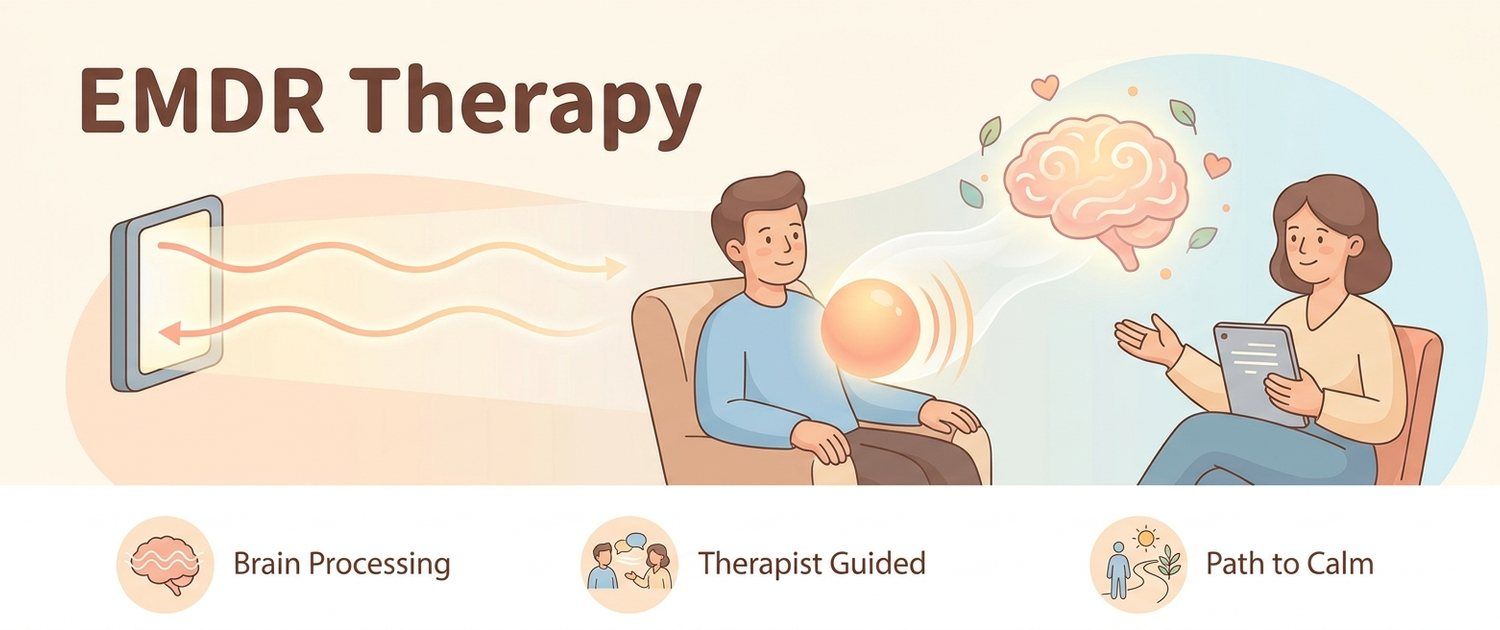
EMDR stands for eye movement desensitisation and reprocessing. It is one of the few psychotherapies that major clinical guidelines name outright as a working option after severe events. Below: what the method is, how a session is built, what research actually shows, how it differs from its neighbours in the same family, and what is worth asking at a first meeting.
What EMDR is
In short: it is trauma therapy that works on the memory directly, and it suits neither everyone nor every moment — both conditions are covered below.
EMDR belongs to the family of trauma-focused therapies. They all share one thing: the work goes into the memory itself rather than around it — into how it is stored and how it fires now. What sets EMDR apart is the procedure. While a person holds a fragment of the experience in mind, the therapist provides rhythmic bilateral stimulation: usually eye movements following a hand or a point on a screen, sometimes taps on the knees or alternating tones through headphones.
The point is not to erase memory. The event stays; its status changes. What used to be lived as happening right now gradually takes its place in the past and stops triggering full bodily readiness for threat at every reminder. That side of things is covered in the article on the body keeping the score.
Why bilateral stimulation helps is still an open question. The most discussed explanation involves working-memory load: holding an image while tracking a moving target is demanding, and the memory becomes less vivid when returned to. That is a hypothesis, not an established fact, and an honest clinician presents it as one.
How an EMDR session runs
The protocol is described as eight phases, spread in practice across several meetings.
- History and plan. What is happening now, what interferes with daily life, which episodes fire hardest. A detailed account is not needed at this stage.
- Preparation. Explaining the method and practising ways back into a settled state — a "safe place", breathing, grounding in bodily sensation.
- Assessment. A specific target is chosen: an image, a negative belief about the self ("I am helpless", "it was my fault"), a preferred belief, the bodily response, and two rating scales.
- Desensitisation. Short sets of stimulation with pauses and the question "what did you notice?". The person is not required to narrate content — reporting what shifted is enough.
- Installation. Strengthening the new belief about the self.
- Body scan. Checking whether tension tied to the target remains.
- Closure. The session does not end at a peak: the task is to restore a settled state before the person walks out.
- Re-evaluation. The next meeting checks what held.
The point about not having to narrate deserves its own line. An extended retelling without support and without a plan is a risk in itself rather than a useful release; how that works is set out in the article on retraumatisation and triggers.
What the evidence shows
The Cochrane review of psychological therapies for chronic PTSD (2013) places trauma-focused CBT and EMDR among interventions with a demonstrated effect. ISTSS guidelines list both among recommended treatments for adults.
At the same time the evidence base is uneven, and it is more honest to say so plainly. A 2020 systematic review and meta-analysis (Cognitive Behaviour Therapy) covering 76 trials found a large effect for PTSD against control conditions (g = 0.93) but noted that only 4 of 27 studies had a low risk of bias and recorded indications of publication bias. A 2023 meta-analysis (Psicothema) across 18 papers produced markedly more modest figures — small effect sizes both at post-treatment and at follow-up.
The practical conclusion from that spread is not "the method does not work" but "keep expectations realistic". No guideline promises a result by a given date, and a promise of that kind is a reason for caution rather than relief.
How EMDR differs from TF-CBT and CPT
All three are trauma-focused, meaning all three engage the experience itself rather than only its consequences.
- TF-CBT — trauma-focused cognitive behavioural therapy: gradual approach to avoided material plus work on thoughts, with substantial homework between sessions.
- CPT, cognitive processing therapy — focused on stuck beliefs: blame, trust, safety, control, self-image. Many written assignments.
- EMDR — less homework and less speaking aloud, more work inside the session.
Head-to-head comparisons give no stable advantage to any one of them: the systematic review and meta-analysis of psychological therapies for PTSD (European Journal of Psychotraumatology, 2020) confirms the effect of trauma-focused approaches while differences between them stay small. So the choice is usually driven by which clinician is available and which format is tolerable, not by a ranking of methods. The wider picture of what helps is in the article on treating PTSD and complex PTSD.
Who needs a skills phase first
Here it matters not to replace discussion with dogma. The phase model says: safety and regulation skills first, memory processing second, reconnection with life third. That is sensible logic, especially after prolonged trauma.
But it is not the only one. In a 2021 randomised trial (BJPsych Open), adults with PTSD following childhood abuse were assigned either to eight sessions of the STAIR skills phase plus sixteen sessions of EMDR, or straight to sixteen sessions of EMDR with no preparation. No significant differences appeared between conditions either at the end of treatment or at follow-up; after treatment 68.8% of participants no longer met PTSD criteria. The authors concluded that a stabilisation phase is not a necessary condition.
So there are two approaches and both work. In practice a skills phase is discussed more often when marked dissociation is present, when danger is still ongoing, or when the state swings so hard that a session risks ending worse than it began. That is decided by a clinician together with the person, not by an article.
Finding a therapist and what to ask
Questions that fit a first meeting:
- where did you train in this method, and how long have you worked with prolonged trauma;
- how will we know this approach fits, and when will we review the result;
- what do you do if a session becomes overwhelming;
- how does closure work — what happens if time runs out mid-way;
- what am I meant to do between sessions.
What should raise an eyebrow: a promise of results within a fixed number of sessions, a demand for a detailed account at the first meeting, and refusal to discuss the plan.
On doing it alone: instructions for "processing memories by yourself" are deliberately absent here. The method is built around a second person who tracks the state and knows how to close a session. At home the sensible work is the opposite — rebuilding support: sleep, routine, movement, contact with people it is safe to reach.
How this looks in Russia
The complex form of post-traumatic disorder is absent from the classification currently in force here: ICD-10 does not contain it. In a consulting room a person will hear a different label — usually F43.1, more rarely F62.0. That is a feature of the document, not a statement about the person and not a refusal to acknowledge what happened.
What is worth asking for: trauma-focused therapy (EMDR, TF-CBT, CPT), and where dysregulation is strong, a skills phase before or alongside it. Decisions about medication are made by a doctor; names and schedules are deliberately absent here.
Two different instruments help clarify what is actually in focus. The free PCL-5 scale is a short single-axis screen: how pronounced PTSD symptoms have been over the past month. The complex PTSD test is built differently — it separates the picture into the six ICD-11 clusters and shows the traumatic core apart from disturbances in self-organisation, and it is that split which decides what kind of help to discuss. Neither is a diagnosis: a doctor makes that in person.
When it is not trauma
Similar complaints arise for entirely different reasons, and trauma therapy is not addressed to them. The reference picture to compare against is what PTSD is: intrusions, avoidance of reminders and a constant sense of threat.
- Depression. Heaviness, loss of interest, early waking, slowing — but without a traumatic core: no intrusions, no avoidance of reminders, no constant sense of threat.
- Long-running exhaustion. Months at the limit produce similar blunting and irritability; what distinguishes it is the link to load and the retreat after genuine rest.
- Anxiety disorder. The anxiety here is about the future and about "what if", not about a reminder of what has passed; the background is not tied to specific cues.
- A borderline pattern. Self-image swings and fear of abandonment sit at the centre, unlike a steadily negative self-concept; that comparison is in the article on complex PTSD or BPD.
- ADHD and autism. Difficulties run from childhood at an even level, with no "before" and "after"; the sensory and communicative side comes first.
- Bodily causes. A shifted TSH, iron deficiency with low ferritin, lack of vitamin B12, sleep debt and apnoea all produce irritability, attention lapses and startle. Results you already have, the service will help you read. The boundary is simple: the body explains the background but not intrusions and avoidance tied to specific reminders.
If there are thoughts of death right now, an urge to self-harm, or danger that is still ongoing, this is not a subject for solo reading. In the US call or text 988; in the UK, Samaritans on 116 123; anywhere else, your local emergency number.
This article is informational and does not diagnose. It claims neither that you have PTSD nor that you do not: a doctor determines that in person.
For informational purposes only
This article is for informational purposes only and does not constitute medical advice, diagnosis, or treatment. Please consult a healthcare professional for medical guidance.