Gaslighting: What It Is, the Signs, and How to Respond
Reviewed by the LabReadAI medical team
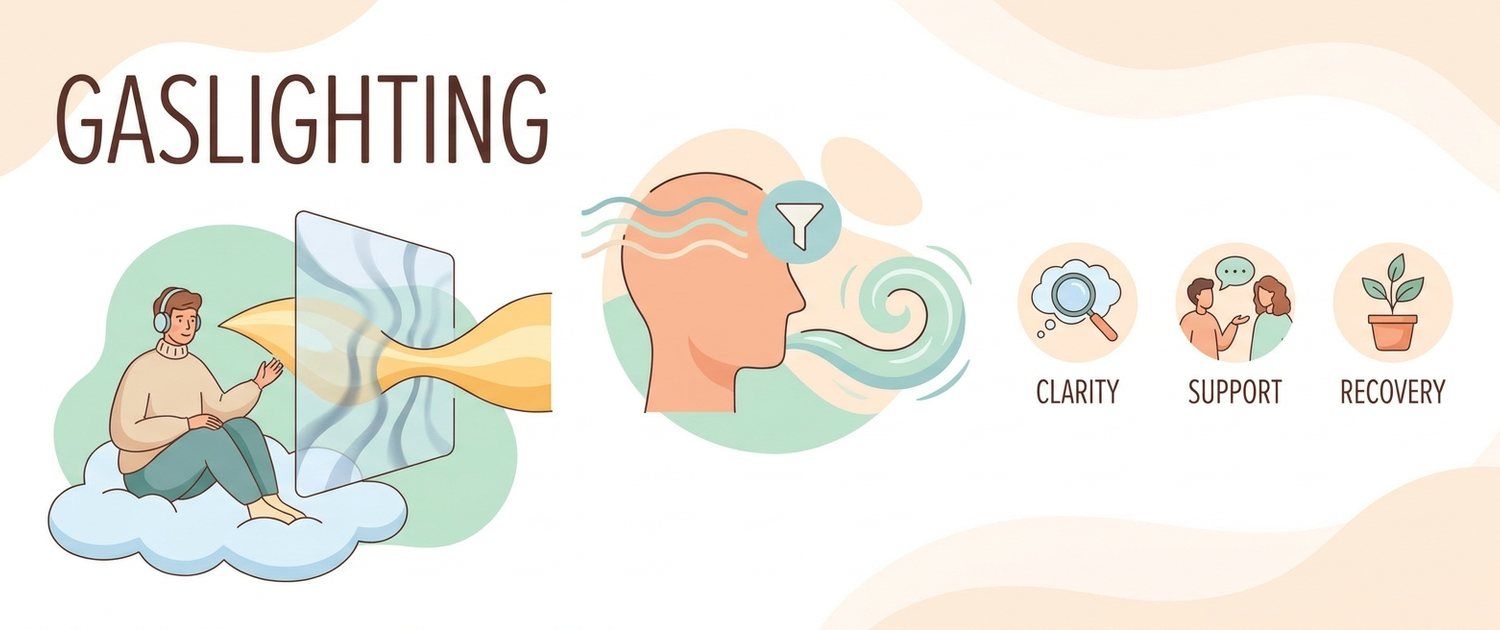
The word comes from Patrick Hamilton's play Gas Light (1938) and the films made from it: a husband dims the gas lamps in the house each evening and, when his wife asks about it, tells her the light is steady and she is imagining things. Nothing supernatural happens in the plot — there is simply a man methodically convincing another person that she cannot trust herself. Hence the term, and hence its origin is worth keeping in mind: the origin story is about a deliberate, patient practice rather than a bad temper.
What gaslighting is in plain words
Gaslighting is a sustained practice in which one person routinely declares another's perception, memory and feelings mistaken, until that person starts doubting their own soundness of mind. Three things make it what it is:
- Repetition. One line in a row is a line in a row. A practice is when every conversation about anything unpleasant is built this way.
- One direction. It is always the same person who has to doubt their own memory.
- Leverage from inequality. What works is not persuasiveness but position: money, housing, documents, children, job title, reputation, command of the language.
That last point is the central argument of Paige Sweet's paper "The Sociology of Gaslighting" (American Sociological Review, 2019), written on domestic violence material. Sweet shows that gaslighting is usually treated as a psychological phenomenon, while its force comes from social structure: gendered stereotypes about women being "too emotional", dependent circumstances, and institutions trusting one side more than the other. Put simply, persistence alone is not enough to convince someone they are unsound — the surrounding life has to keep confirming it. The same practice therefore weighs differently in a couple, at work and in the family a person grew up in — the last of those has a subject of its own, the dysfunctional family.
Signs of gaslighting: the typical lines
The lines prove nothing on their own; they are said in ordinary arguments too. What gives them weight is the system they sit in — the signs are in the pattern, not in any single sentence, and most of them are signs of emotional invalidation rather than of open hostility.
- "That never happened, you made it up" — denial of an event you remember clearly.
- "You are too sensitive, you blow everything up" — denial not of the fact but of your right to react.
- "I never said that" — when it was said, and you remember it word for word.
- "You pushed me to it" — responsibility for behaviour handed to the person it was aimed at.
- "You have memory problems, you should see someone" — the subject replaced by a question about your sanity.
- "Everyone thinks you are impossible" — an invisible coalition of witnesses who cannot be asked.
What is worth checking is not the phrase but the outcome. After an ordinary argument you are left with a bad taste and possibly an unresolved question. After this construction you are left with a question about yourself: am I actually all right?
How it differs from an argument and from ordinary memory error
People genuinely remember things differently. Memory reconstructs, details drift, tone is heard individually — two honest participants in the same conversation can describe it differently. A discrepancy by itself is not a sign of anything.
The difference sits in three places:
- Direction. In an argument either side can be wrong, and sometimes the louder one is. Here it is always the same person.
- Outcome. An argument ends in agreement, compromise, or both sides keeping their view. This construction ends with one person apologising and being confirmed in the idea that they should not trust themselves.
- The trace over time. After an argument an opinion on a question changes. After years of gaslighting what changes is the relationship to one's own perception in general — including outside that relationship.
A note on motive. Sometimes a person genuinely does not remember, genuinely does not consider their words hurtful, and has no strategy at all — while the effect can look similar. We deliberately avoid diagnosing the people around you at a distance: calling someone a "gaslighter" or assigning them a disorder from an internet description is a label rather than an assessment, and it usually makes conversation impossible. It is far more reliable to lean on what can be checked: how the conversations are built and what happens to you after them.
What years of gaslighting do to a person
The picture assembles gradually and looks unremarkable from outside:
- External proof. Screenshots, recordings, a diary — not out of suspicion but because your own memory no longer works as an anchor.
- Pre-emptive self-editing. Sentences get rehearsed in advance so as not to give cause.
- Self-gaslighting. The person starts doing it themselves: "I probably am exaggerating", "he did not mean it that way". The external voice becomes internal, and self-gaslighting then runs with no second party present at all.
- Shame instead of anger. A settled sense that something is wrong with you is its own subject — covered in the article on toxic shame.
- Giving up on trying. When every attempt to clarify something ends the same way, the attempts stop; the mechanism is unpacked in the article on learned helplessness.
The cost is measurable. The systematic review by Dokkedahl and colleagues (Systematic Reviews, 2022) gathered 194 studies, 149 of which entered meta-analyses, and found that psychological violence is strongly associated with PTSD, depression and anxiety — with the strongest association for PTSD, in both female and male victims. The controlling component stands out separately: for women it is the one most closely tied to PTSD. In a study of four Danish women's shelters (European Journal of Psychotraumatology, 2021), women arriving showed high levels of both PTSD and complex PTSD symptoms.
This is the reason a prolonged inescapable situation is treated separately from a single severe event: ICD-11 describes that frame as complex PTSD, where lasting changes in how a person relates to themselves and to others are added to the traumatic core.
How to respond to gaslighting
It helps to separate two kinds of step honestly: some are about clarifying, some are about safety. If the situation is ongoing and there is risk, the second matters more than the first — and how you respond in the moment matters less than what you respond to. One more thing: trying to explain yourself for the hundredth time usually brings the whole state back — how that works is unpacked in the article on retraumatisation and triggers.
- Do not argue about the facts. You will not win an argument about what was said: the other side is not aiming at agreement. What works is leaning on effect — "I am not going to prove what was said; what matters is that after these conversations I do not sleep for a week."
- An outside anchor. One person you tell things to consistently and without editing already changes the picture a great deal. Isolation from such people usually grows unnoticed.
- Notes for yourself. Not as evidence in an argument, but to get your own timeline back. If your devices and messages can be checked, do not keep such notes where they will be found: use a device the other side has no access to, or do not keep them at all. Safety outweighs completeness.
- Small checkable boundaries. Not "behave differently" but something concrete and doable: not discussing this subject after midnight, ending a conversation when there is shouting.
- Do not wait for an admission. Waiting for the sentence "yes, I did that" is the most common trap: it keeps people in place for years and almost never arrives.
- A specialist familiar with the subject. At a first meeting it is fair to ask directly whether they work with the aftermath of prolonged abuse in relationships and how they structure that work.
If the abuse is ongoing or there is a threat, this is no longer a conversation about conversations. In the US, call or text 988 for the Suicide and Crisis Lifeline; in the UK, Samaritans are on 116 123; if there is immediate danger, use your local emergency number. Calling from a phone that is not yours is sometimes safer than calling from your own.
Working out what this has turned into
The free step is the PCL-5 scale: 20 questions on DSM-5 PTSD symptoms. It covers the traumatic core — intrusions, avoidance, changes in thinking and mood, heightened arousal — but by design it does not measure the other half of the picture: self-perception, emotion regulation and the capacity for closeness. And prolonged gaslighting usually damages exactly that half.
If you want to see both axes separately, there is the paid complex PTSD test: it works through the six ICD-11 clusters one by one and shows what is actually loaded — the traumatic core, the disturbances in self-organisation, or both. Neither the screener nor the test makes a diagnosis: a specialist does that in person.
When it is not trauma
Doubting your own perception and constantly checking it happen for reasons other than years of invalidation. What else produces a similar picture:
- Depression. Slowed thinking, difficulty recalling and deciding, a settled sense of being in the wrong. The difference is in the background: with depression things are heavy without a second person too, and solitude brings no relief.
- Long-running exhaustion. At the bottom of the tank memory and attention work worse, and details are genuinely lost. The marker is recovery after rest, which gaslighting does not produce.
- An anxiety disorder. Rechecking, rehearsing sentences and needing reassurance appear here as well, but the engine differs — expecting catastrophe in general rather than one person's behaviour.
- A borderline pattern. Sharp swings in self-image between "I am wonderful" and "I am a monster", plus fear of abandonment. After prolonged abuse the negative self-image is usually stable rather than swinging; the differences are unpacked in the article on complex PTSD or BPD.
- ADHD and autism. Real difficulty with details, agreements and reading subtext makes a person vulnerable to accusations of carelessness. The key is that these difficulties were there from childhood and outside any particular relationship.
- Bodily causes. Disturbed thyroid function, low iron and vitamin B12, chronic sleep loss and apnoea produce brain fog, forgetfulness and irritability. That does not explain another person's behaviour, but it explains why there is no strength left for it; results you already have, the service will help you read.
The boundary is simple: your body and your state explain why things are hard, but they do not explain why every conversation about anything unpleasant ends with your apology.
This article is informational and does not diagnose — neither you nor the person close to you. What is happening, and what to do about it, is determined in person.
For informational purposes only
This article is for informational purposes only and does not constitute medical advice, diagnosis, or treatment. Please consult a healthcare professional for medical guidance.