The Dysfunctional Family: Signs and the Adult Aftermath
Reviewed by the LabReadAI medical team
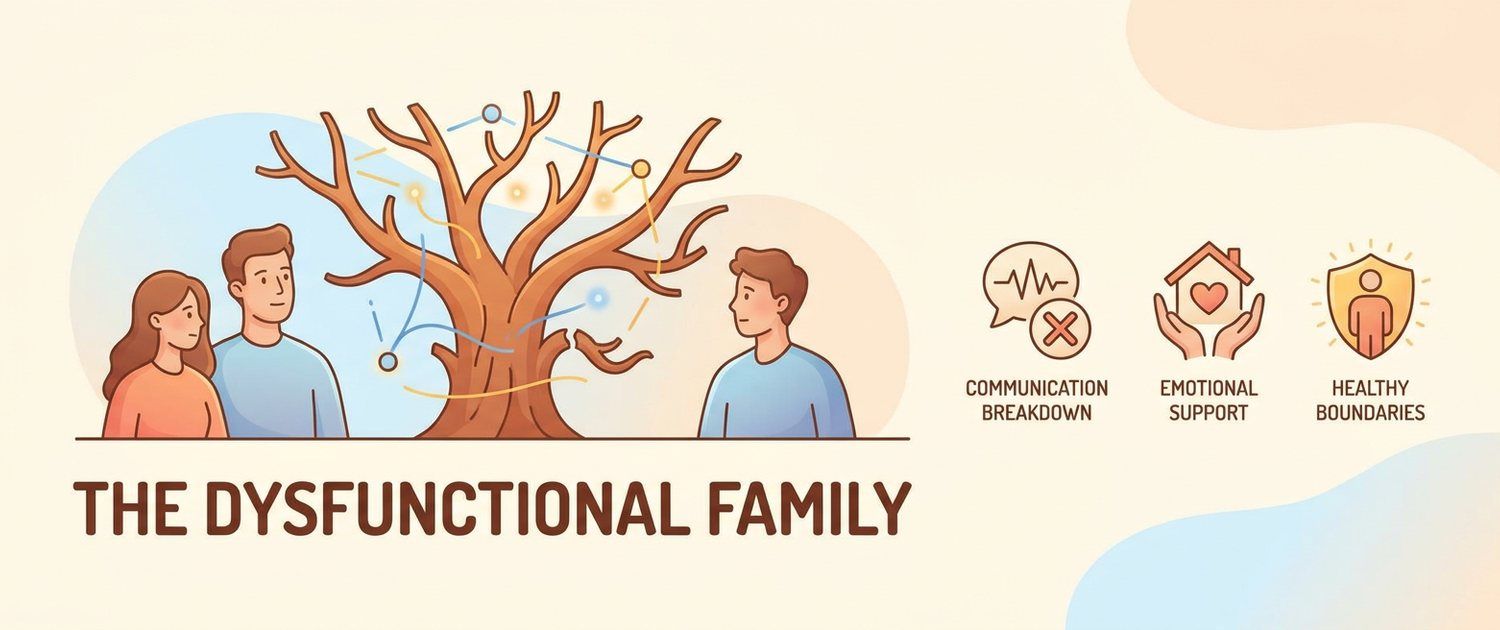
"Dysfunctional family" is not a diagnosis or a legal term but a working description. It is not about the number of rows or the household income: a heavy-drinking family and an outwardly immaculate one can be built the same way. What makes a system dysfunctional is how reality is handled inside it — what may be said aloud, whose feelings are treated as existing, and who is answerable for the adults' state.
Signs of a dysfunctional family
No single item settles anything. What is worth looking at is how settled the pattern is and how many items run at once.
- The main thing goes unnamed. Everyone knows what is happening, but nobody discusses it — not among themselves, and certainly not outside.
- The child's feelings are not granted the status of fact. "You are not cold", "you are not upset", "there is nothing to be sad about". The dispute is not about behaviour but about whether the experience exists at all.
- An adult's mood is the weather in the house. The day is planned around what state one of the grown-ups will come home in.
- Responsibility is displaced. The child is answerable for the mood, the calm, and sometimes the safety of the adults.
- Unpredictable rules. The same act can bring praise or punishment depending on the day.
- Boundaries are either absent or impermeable. Either there is no personal space at all, or there is no contact between people.
- Conditional worth. Warmth is issued for results: grades, obedience, convenience.
- Isolation. Nothing may be carried outside: "this is family business".
Neglect deserves a separate note. It is harder to recognise because memory holds no events — it holds an absence. The child was not hit or insulted; there was simply nobody there when it was needed. The meta-analysis by Xiao and colleagues (Trauma, Violence & Abuse, 2023) on childhood psychological maltreatment — emotional abuse and emotional neglect — found robust associations with adult difficulties: depression, anxiety, substance misuse, suicidal ideation and other problems. Absence leaves a trace no lighter than presence.
The roles that distribute themselves
Roles here are not a metaphor or a personality typology; they are positions children take so that the system stays in balance. One person can hold several, or move between them over time.
- The hero. Top of the class, responsible, "our pride". Their achievements are needed by the family as proof that everything is fine. The adult cost is an inability to stop and a sense of being valued only for output.
- The scapegoat. The one the whole system's tension is written off against. Often the most sensitive and the most honest: they say aloud what is being kept quiet, and pay for it.
- The invisible child. The child who solves the problem by not creating any. They are barely remembered in family photographs. The adult cost is difficulty taking up space and asking for things.
- The mascot. Defuses tension with a joke at any moment. The adult cost is losing access to their own seriousness.
- Parent to the parent (parentification). The child comforts, breaks up fights, makes decisions, listens to adult secrets. This is the least visible role: from outside it looks like a very grown-up child.
A role is not a character. It formed as an adaptation to particular circumstances and made sense there. The problem starts when the circumstances change and the role keeps running: the hero cannot rest, the invisible child cannot ask, the scapegoat expects the accusation before it arrives.
"Don't talk, don't feel, don't trust"
These three unspoken rules were described in the literature on families with addiction, but they occur far more widely.
Don't talk — what is happening is not discussed inside and not carried outside. The child concludes: if it cannot be named, then in some sense it is not there — and if they see it anyway, something must be wrong with them.
Don't feel — part of the emotional range is forbidden. Usually anger and fear; sometimes joy too, when it is out of place. Later a person does not suppress these consciously but stops noticing them: in adulthood it shows up as difficulty answering what you are feeling right now.
Don't trust — if an adult is unpredictable, relying on others is dangerous. Hence the adult over-self-reliance that often reads as strength and from inside feels like an inability to ask.
The rules are never spoken; they are absorbed from reactions. That is exactly why they last: they register not as family rules but as the structure of the world.
What stays with the adult
Typical lines people describe years later:
- Scanning other people's moods automatically, ahead of their own wants.
- Shame as a background rather than a response to an act — covered separately in the article on toxic shame.
- Difficulty with the simple question "what do I want".
- Chronic guilt about resting and about saying no.
- Relationships along a familiar template: calm registers as empty.
- A reaction to a raised voice out of proportion to the occasion.
The ACE study (Felitti et al., American Journal of Preventive Medicine, 1998) — the best-known work on this — showed that adverse childhood experience, including abuse and household dysfunction, accumulates: the more categories of such experience, the higher the risk of health and mental health problems in adulthood. One detail matters when reading that figure: it is statistics across groups, not a prediction for an individual. A high count does not mean something will necessarily happen to you, and a zero does not cancel what did happen.
When the circumstances were prolonged and there was no way out, the picture can go beyond an ordinary "hard childhood": lasting changes in emotion regulation, self-perception and relationships are added to intrusions, avoidance and a sense of threat. ICD-11 describes this as complex PTSD; a separate article covers how it looks as childhood trauma in an adult.
About "narcissistic mother" and other labels
"Narcissistic mother" is one of the most common searches in this area, and it is easy to see why: a label explains everything at once and ends years of uncertainty. But diagnosing a parent at a distance is not assessment. A personality disorder is determined in person by a trained specialist, and by internet descriptions almost anyone in a bad period meets the criteria.
Practically, the label also gets in the way. It merges very different things — an exhausted parent, a person with an addiction, a person carrying their own unprocessed history, and a person who genuinely and systematically caused harm — and offers the same conclusion for all of them.
Something else works: describing the specific behaviour and its consequences. Not "she is a narcissist" but "when I talk about my life, the conversation returns to her wellbeing within a minute, and after such calls I cannot work for half a day". Nothing follows from the first formulation except a diagnosis you cannot make. From the second, decisions follow: how long the call lasts, when it happens, what is discussed and what is not.
The same applies to another common construction — declaring a child's feelings "manipulation". We do not use it either: gaslighting in its family version is built exactly like that.
What adults actually do about it
None of these points requires either cutting the family off or making peace with it. The decision about contact is yours, and it does not have to be final.
- Name it out loud. The first thing that has an effect is to stop calling what happened "an ordinary childhood". Not in order to accuse, but so the facts stop being invisible.
- Separate the role from yourself. A useful question: which of my "character traits" was actually a job I performed in the family?
- Dose the contact rather than deciding its fate. Duration, place, subjects, frequency are adjustable parameters. A full break is an option, but not the only one and not compulsory.
- Do not wait for an admission. Waiting for "sorry, we were wrong" keeps people in place for years. Recovery does not require anyone else's agreement.
- A specialist. This subject takes time and is rarely resolved in a few sessions. At the first meeting it is fair to ask whether they work with the aftermath of prolonged family circumstances.
- Stability before processing. Sleep, regular meals, movement and a predictable routine are not filler: without them, talking about the past is harder to carry.
Working out what this has turned into
A free step is the PCL-5 scale: 20 questions on DSM-5 PTSD symptoms. It catches the traumatic core well but by design does not measure the other half — self-perception, emotion regulation and the capacity for closeness. After prolonged family circumstances it is usually that half that is loaded, and classic flashbacks may be absent entirely.
If you want to see both axes separately, there is the paid complex PTSD test: the six ICD-11 clusters are worked through one by one, so it is visible what is actually loaded. Neither the screener nor the test makes a diagnosis — a specialist does that in person.
When it is not trauma
Similar adult difficulties arise for other reasons too. What to tell apart:
- Depression. A flat background of heaviness, global guilt and loss of interest — with no tie to reminders and no "before".
- Long-running exhaustion. Irritability, tears, withdrawal; the difference is that it recovers with rest, while the aftermath of circumstances does not.
- An anxiety disorder. Constantly expecting the worst occurs on its own; what is checked is whether it was always there and outside the family context.
- A borderline pattern. A swinging self-image (from "I am wonderful" to "I am a monster"), fear of abandonment, self-harm as regulation. After prolonged circumstances the self-image is usually stably negative; more in complex PTSD or BPD.
- ADHD and autism. Difficulties with communication, plans and details exist from childhood and do not depend on the family; in a dysfunctional family they are additionally punished, which makes them easy to mistake for a trace of the environment.
- Bodily causes. Disturbed thyroid function, low iron and vitamin B12, vitamin D deficiency and chronic sleep loss produce weakness, brain fog and tearfulness; results you already have, the service will help you read.
The boundary is simple: the body explains why living today is hard, but not the rules that taught you not to talk, not to feel and not to trust.
This article is informational and does not diagnose — neither you nor your parents. If things are hard right now, contact a local crisis line: in the US call or text 988, in the UK Samaritans are on 116 123.
For informational purposes only
This article is for informational purposes only and does not constitute medical advice, diagnosis, or treatment. Please consult a healthcare professional for medical guidance.