Pancreatic Panel: What's Included, Normal Levels and Results
Reviewed by the LabReadAI medical team
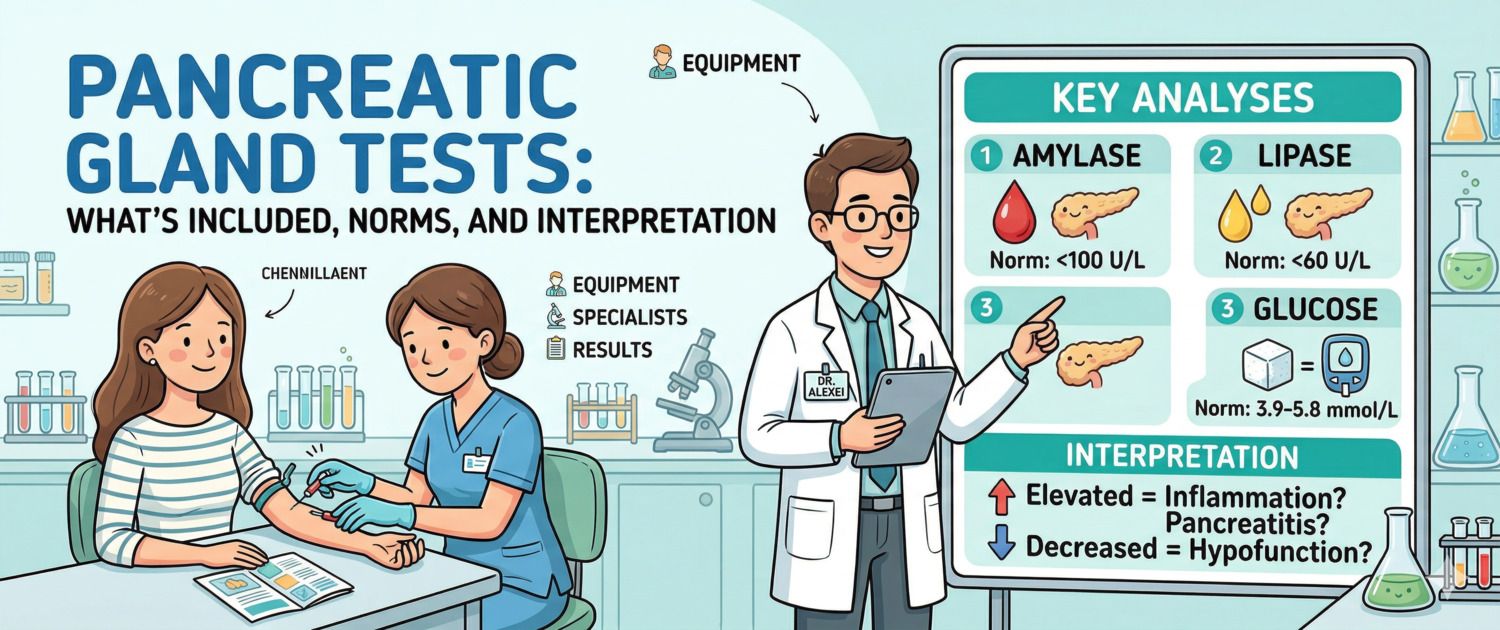
Upper abdominal pain radiating to the back, nausea, and rising blood sugar — symptoms that call for a thorough assessment of the pancreas. Unlike the liver or kidneys, no single universal marker exists for this organ: the pancreas performs two fundamentally different functions, each requiring its own set of tests. Here is what the pancreatic panel includes, what abnormal results mean, and how to prepare correctly for the blood draw.
What the Pancreatic Panel Includes
The pancreas has a dual identity. Its exocrine component — about 95% of the organ's volume — produces digestive enzymes delivered through ducts into the duodenum. Its endocrine component — the islets of Langerhans — secretes hormones directly into the bloodstream: insulin, glucagon, and somatostatin.
This duality determines the structure of the diagnostic panel:
Markers of exocrine function (tissue damage):
Markers of endocrine function (carbohydrate metabolism):
- Fasting glucose
- Insulin and HOMA-IR index
- Glycated haemoglobin HbA1c
The specific combination ordered depends on the clinical question: when acute pancreatitis is suspected, enzyme tests take priority; for diabetes diagnosis, glucose and HbA1c lead the workup. A full panel is most valuable when the clinical picture is unclear.
Pancreatic Enzymes: Amylase and Lipase
Both enzymes are normally present in blood in small amounts. When acinar cells are damaged — by inflammation, necrosis, or ductal obstruction — they pour into the bloodstream.
Amylase breaks down starch. It is produced not only by the pancreas but also by the salivary glands, which means moderate amylase elevation can reflect salivary gland pathology (parotitis, sialolithiasis) rather than a pancreatic problem. The normal range for pancreatic amylase is 13–53 U/L. Amylase rises within 2–6 hours of acute pancreatitis onset and returns to normal within 3–5 days.
Lipase is more specific: it is produced almost exclusively by the pancreas. This makes lipase the preferred marker for acute pancreatitis. Normal range: 13–60 U/L. Lipase rises slightly more slowly than amylase (4–8 hours after onset) but remains elevated for much longer — up to 8–14 days. When patients present late and amylase has already normalised, lipase retains its diagnostic value.
One important rule: the height of enzyme elevation does not correlate with pancreatitis severity. Mild oedematous pancreatitis sometimes produces higher amylase than severe necrotising disease — because in extensive necrosis, fewer enzyme-producing cells remain.
Endocrine Function: Glucose and Insulin
While enzymes reflect exocrine tissue damage, glucose and insulin reveal how well the endocrine islets are functioning.
Fasting glucose is the fundamental carbohydrate metabolism screening test. Normal: 3.9–6.0 mmol/L (WHO criteria). A level of 6.1–6.9 mmol/L indicates impaired fasting glucose — a pre-diabetic state requiring further workup. A level ≥ 7.0 mmol/L on two separate measurements meets the diagnostic threshold for diabetes mellitus.
Fasting insulin is paired with glucose to calculate the HOMA-IR index:
HOMA-IR = (fasting glucose × fasting insulin) / 22.5
A HOMA-IR below 2.7 is considered normal; above 2.7 indicates insulin resistance. This index is particularly valuable in diagnosing metabolic syndrome and early pre-diabetes — when fasting glucose is still normal but the pancreas is already working under excess load.
In chronic pancreatitis with progressive destruction of the islets of Langerhans, a distinctive "pancreatogenic" diabetes can develop — characterised by endocrine insufficiency combined with malabsorption and steatorrhoea.
Glycated Haemoglobin in Pancreatic Assessment
Fasting glucose captures a single moment. Glycated haemoglobin HbA1c reveals the average glucose level over the preceding 2–3 months — the lifespan of a red blood cell, during which glucose binds irreversibly to haemoglobin in proportion to its concentration.
| HbA1c value | Interpretation |
|---|---|
| < 5.7% | Normal |
| 5.7–6.4% | Pre-diabetes |
| ≥ 6.5% | Diabetes mellitus |
| ≥ 7.0% | Suboptimal control in a known diabetic |
HbA1c is independent of food intake, time of day, and acute stress — its key advantage over fasting glucose. It loses reliability in haemolytic anaemias and certain haemoglobinopathies, where fructosamine is used instead.
Normal Reference Ranges for the Pancreatic Panel
| Test | Normal range | Method |
|---|---|---|
| Total amylase | 28–100 U/L | Kinetic |
| Pancreatic amylase | 13–53 U/L | Immunoinhibition |
| Lipase | 13–60 U/L | Turbidimetry |
| Fasting glucose | 3.9–6.0 mmol/L | Hexokinase |
| Fasting insulin | 2.6–24.9 µIU/mL | ELISA |
| HOMA-IR | < 2.7 | Calculated |
| HbA1c | < 5.7% | HPLC |
Reference intervals vary slightly between laboratories — always compare your result against the range printed on your own report.
Interpreting Results: What Each Abnormality Means
High amylase + high lipase — a strong argument for acute or chronic pancreatitis in flare. Ultrasound or CT of the abdomen is ordered to confirm the diagnosis and assess severity. Isolated amylase elevation with normal lipase most often points to a non-pancreatic source.
High glucose with normal enzymes — endocrine dysfunction without acute inflammation. Causes: type 1 or type 2 diabetes, post-meal hyperglycaemia, stress hyperglycaemia. Requires follow-up testing and longitudinal monitoring.
High enzymes + high glucose — possible severe pancreatic inflammation with islet involvement. In acute necrotising pancreatitis, transient hyperglycaemia is a poor prognostic sign.
Elevated HOMA-IR with normal fasting glucose — early insulin resistance. The pancreas is compensating, but at the cost of excess insulin secretion. Lifestyle modification is most effective at this stage.
HbA1c in the pre-diabetes range (5.7–6.4%) — a call to action: dietary changes, physical activity, weight management, and a repeat test in 3–6 months.
How to Prepare for Pancreatic Panel Tests
Preparation significantly affects results — particularly for enzyme tests and glucose.
Fast strictly for 8–12 hours — essential for glucose, insulin, and HbA1c. For enzymes (amylase, lipase), fasting is recommended but not critical: a fatty meal modestly elevates lipase. No alcohol for 24 hours — alcohol directly raises amylase and can mimic pancreatitis. Avoid intense exercise the day before — physical activity affects glucose and insulin levels. Declare all medications: corticosteroids, thiazide diuretics, and oral contraceptives raise glucose; furosemide and azathioprine elevate amylase.
In acute abdominal pain with suspected pancreatitis, tests are drawn immediately without preparation — the clinical situation takes absolute priority.
When to Seek Urgent Medical Attention
Call emergency services or go to the emergency department immediately if: acute girdle-like abdominal pain radiates to the back, especially after a heavy meal or alcohol; nausea and vomiting are persistent and bring no relief; pain worsens alongside fever and chills; glucose is markedly elevated (above 14–15 mmol/L) with thirst, polyuria, and nausea.
A routine gastroenterology or endocrinology referral is warranted when: amylase or lipase is incidentally elevated without pain; HbA1c falls in the pre-diabetes or diabetes range; HOMA-IR exceeds 2.7 with normal fasting glucose.
This article is for informational purposes only. Test interpretation and treatment decisions are the responsibility of a qualified physician.
For informational purposes only
This article is for informational purposes only and does not constitute medical advice, diagnosis, or treatment. Please consult a healthcare professional for medical guidance.