Lipase in Blood: Normal Levels and Causes of Elevation
Reviewed by the LabReadAI medical team
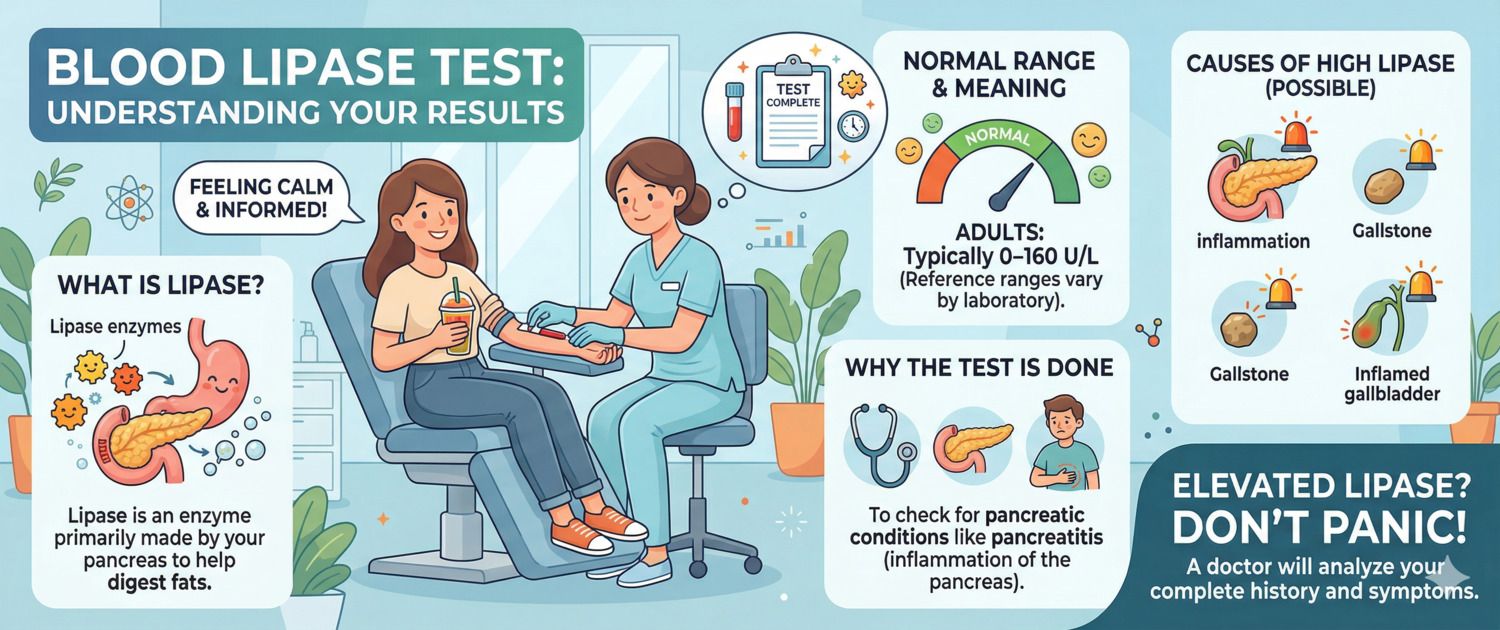
If amylase is the first alarm signal when a patient arrives with abdominal pain, lipase is the primary confirmatory test. Current international guidelines place it first in diagnosing acute pancreatitis: it is more specific, stays elevated longer, and virtually never produces false positives from salivary gland disease. Yet lipase is not a magic number to read in isolation. Here is what it shows, when its elevation genuinely means pancreatitis, and when it does not.
What Is Lipase and Why It Is More Specific Than Amylase
Lipase (pancreatic lipase, triacylglycerol lipase) is an enzyme that cleaves triglycerides into fatty acids and glycerol. It is the key enzyme for fat digestion — without lipase, dietary fats cannot be absorbed in adequate amounts in the small intestine.
Almost all serum lipase originates from the pancreas. Unlike amylase, which is produced in significant quantities by the salivary glands, intestine and several other tissues, lipase is manufactured almost exclusively by pancreatic acinar cells. This is precisely why its specificity for pancreatic pathology is substantially higher — approximately 85–90% versus 60% for amylase.
When the pancreas is inflamed or damaged, acinar cells disintegrate and release their lipase into the bloodstream. This process begins slightly later than for amylase (4–8 hours after attack onset), but the peak is higher and it persists far longer: normalisation occurs over 7–14 days versus 3–5 days for amylase. This is clinically critical: a patient presenting 4–5 days after onset, when amylase has already returned to normal, will still show elevated lipase.
A further advantage of lipase: it does not rise in parotitis or salivary gland disease. Any isolated lipase elevation with normal or mildly raised amylase points almost unambiguously to the pancreas.
Normal Lipase Levels in Blood: Test Results Interpretation
| Group | Normal lipase, U/L |
|---|---|
| Adults 18–60 years | 13–60 |
| Adults over 60 years | 13–70 |
| Children under 1 year | 1–28 |
| Children 1–14 years | 8–48 |
Reference ranges at your specific laboratory may differ. Some laboratories use an upper limit of 55–67 U/L — always use the values on your own lab report.
Several important points:
Diagnostic threshold in pancreatitis. Clinically, a lipase elevation of 3 or more times the upper limit of normal (≥ 180–200 U/L) is the diagnostically significant threshold. This figure — not simply "above normal" — is recommended by most international guidelines as a criterion for acute pancreatitis, in combination with a compatible clinical picture.
Children. Lipase norms are lower in children; the pancreas reaches mature secretory function around age 3–5. In suspected childhood pancreatitis, the diagnostic threshold remains the same 3× ULN.
Renal insufficiency. Lipase is partially excreted by the kidneys; with significant GFR reduction it accumulates in the blood. Elevated lipase in renal insufficiency without pancreatitis symptoms is a well-known but frequently forgotten interpretive pitfall.
How to Prepare for a Lipase Blood Test
Lipase is measured from venous blood, usually as part of a biochemistry panel.
Fasting. Strictly fasting — last meal 8–12 hours before. Fatty food directly stimulates pancreatic secretion and may transiently affect enzyme levels.
Alcohol. Avoid for 48–72 hours — alcohol is a direct trigger of acute pancreatitis. Occasional moderate use in a person without pancreatitis has minimal effect, but regular heavy drinking significantly raises lipase.
Medications. Elevating: morphine and other opioids (Oddi sphincter spasm), cholinergic drugs, thiazide diuretics, cholinesterase inhibitors. Lowering: somatostatin analogues (suppress pancreatic secretion).
Hypertriglyceridaemia. At very high triglyceride levels (> 11–13 mmol/L), lipase measurements can be falsely normal or low due to interference from lipaemic serum with photometric assay methods. This is paradoxical — severe hypertriglyceridaemia is itself the third most common cause of acute pancreatitis.
Emergency testing. For acute abdominal pain with suspected pancreatitis — measure immediately, without waiting for a routine biochemistry run.
Elevated Lipase: Causes and Degrees of Elevation
| Degree of elevation | Fold above ULN | Typical causes |
|---|---|---|
| Mild | 1–3× ULN | Chronic pancreatitis (outside flare), renal insufficiency, opioid use, diabetic ketoacidosis |
| Moderate | 3–5× ULN | Mild acute pancreatitis (diagnostic threshold), peptic ulcer perforation, bowel obstruction, coeliac disease |
| High | 5–10× ULN | Moderate acute pancreatitis, gallstone disease with choledocholithiasis, pancreatic cancer |
| Very high | > 10× ULN | Severe acute pancreatitis, early-phase pancreatic necrosis |
Lipase height does not correlate with pancreatitis severity — this is a critical clinical rule. Severe necrotising pancreatitis can produce both very high and only moderately elevated values, depending on the volume of remaining secretory tissue.
Non-pancreatic causes of elevated lipase:
- Renal insufficiency — impaired clearance; lipase accumulates proportionally to GFR reduction
- Hollow organ perforation — peritoneal contents irritate the pancreas; moderate elevation
- Acute cholecystitis and choledocholithiasis — bile pressure on the ampulla of Vater; frequently raises both enzymes
- Bowel obstruction — intestinal ischaemia and distension trigger enzyme "leak"
- Pancreatic cancer — tumour destroys acinar tissue or obstructs ducts; moderate, occasionally high elevation
- Severe hypertriglyceridaemia — itself causes pancreatitis via fat emboli in pancreatic vessels
- Diabetic ketoacidosis — mechanism not fully established; mild lipase elevation in 15–25% of patients without clinical pancreatitis
- Coeliac disease — intestinal mucosal inflammation with a mild "sympathetic" enzyme rise
The key diagnostic principle: lipase elevation is only a criterion for acute pancreatitis when combined with compatible clinical features (abdominal pain, vomiting). Isolated elevated lipase without symptoms requires a search for alternative causes — primarily renal insufficiency and medications.
Low Lipase: Exocrine Pancreatic Insufficiency and Other Causes
Lipase below the lower limit of normal is less discussed but clinically meaningful.
- Severe chronic pancreatitis with exocrine insufficiency — the main cause. After years of inflammation, acinar tissue is replaced by fibrosis; secretion of all enzymes, including lipase, falls. Clinically this manifests as fat malabsorption: steatorrhoea, weight loss, deficiency of fat-soluble vitamins (A, D, E, K).
- Cystic fibrosis — genetically determined exocrine dysfunction present from birth; exocrine insufficiency develops in most patients.
- Pancreatic resection — post-operative enzyme deficit; lifelong replacement therapy required.
Low lipase in a patient with fatty stools and weight loss is a direct indication for faecal elastase-1 measurement (the most accessible and specific test for exocrine insufficiency) and initiation of pancreatic enzyme replacement therapy.
Lipase and Amylase: When One Is Enough and When Both Are Needed
A practical question: must both enzymes always be measured, or can one suffice?
Lipase alone is sufficient in most clinical scenarios when acute pancreatitis is suspected. This is the recommendation of most gastroenterological societies (ACG, BSG): lipase has higher diagnostic accuracy and does not require "confirmation" by amylase.
Both enzymes are preferable in the following situations:
- Patient presents late (> 3 days from pain onset) — amylase has normalised; the divergence between a normal amylase and still-elevated lipase helps establish a timeline
- Differential diagnosis with salivary gland pathology — isolated amylase elevation with normal lipase unambiguously indicates a salivary source
- Atypical clinical picture — when the diagnosis is unclear and maximum diagnostic information is needed
In comprehensive abdominal biochemistry, both enzymes are assessed alongside liver function tests: gallstone disease and biliary pathology frequently accompany pancreatitis, and simultaneous assessment immediately distinguishes biliary from alcoholic causes. In acute pancreatitis this distinction is fundamental, since it determines management.
The metabolic connection is also direct: in metabolic syndrome with hypertriglyceridaemia, the risk of acute pancreatitis is substantially elevated — and this is the patient group in which lipase is most often discovered incidentally on routine testing.
When to See a Doctor Urgently
- Lipase above 3× ULN with abdominal pain of any intensity — diagnostic criterion for acute pancreatitis; hospitalise without delay, even if pain seems tolerable
- Lipase above 5× ULN without pain — urgent clarification of cause; renal insufficiency, occult pancreatitis or pancreatic cancer
- Rising lipase on serial testing in established chronic pancreatitis — sign of a flare or progression
- High lipase with jaundice — probable choledocholithiasis with obstructive pancreatitis; an acute emergency
- Sudden fall in previously high lipase during worsening pain — possible pancreatic necrosis; deterioration, not improvement
On an elective basis: mild isolated lipase elevation (1–2× ULN) without pain in a patient with chronic renal insufficiency or on opioid therapy is an expected finding. The cause should be clarified, but no emergency measures are required.
This article is for informational purposes only. Interpretation of test results and diagnosis are the responsibility of a qualified physician.
For informational purposes only
This article is for informational purposes only and does not constitute medical advice, diagnosis, or treatment. Please consult a healthcare professional for medical guidance.