Hazel Pollen Allergy: Symptoms, Cross-Reactions and Treatment
Reviewed by the LabReadAI medical team
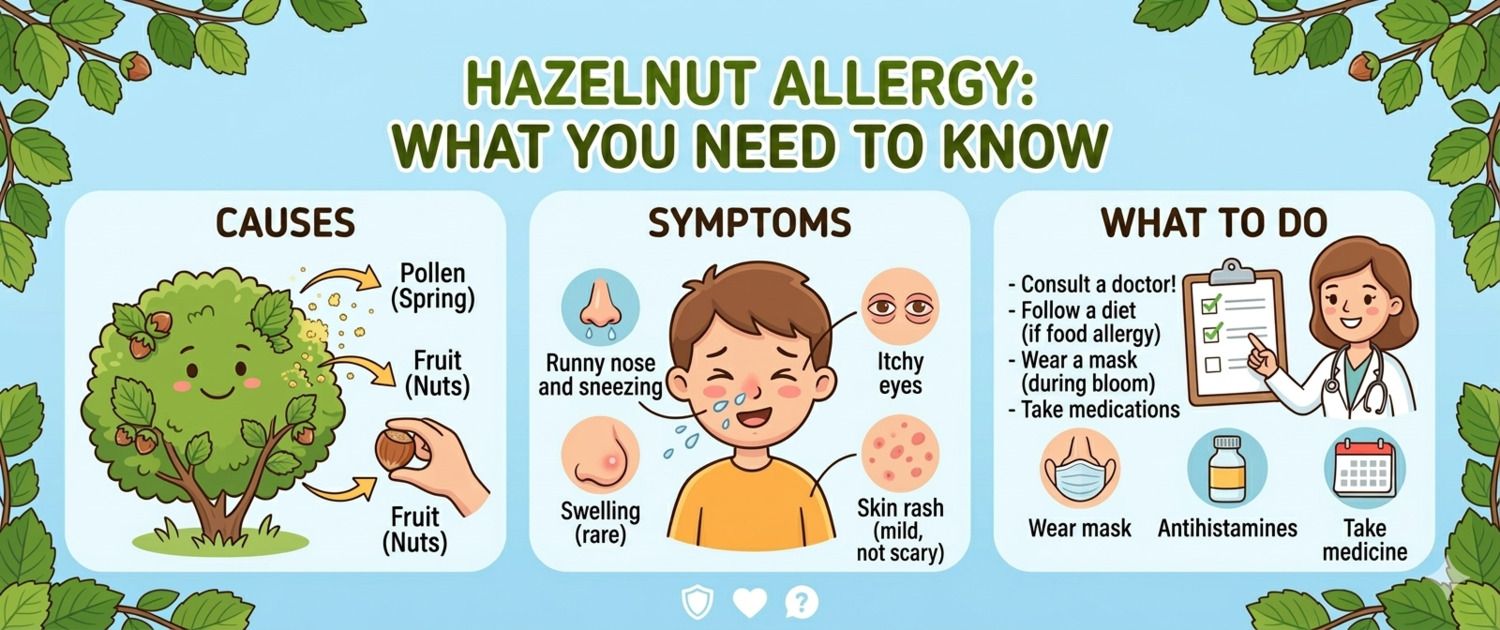
When your nose starts running in February with snow still on the ground — hazel is almost certainly the cause. Common hazel (Corylus avellana) flowers earlier than any other tree in temperate climates — sometimes as early as January in a warm winter. It is the very first "start" of the spring hay fever season, and it is easily mistaken for a cold. Let's look at how hazel connects to birch and alder, why hazelnut reactions come in two fundamentally different types, and how to treat this hay fever effectively.
Why Hazel Causes Allergy: The Birch Cluster Connection
The main hazel allergen is Cor a 1, a PR-10 family protein. It is structurally nearly identical to Bet v 1 of birch and Aln g 1 of alder — not by coincidence: all three trees belong to the birch family (Betulaceae). This is why allergy to hazel, alder, and birch is essentially one allergy to one protein cluster, expressing at different times of year.
A typical pattern: a patient with hazel allergy almost always reacts to alder and birch as well. Sensitisation often begins with hazel — as the first tree encountered by the immune system in spring. The immune system then "recognises" similar proteins in alder and birch and reacts to those too.
The combined "birch cluster season" for such patients runs from January through May: hazel (January–March) → alder (February–April) → birch (April–May).
Hazel Flowering Season
Hazel blooms from late January through March — earlier than any other tree. In southern regions the season can begin in December–January during a mild winter. In central zones, typically mid-February through late March. Duration: 2–4 weeks.
A distinctive feature: hazel often flowers during unstable weather — mild spells alternating with cold snaps. Pollen concentrations spike sharply on warm sunny days and fall when cold returns. Symptoms therefore appear in "waves" depending on the weather.
Hazel pollen is wind-carried for tens of kilometres — reactions are possible in cities where hazel does not grow locally if it is flowering in surrounding woodlands.
Symptoms of Hazel Allergy
Symptoms are typical of hay fever and virtually indistinguishable from alder or birch allergy. In February they are easily confused with a cold — particularly since the cold and flu season coincides.
Allergic rhinitis — abundant watery discharge, paroxysmal sneezing in runs, nasal and soft palate itch, congestion. Symptoms worsen on warm sunny days and ease in cold weather.
Allergic conjunctivitis — redness, itch, tearing, light sensitivity, gritty eye sensation.
Bronchospasm — in patients with asthma or a predisposition to it.
General symptoms — fatigue, headache, sleep disruption.
How to distinguish from a cold: allergy causes no fever, discharge is clear and watery, symptoms worsen outdoors in warm weather and disappear indoors, and they return every year at the same time.
Cross-Reactivity: Two Different Hazelnut Reaction Scenarios
This is the most important and least widely known aspect of hazel allergy. Hazelnut reactions involve two fundamentally different mechanisms — and they require very different clinical approaches.
Scenario 1: Pollen cross-reaction via Cor a 1 (oral allergy syndrome)
Cor a 1 is a pollen allergen, but it is also present in the flesh of raw hazelnuts. The immune system sensitised to Cor a 1 from pollen reacts to the same protein in the nut.
Reaction: oral allergy syndrome — itch and tingling in the lips, tongue, and throat within minutes of eating raw hazelnuts. Typically mild and brief.
Key feature: Cor a 1 is heat-labile — it is destroyed by heating. So roasted hazelnuts, hazelnut paste, and baked goods containing hazelnut do not trigger a reaction in these patients. If there is a reaction to raw hazelnuts but not roasted — this is Cor a 1, a pollen cross-reaction, clinically mild.
Scenario 2: True nut allergy via Cor a 9 and Cor a 14 (systemic reactions)
Cor a 9 (11S globulin) and Cor a 14 (2S albumin) are storage proteins of the nut itself — unrelated to pollen. They are heat-stable and are not destroyed by cooking.
Reaction: can be systemic — urticaria, angioedema, bronchospasm, anaphylaxis. Occurs with any form of hazelnut — raw, roasted, or in confectionery.
Key feature: this type of allergy is unrelated to hay fever and requires strict hazelnut avoidance and an adrenaline auto-injector.
| Allergen | Reaction type | Roasted hazelnut | Risk level |
|---|---|---|---|
| Cor a 1 (pollen) | Oral allergy syndrome | No reaction | Mild, safe |
| Cor a 9 / Cor a 14 (nut) | Systemic, anaphylaxis | Reaction present | Serious — EpiPen needed |
This is why molecular diagnostics are critically important in hazelnut allergy — they distinguish these two scenarios and determine clinical management.
Other Cross-Reactive Foods
Via Cor a 1, all foods in the birch cluster cross-react: apples, pears, peaches, cherries, carrots, celery, soy (Gly m 4). The full list mirrors birch allergy — the mechanism is identical.
Diagnosing Hazel Allergy
Skin prick tests with hazel pollen extract — the diagnostic standard. Performed outside the season, at least 2 weeks after stopping antihistamines. Suspected hazelnut food allergy requires separate testing with nut extract.
Specific IgE blood test for Cor a 1 — done any time of year. For suspected true hazelnut allergy — additionally Cor a 9 and Cor a 14.
Molecular diagnostics — critically important specifically in hazel allergy to distinguish Cor a 1 (mild pollen cross-reaction) from Cor a 9/Cor a 14 (serious true nut allergy). This result changes clinical management entirely.
Complete blood count — elevated eosinophils during the flowering season indirectly confirm allergic inflammation.
Treatment of Hazel Allergy
Reducing Pollen Exposure
- During flowering (February–March) avoid walks in woodland and parks on warm sunny days
- Monitor temperature forecasts — pollen concentrations peak on warming days
- Keep windows closed on warm days; use a HEPA air purifier
- After outings: shower, nasal rinse, change clothes
- Wear wraparound sunglasses
Medication
The approach mirrors alder and birch allergy management:
Second-generation antihistamines (cetirizine, fexofenadine, bilastine) — start 1–2 weeks before expected bloom; take daily throughout the season.
Intranasal corticosteroids (mometasone, fluticasone) — most effective for rhinitis; start 2 weeks before the season.
Eye drops (azelastine, olopatadine) — for significant conjunctivitis.
AIT for Hazel Allergy
AIT specifically for hazel is used but is far less common than birch AIT — primarily because Cor a 1 and Bet v 1 are near-identical. Most patients with hazel allergy also react to birch, and birch AIT often reduces hazel-season symptoms through cross-reactive immunological tolerance.
AIT is started during remission — in autumn or winter, 3–4 months before the expected bloom. The allergist determines which allergen or combination to use based on the patient's sensitisation profile.
When to Seek Urgent Medical Attention
Immediately if: breathing difficulty or wheezing; swelling of lips, tongue, or throat; sudden drop in blood pressure, loss of consciousness — signs of anaphylaxis.
Especially urgent: any reaction to roasted hazelnuts or hazelnut in baked goods — this is Cor a 9/Cor a 14, systemic allergy requiring an adrenaline auto-injector prescription.
Routine allergist visit: symptoms recur every winter-spring; hazelnut reactions; you want to start AIT.
Summary
Hazel allergy is the opening page of the spring hay fever diary. Cor a 1 links it with alder and birch into a single cluster. The most important thing to understand about hazelnuts: an oral reaction to raw nuts via Cor a 1 is mild and safe; a reaction to roasted nuts via Cor a 9/14 is systemic and requires serious attention. Molecular diagnostics separates these two scenarios — and that changes everything about clinical management. For more on allergy mechanisms, see the complete allergy guide.
This article is for informational purposes only. Interpretation of test results and treatment decisions are the responsibility of a physician.
For informational purposes only
This article is for informational purposes only and does not constitute medical advice, diagnosis, or treatment. Please consult a healthcare professional for medical guidance.